Urban Form: Young Saint John and the Lamb
Urban Silhouette Research: The Vessel as Structural Proposition
I. Geometric Integrity and the Architecture of Restraint
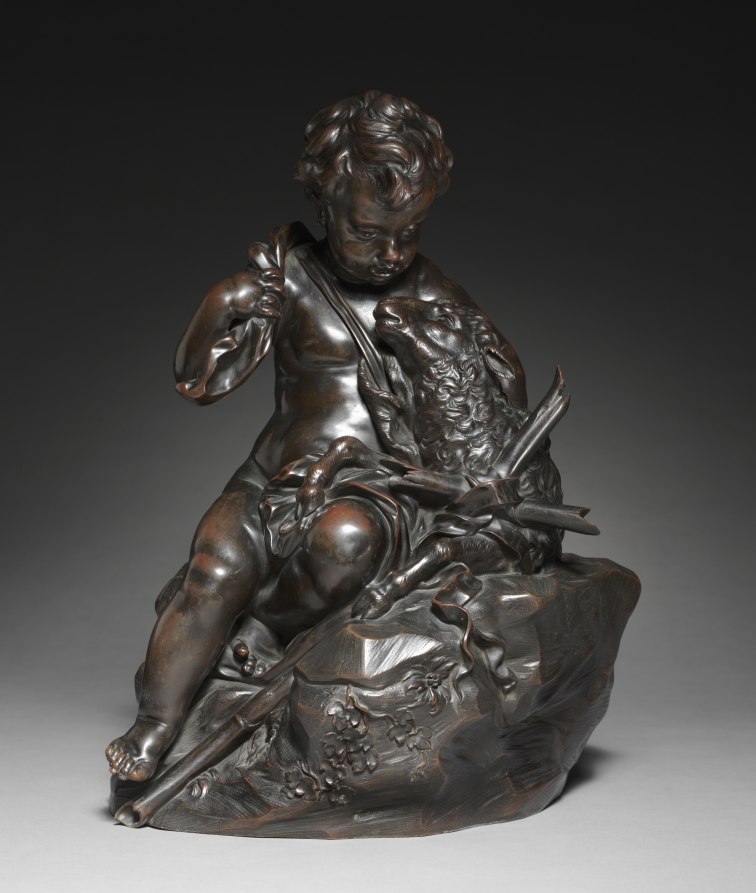
The compositional armature of Young Saint John and the Lamb operates through a deliberate economy of mass and void. The subject’s contrapposto is not merely a classical gesture but a load-bearing axis: the torso rotates along a vertical spine that anchors the figure within a triangular envelope, while the lamb introduces a secondary, lower center of gravity. This dual-mass structure—upright column and grounded counterweight—constitutes the foundational geometry for the 2026 executive silhouette. The shoulder line descends with calculated asymmetry; the drapery falls in unbroken verticals that refuse ornament. What emerges is a sculptural column interrupted only by the diagonal of the arm, a line that functions as a structural brace rather than a decorative flourish.
The geometric integrity here is not static. The figure’s weight shift generates a subtle torque, a rotational tension that prevents the silhouette from collapsing into inert symmetry. For Addison Fashion, this translates into tailoring that respects the body’s verticality while introducing a controlled diagonal—a lapel angle, a seam displacement—that activates the form without disrupting its severity. The lamb, positioned low and forward, establishes a secondary horizon, a grounding plane that mirrors the urban necessity for balance between aspiration and foundation.
II. Structural Poetics: The Vessel and the Void
The internal DNA of this research draws its tension from two opposing treatments of the vessel. In David’s Death of Socrates, the hemlock cup is a charged object—a vessel saturated with narrative, its geometry sharpened by dramatic chiaroscuro into an instrument of philosophical martyrdom. In Morandi’s Jars, the vessel is evacuated of narrative; its geometry is reduced to proportion, its surface to a whisper of grey. The 2026 silhouette must inhabit the space between these poles: structured enough to carry meaning, silent enough to resist it.
Applied to the artwork at hand, the lamb functions as the Morandi vessel—a quiet, rounded mass that absorbs light and refuses dramatic emphasis—while the figure’s extended arm echoes the Socratic gesture, a line that points beyond the self. The resulting silhouette is neither purely narrative nor purely phenomenological. It is a tailored vessel: a garment whose internal architecture (shoulder structure, waist suppression, hem line) provides the rigor of David, while its surface treatment (matte wool, undyed finish, absence of hardware) maintains the restraint of Morandi. The executive silhouette for 2026 is thus defined by this double operation—structural conviction without rhetorical excess.
III. Urban Materiality: Surface as Philosophical Position
The materiality implied by the artwork is one of compressed softness. The flesh is rendered with a smoothness that suggests density without hardness; the drapery falls with the weight of a fabric that has been chosen for its ability to hold a line without stiffness. In urban terms, this points toward fabrics that behave like architecture: high-twist wool crepe, bonded jersey, double-faced cashmere with a matte hand. These are materials that do not shine; they absorb the city’s light and return it as shadow. The palette is necessarily restrained—slate, onyx, ivory—not as a concession to minimalism but as a structural decision. Color here is not decoration; it is the visible edge of a form.
The lamb’s fleece introduces a textural counterpoint: a soft, broken surface that resists the smoothness of the figure’s skin. This duality—polished structure and raw texture—is essential to the urban silhouette. The 2026 executive wardrobe must negotiate between the boardroom’s demand for finish and the street’s demand for authenticity. A felted wool overcoat over a crisp poplin shirt; a bonded leather panel against a raw-edged seam. The materiality is not eclectic but deliberately stratified, each surface chosen for its structural role.
IV. The 2026 Executive Silhouette: A Provisional Conclusion
The silhouette that emerges from this analysis is columnar, asymmetric, and materially stratified. It borrows the figure’s vertical authority and the lamb’s grounded humility. It refuses the Socratic cup’s theatrical charge while acknowledging the Morandi jar’s silent proportion. For Addison Fashion, this means tailoring that is architectural in its internal logic and phenomenological in its surface—a garment that holds its shape without announcing its intention. The executive of 2026 does not need to point to the sky; the line of the shoulder already does the work. The vessel is empty, and that is its strength.