Urban Form: The Holy Family with Saint John the Baptist and Saint Margaret
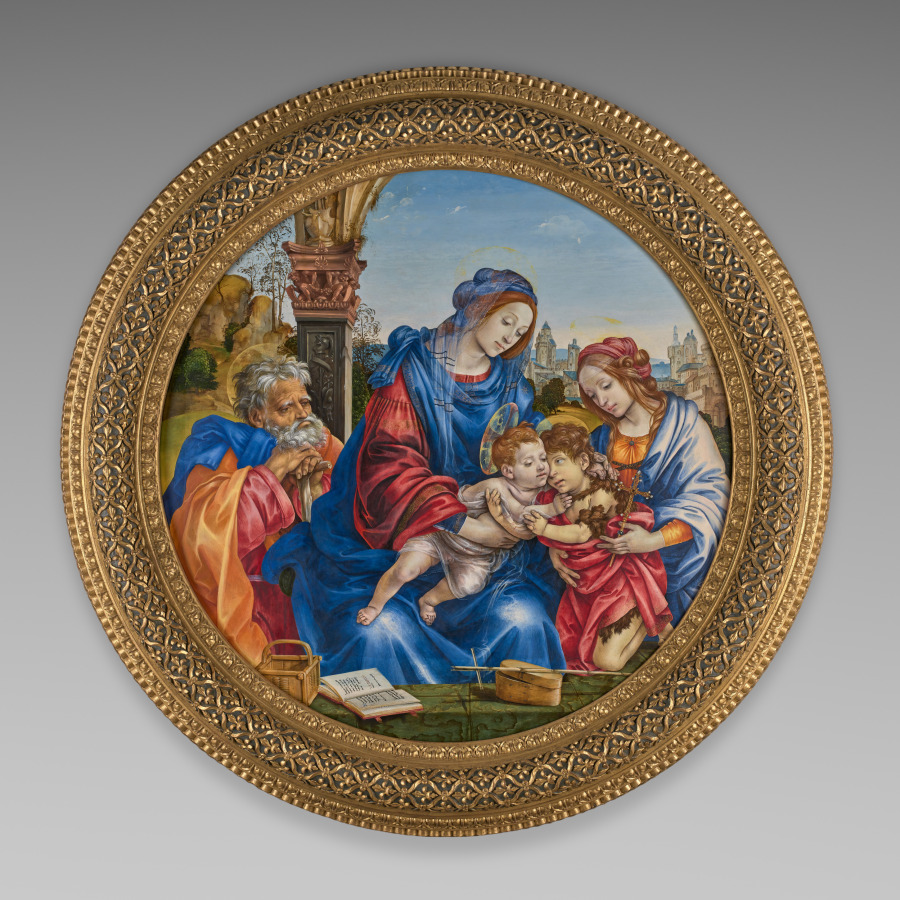
Urban Silhouette Research: The Holy Family with Saint John the Baptist and Saint Margaret — Geometric Integrity and the 2026 Executive Form
Preliminary: The Pictorial Frame as Pattern Block
The subject under examination is a Renaissance devotional composition — the Holy Family with Saint John the Baptist and Saint Margaret — read here not as iconography but as a structural document. The Addison studio treats the canvas as a flat pattern of interlocking planes: a pyramidal mass at center, a countervailing vertical at the right margin, and a low horizontal band of drapery that anchors the whole. This is the raw geometry from which the 2026 executive silhouette is cut. The reading is deliberately cold: we are not interested in the narrative of the saints, but in the load-bearing logic of their arrangement. What holds the composition upright is precisely what will hold a coat upright on a moving body in an urban field.
The Pyramid and the Counter-Weight
The central grouping resolves into a triangle whose apex is the head of the Virgin and whose base is the pooled fabric at the lower edge. This is a closed, self-supporting form — the classical pyramid, the most stable of all planar figures. In tailoring terms it translates to a shoulder line that is broad and level, a waist that narrows without cinching, and a hem that releases into controlled volume. The 2026 executive jacket will not chase the waist; it will construct a pyramid over the torso, letting the shoulder carry the authority and the hem carry the air.
Against this pyramid, the figure of Saint Margaret at the right introduces a vertical counter-weight — a slender column that interrupts the triangle's symmetry and prevents it from becoming inert. This is the structural principle of the asymmetric seam: a single uninterrupted line, placed off-center, that gives the garment its tension. In the Addison atelier this becomes a princess seam displaced two centimeters from the natural axis, or a placket that runs not down the center but along the sternum's edge. The eye reads the imbalance as intention, not error. That is the difference between a garment and a uniform.
Drapery as Negative Space
The lower third of the composition is given to folded cloth — heavy, faceted, and deliberately unresolved. The folds do not describe the body beneath; they replace it. This is the crucial lesson for urban materiality. The 2026 silhouette will treat fabric not as a skin but as a volume with its own architecture. Wool crepe, bonded double-face, and dense technical gabardine will be cut to hold a fold rather than collapse into it. The hem of a coat will behave like the painted drapery: a sequence of planes, each catching light differently, each a small independent structure.
Note the negative space — the dark intervals between folds, the gaps at the composition's edges. These voids are as engineered as the solids. In the garment, this means deliberate ease: a sleeve set with air around the arm, a back yoke that stands away from the spine. The body is not compressed into the silhouette; the silhouette is built around the body's movement and leaves room for the city to enter.
Palette and Surface: Slate as Structural Neutral
The tonal range of the composition — cool greys, muted flesh, a single warm accent — reads in the Addison system as Slate. Slate is not a color so much as a structural neutral: it absorbs shadow, refuses shine, and holds a seam line without decoration. For 2026, Slate appears in matte wool, brushed twill, and a coated cotton that repels the urban climate without gloss. The single warm accent — the red of a sleeve or a mantle — is translated as a single point of saturation: a lining flash, a stitch, a belt edge. Restraint is the discipline; the accent is the proof of the hand.
Geometric Integrity and the Executive Body
The composition's integrity lies in its closure: every figure is contained within the pyramid, every fold returns to the base line. Nothing escapes the frame. The 2026 executive silhouette inherits this closure but opens it at one seam — the shoulder-to-hem diagonal — to allow motion. The result is a garment that reads as a single geometric proposition from the front and reveals its construction only in movement. This is the Addison position: form first, evidence second. The city will supply the chaos; the silhouette supplies the order.
In sum, the painting offers a pattern block for authority: pyramid, counter-weight, engineered void, and a slate discipline of surface. The 2026 executive form is not a quotation of the Renaissance but a reduction of its geometry to the body's scale — a coat that stands like a painted figure, and moves like a citizen.