Urban Form: Jar with Spiral Designs
Urban Silhouette Research: The Spiral Jar as Structural Artifact
I. Formal Deconstruction: The Spiral as Negative Architecture
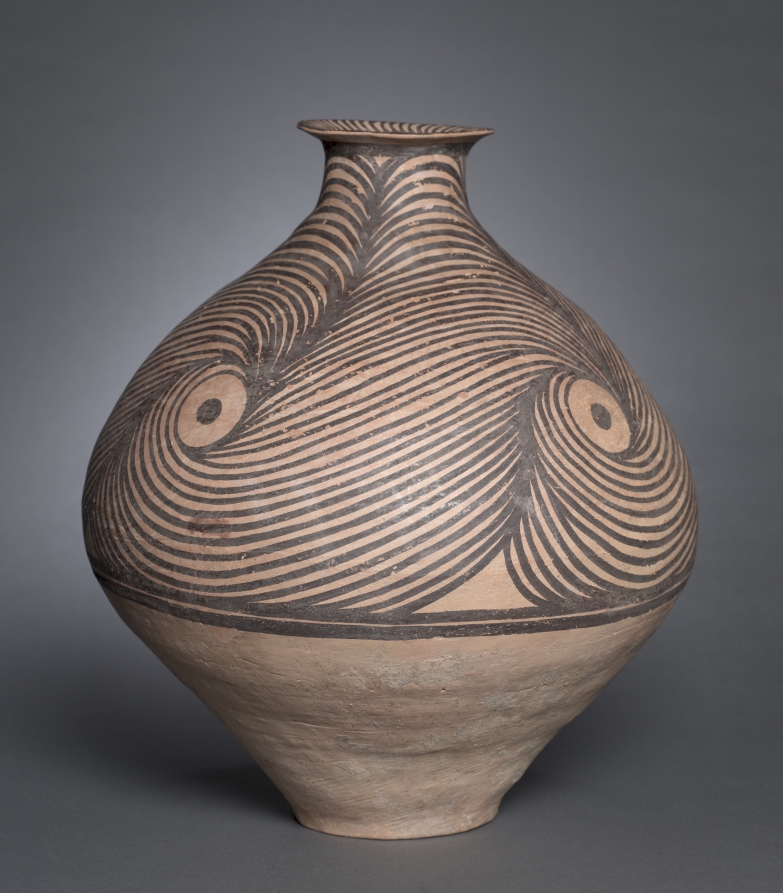
The subject under examination—a jar bearing spiral designs—operates within the same aesthetic economy as the Mold Fragment with Musicians and the Mortuary Figure of the Zodiac Sign: Ox (Taurus). Each object, though separated by function and epoch, resolves a singular design problem: how to compress a temporal event into a permanent material envelope. The spiral jar is the most abstract of the three, and for that reason the most instructive for our purposes. Where the mold fragment captures the negative space of an absent musician and the zodiac ox embodies the compressed mass of celestial order, the spiral jar translates both principles into pure geometry. The spiral is not ornament; it is a structural record of rotation—the potter's wheel, the passage of the hand, the accumulation of clay coils. It is motion arrested at the moment of firing.
Formally, the jar presents a continuous convex volume interrupted only by the incised spiral band. The silhouette is unbroken—no shoulder break, no neck articulation, no applied handle. This is a monolithic contour, and its minimalism is not a lack of information but a deliberate suppression of it. The spiral itself functions as a low-relief datum line, a single continuous gesture that reads differently under raking light versus diffuse light. In daylight, the spiral is a graphic mark; in shadow, it becomes a topographic ridge. This dual reading—flat sign versus dimensional structure—is precisely the tension we will exploit in the 2026 executive wardrobe.
II. Color Logic: Slate as the Fired Surface
The color designation for this research is Slate, and the choice is not arbitrary. Slate occupies the precise chromatic register of reduced, fired clay—the gray-blue of a reduction atmosphere, the cool neutral of a surface that has passed through heat and emerged without gloss. It is the color of the mold fragment's interior, of the unglazed burial figure, of the spiral jar's matte body. Slate is the chromatic equivalent of silence: it absorbs light rather than reflecting it, and in doing so it prioritizes form over surface. For the executive wardrobe, Slate functions as a structural neutral—a ground against which a single gesture (a seam, a fold, a spiral) can register with maximum clarity and minimum decoration.
Critically, Slate resists the seasonal logic of fashion color. It does not announce itself. It does not date. It is the color of permanence through understatement, and it aligns with the Addison Fashion NYC thesis that the modern executive silhouette should be legible at ten paces and rewarding at one. The spiral jar does not shout; it rewards sustained attention. So too should the garment.
III. The Spiral Principle in Tailored Form
Translating the spiral jar into a wearable silhouette requires a disciplined abstraction. The jar's continuous convex volume maps onto a single-piece torso construction—a coat or tunic cut without a waist seam, where the spiral is expressed not as surface print but as directional seam architecture. A spiral seam, in tailoring terms, is a continuous curved panel line that begins at the shoulder, wraps the torso, and resolves at the hem. This is technically demanding: it requires princess-seam engineering combined with a bias-cut panel to maintain drape without distortion. The result is a garment that reads as a monolithic silhouette from the front and reveals its structural logic only in motion.
The jar's negative space—the absent handle, the unarticulated neck—informs a suppression of hardware. No visible buttons, no exposed zippers, no applied pockets. Closure is concealed; access is internal. This is the minimalist executive discipline: the garment performs its function without announcing its mechanism. The spiral jar does not display its making; it displays its result. The 2026 wardrobe should do the same.
IV. Material and the Fired Surface
The jar's surface is matte, slightly irregular, and non-reflective—the signature of unglazed fired clay. In textile terms, this translates to dense wool crepe, dry-hand flannel, or a bonded double-face with a low-luster finish. Gloss is prohibited; sheen is suspect. The fabric must absorb light and hold a crease, because the spiral seam depends on crisp edge definition to read as a structural line rather than a soft fold. A double-face wool in Slate, bonded to a micro-twill backing, provides the necessary dimensional stability for curved panel construction while maintaining the matte, fired-surface quality that the jar demands.
V. Conclusion: The Artifact as Wardrobe Logic
The spiral jar is not a decorative reference. It is a design protocol: continuous volume, single-gesture surface articulation, suppressed hardware, matte chromatic neutrality. These four principles, derived from the object's formal DNA and cross-referenced against the mold fragment's negative-space logic and the zodiac ox's compressed mass, constitute a coherent minimalist thesis for the 2026 executive wardrobe. The Addison Fashion NYC client does not require ornament. She requires structure that reads as restraint—a silhouette that holds its form under pressure, a surface that rewards proximity, and a color that refuses to expire. The spiral jar, fired and silent, offers precisely that.