Urban Form: Saint Peter of Alcántara
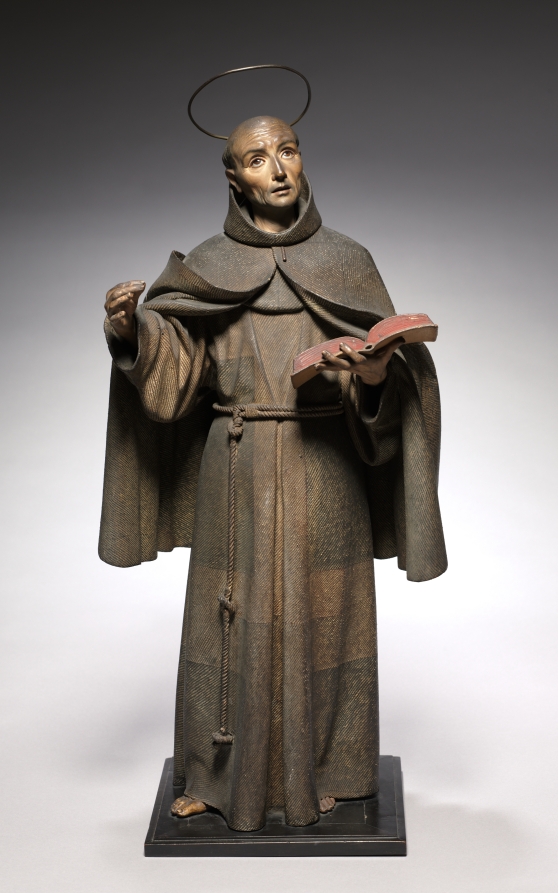
Urban Silhouette Research: The Alcántara Protocol
I. Preliminary Structural Reading
The subject designated Saint Peter of Alcántara presents a devotional corpus whose internal logic operates at the intersection of carved permanence and ceramic void. For the Addison Fashion atelier, this is not a liturgical inquiry but a study in negative-space engineering. The two artifacts—the Udumbara Flowers plaque and the Cup and Stand—constitute a paired grammar of restraint. Our task is to extract from this pairing a wearable architecture for the 2026 executive wardrobe.
The plaque’s surface is a controlled turbulence: wood grain manipulated into floral vortices, petal strata cut to sub-millimeter tolerance, lacquer loss recorded as temporal data. The cup is its inverse—an eggshell-thin vessel whose rim contracts like joined palms, whose stand spreads as a lotus platform. One is dense with incision; the other is defined by what it refuses to hold. Together they establish the governing dialectic of the season: the silhouette must be simultaneously inscribed and evacuated.
II. Geometric Integrity: The Suspended Balance
Examine the plaque’s compositional armature. The carved blossoms do not sit upon the plane; they hover within it, their edges dissolving under raking light. This is a geometry of oscillation—form that advances and recedes without resolving into a fixed contour. Translated to tailoring, this demands a shoulder line that is present but not declarative: a suppressed roping, a sleeve head set with deliberate softness so that the seam reads as shadow rather than structure.
The cup contributes the countervailing principle. Its profile is governed by compression at the aperture—the rim narrows, the belly releases, the foot widens. In garment terms, this is the cinched waist over a voluminous hip, or more precisely, the inward-turning collar that frames the neck without gripping it. The 2026 executive jacket must adopt this aperture logic: a neckline that gathers toward the throat, creating a contained opening through which the wearer’s presence—not the garment’s—becomes the visible event.
The critical geometric insight is that neither object asserts a closed boundary. The plaque’s worn edges admit time; the cup’s emptiness admits the sacred. Integrity, here, is porosity managed with precision—not the sealed shell of prior seasons but a calibrated membrane.
III. Materiality: Urban Surfaces and the Discipline of Subtraction
The plaque’s material narrative is one of layered erosion: pigment lifted, timber exposed, the carved flower surviving as a ghost of its original density. This suggests a fabric strategy for the urban environment—surfaces that reveal their construction rather than conceal it. We propose a double-faced wool in ivory whose reverse shows the loom’s tension lines, and a matte silk faille whose sheen is interrupted at irregular intervals, mimicking the plaque’s flaking lacquer under low-angle light.
The cup’s ceramic body offers the opposing material lesson: thinness as authority. Eggshell porcelain achieves presence through the elimination of mass. For the executive silhouette, this translates to unlined construction in the torso—a canvassed but weightless chest piece, the interior structure visible only as a faint ridge along the lapel roll. The garment’s authority derives from what has been removed, not what has been added.
Urban materiality for 2026 must therefore negotiate between the plaque’s archival density and the cup’s engineered vacancy. We specify a palette anchored in ivory—the color of unglazed porcelain and aged timber alike—with slate and onyx reserved for structural punctuation: a collar stand, a cuff facing, the interior of a vent.
IV. The 2026 Executive Silhouette: A Provisional Specification
The resulting garment is a single-breasted coat-jacket of elongated proportion, its shoulder unroped and its waist suppressed by a narrow belt set slightly below the natural line. The collar is a standing band that curves inward at the throat—the cup’s aperture. The front closure is concealed; the only visible seam is a vertical dart that runs from shoulder to hem, its stitching deliberately uneven, recording the hand’s passage like the plaque’s tool marks.
The sleeve is cut with a suspended elbow: a two-piece construction that allows the forearm to hang with the slight forward drift of carved petals. The hem is raw-edged and lightly frayed, admitting time. The lining—where visible—is a matte ivory silk, unprinted, its only ornament the selvedge line left intact.
This is not a garment of display. It is a vessel and an inscription simultaneously—a wearable argument that the executive presence of 2026 is achieved not through accumulation but through the disciplined orchestration of void. The wearer does not fill the silhouette; the silhouette creates the conditions for the wearer’s arrival.
V. Conclusion: The Gift of Clean Perception
The Alcántara pairing teaches that the highest luxury is the object that steps aside. The plaque negates its wood to conjure a flower; the cup negates its function to hold emptiness. Addison Fashion’s 2026 proposal follows this protocol: a minimalist architecture in ivory, porous at its edges, compressed at its aperture, material-honest in its surfaces. The executive silhouette becomes a devotional instrument—not for worship, but for the clear seeing of the urban world. In the space between carved flower and empty cup, we locate the precise coordinates of the coming season’s authority.