Urban Form: Frieze with Dancer and Musicians
Urban Silhouette Research: Frieze with Dancer and Musicians
Preliminary Structural Reading
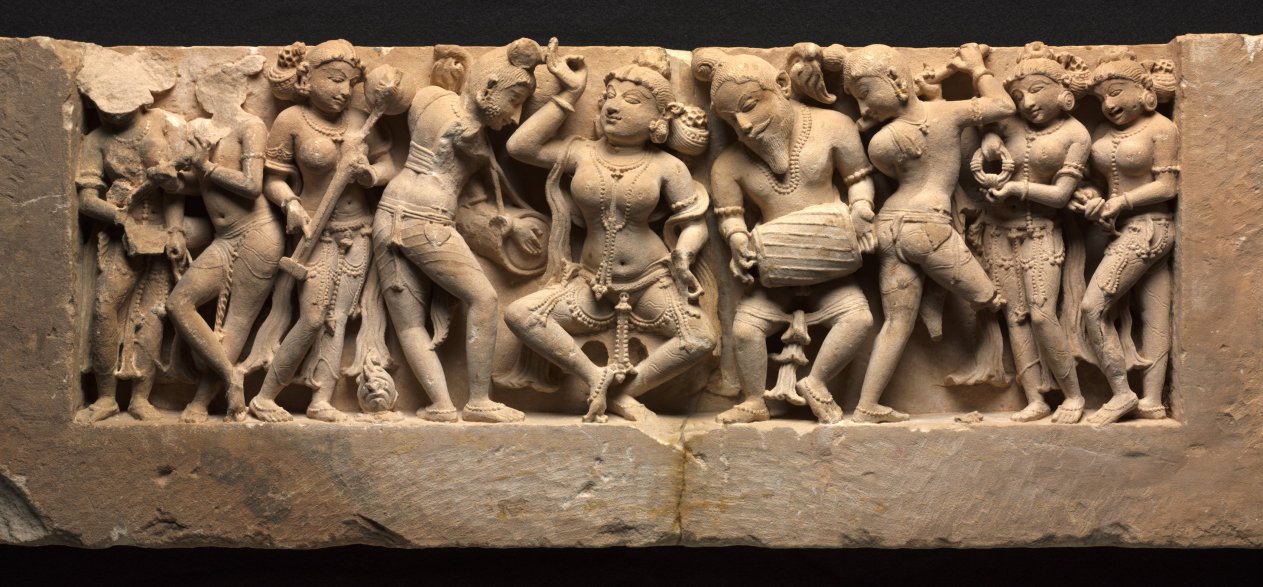
The frieze presents a horizontal register of figures—dancer and musicians—organized within a shallow, continuous band. The composition is governed not by perspectival depth but by planar adjacency: each body occupies a discrete vertical zone, articulated against a neutral ground. The silhouette logic is therefore additive and sequential, a procession of discrete volumes rather than a single unified mass. For Addison Fashion, this register structure is the primary datum: the 2026 executive silhouette must be read as a sequence of calibrated planes, each figure—each garment—a self-contained architectural unit that nonetheless participates in a continuous horizontal rhythm.
Geometric Integrity: The Register as Armature
The frieze’s geometric integrity resides in its orthogonal containment. The upper and lower boundaries are strict horizontals; the figures are compressed between them, their gestures—raised arms, inclined torsos, the dancer’s torque—contained within a shallow depth of field. This is not a failure of spatial ambition but a deliberate compression of volume into contour. The dancer’s body, in particular, is rendered as a series of angular breaks: the lifted knee, the counter-rotated shoulder, the extended forearm. These are not soft curves but faceted transitions, each joint a hinge between planes.
Translated to tailoring, this demands a silhouette that treats the body as a sequence of articulated facets. The 2026 executive jacket must not drape; it must hinge. Shoulder seams are set to create a crisp lateral plane; the waist is suppressed not by darts but by a single angular transition from ribcage to hip. The dancer’s torque becomes a diagonal closure—an asymmetric front panel that resolves the garment’s volume into a single continuous line. The musicians’ static verticality informs the trouser: a columnar leg with a break at the knee that reads as a deliberate geometric event, not a fold.
Structural Poetics: The Tension of Containment
The frieze’s poetics are the poetics of containment under pressure. The dancer’s movement is not free; it is inscribed within the register, its energy bounded by the horizontal frame. This is the central lesson for urban tailoring: movement must be structured, not released. The 2026 silhouette achieves its authority through restrained kinetic potential—garments that appear capable of motion but are held in precise geometric tension.
This manifests in paneled construction: the jacket back is divided into three vertical planes, each with a slight angular offset, creating a surface that reads as compressed movement. The sleeve is set with a forward-pitched armhole, the elbow articulated by a single seam that echoes the dancer’s bent limb. The result is a silhouette that is static in stance but dynamic in structure—a garment that holds its form while implying the next gesture. The frieze’s shallow depth becomes the tailoring’s reduced ease: close to the body, but never tight; structured, but never rigid.
Urban Materiality: Stone, Pigment, and the Executive Surface
The frieze’s materiality—carved stone or painted plaster—is matte, granular, and light-absorptive. There is no sheen, no reflection; the surface is opaque and dense. For Addison Fashion, this translates to a fabric vocabulary of dry-handed wools, compact gabardines, and bonded cottons—materials that hold an edge without gloss. The palette is Slate: a cool, mineral grey that reads as both stone and shadow, a neutral that is not passive but structurally assertive.
The frieze’s surface is also marked by incision—the carved line, the painted contour. This suggests topstitching as structural notation: seams that are visible, deliberate, and geometric. A single needle-line traces the jacket’s angular closure; the trouser’s knee break is reinforced by a double-stitched horizontal. These are not decorative but architectural annotations, the garment’s geometry made legible. The urban environment—concrete, steel, glass—is echoed in these mineral surfaces and precise incisions, a materiality that is cold, durable, and quietly authoritative.
Conclusion: The 2026 Executive Silhouette
The frieze defines the 2026 executive silhouette as a register of contained geometries: a horizontal procession of faceted volumes, each garment a self-sufficient architectural unit held within a strict frame. The silhouette is minimalist in surface, maximalist in structure—a tailoring of hinged planes, compressed movement, and mineral materiality. It is a silhouette that does not drape but constructs; that does not decorate but annotates. In the frieze’s shallow band, Addison Fashion finds the armature for a new urban poetics: the executive body as a sequence of slate-grey facets, moving through the city with the cold, precise authority of carved stone.