Urban Form: Saint Sebastian
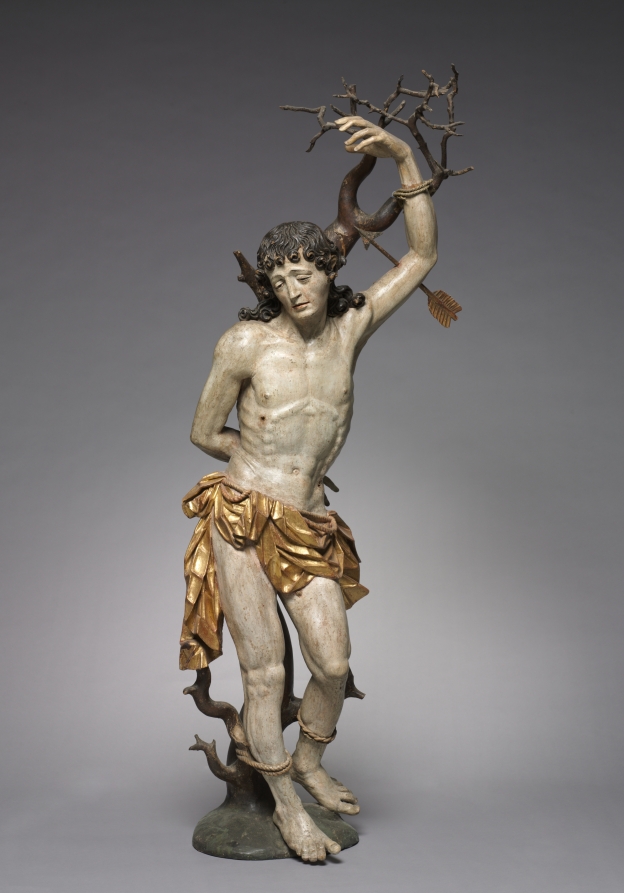
Urban Silhouette Research: Saint Sebastian — Form, Color, and the 2026 Executive Wardrobe
I. The Martyr as Structural Proposition
Saint Sebastian occupies a singular position within the iconographic canon: the body is simultaneously penetrated and preserved, wounded yet erect, exposed yet composed. For the purposes of Addison Fashion's 2026 research cycle, Sebastian is not a devotional subject but a structural hypothesis—a figure whose formal logic interrogates the relationship between aperture, containment, and vertical authority. The arrows function as negative space made violent; the flesh functions as substrate made legible. Our task is to translate this dialectic into garment architecture suitable for the executive woman operating within the compressed geometries of Manhattan's commercial grid.
The DNA sources—the gilt-bound Book of Common Prayer and the Seated Guanyin—supply the chromatic and philosophical grammar. From the Western codex we extract the discipline of the frame: the page as bounded field, the letter as controlled mark, the gold as sanctioned luminosity. From the Guanyin we extract the drape: the cascade of textile as meditative continuum, the absence of shadow as democratic light. Sebastian is the synthesis—the body as both text and statue, inscribed and serene.
II. Form: The Aperture and the Column
The Sebastian silhouette is defined by a vertical spine interrupted by punctures. In tailoring terms, this manifests as a columnar foundation—shoulder-to-hem linearity—disrupted by calculated openings: a slit at the ulnar seam, a keyhole at the sternum, a vent that reveals rather than conceals. The 2026 executive blazer, therefore, abandons the defensive buttoning of the previous decade. It proposes instead a controlled permeability: the garment admits air, admits gaze, admits motion, yet retains its structural integrity through internal corsetry and bonded seams. The arrow, after all, does not destroy the column; it annotates it.
The Guanyin's seated posture informs the lap architecture. Where Western tailoring has historically privileged the standing figure, the 2026 trouser and skirt adopt a seated-first engineering: the waistband rises, the pleat deepens, the knee breaks forward. The executive spends her day in conference—seated, leaning, gesturing across tables. The garment must perform under compression. We achieve this through a double-faced wool in Slate, bonded to a micro-mesh, allowing the fabric to fold without creasing and to recover without memory loss.
III. Color: Slate as Chromatic Asceticism
Slate is the color of petition and restraint. It is neither the black of mourning nor the grey of indecision; it is the hue of stone that has been quarried, dressed, and set into civic architecture. Within the Sebastian iconography, slate corresponds to the cold light of the catacomb—the illumination that reveals without warming. For the executive wardrobe, Slate functions as a chromatic neutralizer: it absorbs the ambient color of the boardroom (the mahogany, the screen-glow, the skin-tone) and returns it as authority. It is the color of the Book of Common Prayer's endpapers—the ground upon which the gilt lettering of one's professional identity is stamped.
We pair Slate with Ivory at the collar and cuff—the Guanyin's porcelain flesh, the prayer book's page. The contrast is not decorative but indexical: it marks the boundary between the armored self and the exposed self, between the public column and the private aperture. A single Silver hardware element—a concealed clasp, a throat-latch—serves as the arrow: the point of metallic interruption that signifies vulnerability as deliberate choice.
IV. The 2026 Executive Wardrobe: Technical Specifications
The resulting capsule comprises three garments. First, the Sebastian Column Coat: a floor-grazing duster in Slate double-faced cashmere, with a single vertical slit at the left scapula, revealing an Ivory silk underlayer. The slit is not a tear but a designed aperture, finished with a hand-rolled edge. Second, the Guanyin Drape Blouse: a bias-cut Ivory silk crepe de chine, with a cowl that falls asymmetrically, its folds calculated to echo the观音's cascading robe. Third, the Prayer Book Trouser: a high-rise, wide-leg wool in Slate, with a pressed crease that runs not to the hem but to the ankle, where it terminates in a Silver-tipped aglet—a full stop in the sentence of the leg.
These garments are not costumes. They are instruments of presence. The executive who wears them does not invoke martyrdom; she invokes composure under penetration—the capacity to be seen, to be struck, and to remain vertical. This is the Addison proposition for 2026: that the urban silhouette, at its most refined, is a theology of the seam—a negotiation between the word and the void, between the gold and the grey, between the arrow and the column.
V. Conclusion: The Cold Light of the Boardroom
Saint Sebastian, read through the twin lenses of the Western codex and the Eastern statue, yields a wardrobe that is ascetic in color, architectural in form, and quietly transgressive in its apertures. The 2026 executive does not require armor; she requires legibility. She requires garments that state their structure and then admit their vulnerability. Slate is her ground, Ivory her margin, Silver her punctuation. The arrows are hers to place.