Urban Form: Text, Folio 46 (verso), from a Kalpa-sutra
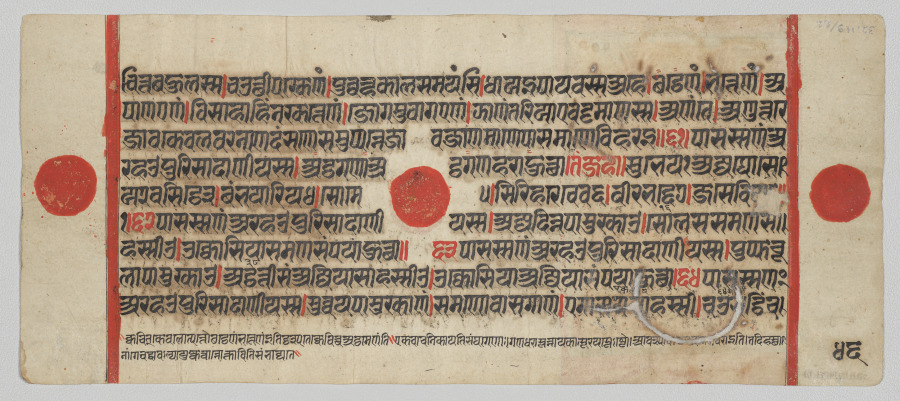
Urban Silhouette Research: Folio 46 (verso), Kalpa-sutra — Structural Poetics of the Devotional Plane
I. Geometric Integrity: The Manuscript as Architectural Artifact
Folio 46 (verso) of the Kalpa-sutra operates not as illustration but as spatial construction. The Jain manuscript page—its text block, its interlinear registers, its marginal framing—constitutes a rectilinear armature of uncommon rigor. The composition is governed by a modular grid: horizontal bands of script compressed into disciplined registers, bounded by vertical rules that function as load-bearing members. This is architecture in two dimensions, a syntax of containment in which every glyph is assigned a cell and every cell obeys the logic of the whole.
The geometric integrity here is not ornamental but structural. The folio's proportions—its near-square field, its calibrated margins, the rhythmic interval between lines—produce a visual stability that reads as permanence. There is no asymmetry of the picturesque; there is instead the cold equilibrium of the plan. For the 2026 executive silhouette, this is the governing principle: the garment as a ruled surface, where seam lines assume the authority of the folio's bounding rules and the body is organized into registers of controlled compression and release.
II. The Register as Silhouette Logic
Observe the folio's vertical hierarchy. Text occupies the field in stacked strata, each line a horizontal datum, each margin a vertical boundary. The eye is conducted through the page in a measured descent—no digression, no aperture, no invitation to wander. This is the opposite of the Song scholar's rock with its porous, meandering invitation; it is closure as compositional ethic. The Kalpa-sutra page does not breathe; it declares.
Transposed to the executive silhouette, this register logic yields a stratified tailoring: shoulder line as upper rule, waist as median datum, hem as terminal boundary. The 2026 Addison executive does not drape; she is composed. Each horizontal transition—yoke, seam, closure—functions as a line of script, deliberate and legible. The silhouette achieves its authority through accumulation of disciplined intervals rather than through volume or gesture. Where the oversized silhouette asserts through mass, this silhouette asserts through measure.
III. Materiality: The Folio's Surface as Urban Textile
The physical substrate of the manuscript—palm-leaf or paper, its pigment mineral and matte, its ink a dense carbon black against a ground of aged ivory—offers a materiality of compressed urbanity. This is not the luxury of sheen; it is the luxury of density. The folio's surface absorbs light rather than reflecting it, producing a chromatic restraint that aligns precisely with the Slate register: cool, mineral, unyielding.
For 2026, this translates into fabric selection governed by matte density: high-twist wool, compact gabardine, bonded crepe—surfaces that hold a crease with the finality of an incised rule. The palette is monochrome and tonal, the color of the folio's ground and ink collapsed into a single disciplined register. Embellishment is refused. The only permissible ornament is the precision of the seam itself, the visible evidence of construction, much as the folio's beauty resides in the exactitude of its ruling rather than in any applied decoration.
IV. Structural Poetics: Containment as Executive Statement
The poetics of this folio are the poetics of containment. The text is held; the margins discipline; the frame encloses. There is no leakage, no excess, no romantic overflow. In an urban context defined by informational saturation and visual noise, the executive silhouette derived from this logic becomes a form of strategic reticence—a garment that communicates through what it refuses to disclose.
The 2026 silhouette therefore adopts the folio's closed geometry: a defined shoulder, a controlled sleeve, a torso articulated by vertical rules rather than shaped by the body's contingency. The wearer is not revealed; she is inscribed within a system. This is minimalism not as absence but as governance—the same governance the Kalpa-sutra page exerts over its sacred text, assigning each element its place and permitting no deviation.
V. Conclusion: The Devotional Plane as Executive Armature
Folio 46 (verso) is a document of regulated space. Its geometric integrity—grid, register, rule—furnishes the 2026 Addison executive silhouette with a grammar of restraint that is at once archaic and urgently contemporary. The urban wardrobe it proposes is not soft, not fluid, not expansive; it is architectural in its discipline and mineral in its materiality. The silhouette becomes a folio: a bounded field in which every line is intentional, every interval measured, and every surface held to the standard of the incised rule. This is the structural poetics of the executive plane—cold, exact, and complete.