Urban Form: Venus with a Burning Urn
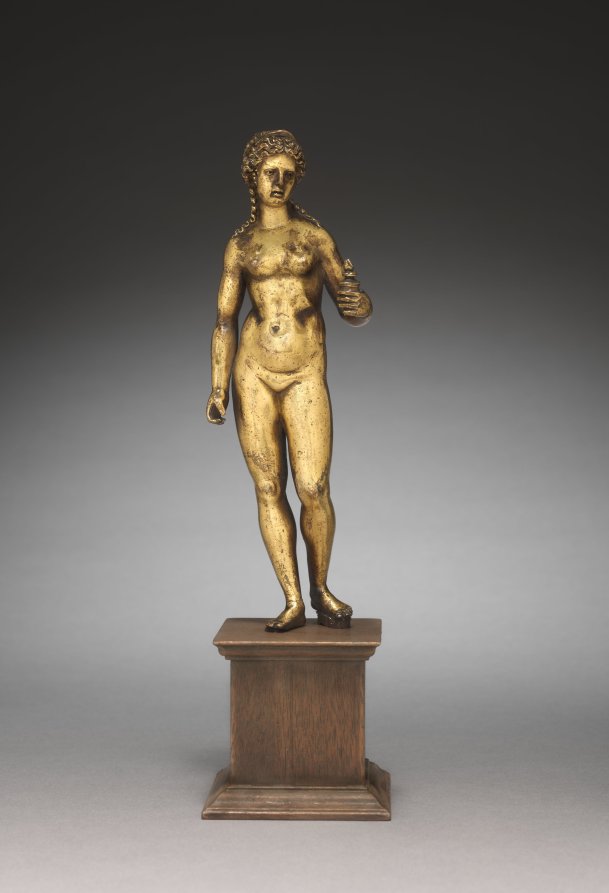
Urban Silhouette Research: Venus with a Burning Urn
Preliminary Note on the DNA Source
The source text stages a comparative reading of two artifacts—a Bodhisattva figure and a Near Eastern or Egyptian amulet in the form of a seated figure with bovine head—and arrives at a thesis of "resonance and subtle divergence." For the purposes of this research, that thesis is treated not as art-historical commentary but as a formal brief. Two distinct strategies for compressing metaphysical force into a finite material body are placed in tension: the idealized anthropomorphic vessel (the Bodhisattva, whose drapery, gesture, and precious alloy encode transcendence through refinement) and the hybrid talismanic object (the bovine-headed amulet, whose power derives from symbolic compression and direct apotropaic function rather than from beauty). The Addison design problem for 2026 is precisely this: how does a garment carry authority without ornament, and how does a silhouette hold latent force without display? The working title, Venus with a Burning Urn, fixes the governing image—a classical vessel-form under internal combustion—and the palette is resolved to Onyx, a near-black that absorbs light rather than reflecting it, suppressing surface incident in favor of edge and mass.
Form I: The Vessel Silhouette and the Logic of Containment
The Bodhisattva's formal achievement is containment: a stable vertical axis, a controlled fall of drapery, and a frontal symmetry that reads as composure under weight. Translated to tailoring, this yields the columnar overcoat and the single-breasted long jacket—garments whose primary design decision is the shoulder-to-hem ratio rather than the surface treatment. In Onyx wool-cashmere with a matte finish, the vessel silhouette eliminates the reflective noise that reads as "product" in midtown light. The shoulder is set clean and slightly extended; the waist is suppressed but not cinched; the hem falls to mid-calf with a controlled break. The result is a closed volume—a form that does not invite touch, does not advertise its fiber content, and does not resolve into a recognizable "look" at conversational distance. This is the executive register: legibility at ten meters, ambiguity at one.
The critical technical constraint is drape memory. A vessel silhouette fails the moment the fabric collapses at the elbow or bags at the seat; the form must hold its own architecture across a twelve-hour day. Specification therefore favors a bonded or lightly fused front panel, a half-canvas construction, and a weighted hem tape that maintains the vertical fall. The garment is engineered, not styled.
Form II: The Talismanic Register and Compressed Symbolism
The bovine-headed amulet operates by a different logic: it is small, dense, and semiotically overdetermined—human posture fused with animal head, ritual function fused with portable object. Its formal lesson for the 2026 wardrobe is compression: authority concentrated into a single, irreducible element rather than distributed across the ensemble. In practice this means the single hard accessory—one sculptural clasp, one architectural belt, one squared shoulder line—carried against an otherwise silent ground. The Onyx palette makes this possible: against near-black, a single silver-toned or brushed-metal element reads as signal, not decoration.
The amulet also instructs on asymmetry as function. Its hybrid form is not balanced; it is operative. Applied to tailoring, this licenses the off-axis closure, the diagonal seam, and the single exposed dart—formal irregularities that read as intention rather than error. The executive wardrobe of 2026 tolerates one such irregularity per look, no more. The discipline is arithmetic: one compressed symbol, one silent field.
Color: Onyx as Structural Neutral
Onyx is selected not for its fashion currency but for its optical behavior. It absorbs incident light, which flattens surface texture and foregrounds edge, seam, and mass—the three variables this research treats as primary. In a city of glass and mixed-spectrum lighting, an Onyx garment maintains a consistent silhouette value from lobby to car to conference room, whereas mid-tone neutrals shift and fragment. The palette also enforces the vessel/talisman dichotomy: the ground recedes, the single metallic or matte-hardware element advances. Contrast is rationed, therefore contrast is meaningful.
Application: The 2026 NYC Executive Wardrobe
The synthesis is a three-piece modular system: (1) the Onyx columnar overcoat as the vessel—closed, weighted, unadorned; (2) the long single-breasted jacket with off-axis closure as the talismanic register—one operative irregularity; (3) the straight-leg trouser with a clean, unbroken fall as the plinth. Accessories are limited to a single architectural element per look. The system is designed for repeat wear without visual fatigue, which is the actual performance metric of executive dress: the garment must survive forty appearances without reading as costume.
The research conclusion is deliberately cold. The Bodhisattva and the amulet are not reconciled; they are sequenced. Containment first, compression second. The 2026 Addison executive does not dress to be seen. She dresses to hold form under internal pressure—the burning urn, sealed and onyx, carrying its fire without visible flame.