Urban Form: Saddled Arabian Horse in Courtyard
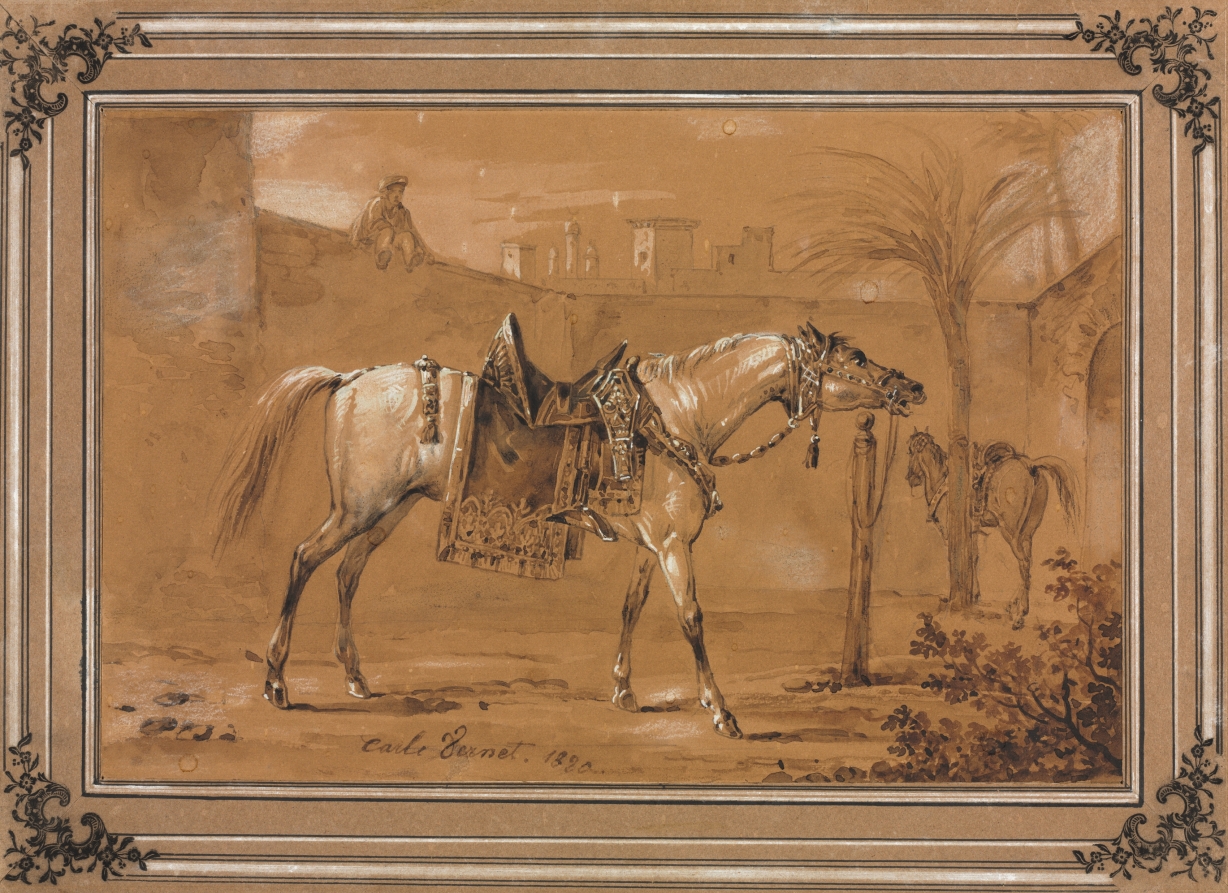
Urban Silhouette Research: The Saddled Arabian Horse in Courtyard — Structural Poetics of the Threshold
I. Preliminary Geometry: The Courtyard as Containment Frame
The courtyard is not a backdrop; it is a spatial armature. Its orthogonal boundaries — wall, ground plane, the implied verticality of the gate — establish a rectilinear cage within which the equine form operates as the sole organic disruption. This is the first principle of the 2026 executive silhouette: containment before release. The horse does not overflow its frame; it negotiates it. The architecture of the garment must perform identically — a disciplined perimeter that renders interior volume legible rather than chaotic. The courtyard's geometry is unforgiving, and the silhouette it hosts must answer with equal rigor.
II. The Equine Axis: Curvature Against the Grid
The Arabian horse introduces a controlled asymmetry into the composition. Its spine describes a shallow S-curve; the neck rises at an angle that refuses both the vertical and the horizontal. This is the anatomical equivalent of a bias-cut seam set against a straight-grain panel — tension without rupture. For the 2026 executive, this translates to tailored pieces that acknowledge the body's curvature without surrendering to it. The shoulder line must remain architectural, but the waist and hip require a calibrated deviation from the central axis. The saddle itself — a foreign object strapped to the organic form — functions as a structural intervention: a rigid element imposed upon soft tissue, much as a defined shoulder or a structured collar imposes form upon the wearer. The saddle is not decoration; it is engineering. The silhouette absorbs it, and in doing so, achieves a hybrid integrity — part anatomy, part apparatus.
III. Materiality: The Silver Mirror and the Stone Sarcophagus
The internal DNA of this research is explicit: silver and gold against cold stone. The mirror's reflective plane and the sarcophagus's matte relief are not opposites but sequential states of the same surface logic. The courtyard in the artwork mediates between them — its stone walls absorb light, its ground plane offers no reflection, and yet the horse's coat carries a sheen that recalls the mirror's polish. For 2026, this demands a dual-material strategy: surfaces that alternate between high-luster and low-absorption. A silver-toned technical fabric — matte in diffuse light, reflective under direct illumination — becomes the operative textile. The gold inlay of the palmette motif is not reproduced literally; it is translated into tonal contrast at the seam line, a hairline of warmth against the cool ground. The stone's weight is evoked through density of weave, not through bulk. The garment must feel quarried, not woven.
IV. The Saddle as Structural Motif: Restraint and Release
The saddle is the most consequential object in the composition. It is the point where utility becomes form. Its geometry — a curved panel with defined edges, strapped and buckled — prefigures the 2026 executive's relationship to functional hardware as aesthetic anchor. The silhouette does not hide its closures; it integrates them as rhythmic interruptions. A belt, a strap, a reinforced panel at the hip: these are not afterthoughts but load-bearing gestures. The saddle also introduces the principle of the removable layer — a garment that can be partially shed without losing its structural logic. The executive wardrobe of 2026 must accommodate transition: the courtyard is both interior and exterior, and the silhouette must perform in both registers without reconfiguration.
V. The Threshold Condition: Between Mirror and Sarcophagus
The artwork's deepest structural lesson is its threshold logic. The horse stands at the boundary between the courtyard's enclosure and the implied openness beyond the gate. It is neither fully contained nor fully free. This is the operative posture of the 2026 executive silhouette: a garment that reads as complete in itself yet suggests an unresolved edge — a vent that does not close, a hem that does not settle, a collar that stands away from the neck by a calculated margin. The mirror's reflective surface and the sarcophagus's narrative relief are both surfaces that conceal depth. The silhouette must do the same: appear planar from a distance, reveal structural complexity upon approach. The gold palmette's infinite symmetry and the stone relief's frozen narrative are two answers to the same problem — how to make a surface carry time. The 2026 silhouette answers with seams that read as inscriptions and closures that function as punctuation. The result is not a garment that describes the body but one that argues with it — and wins, on architectural terms.
VI. Conclusion: The Courtyard Silhouette
The saddled Arabian horse in its courtyard is a study in negotiated containment. The 2026 executive silhouette inherits this negotiation: a minimalist perimeter of silver-toned density, a controlled curvature that respects the grid, and a hardware language that treats restraint as a form of release. The mirror and the sarcophagus are not opposites; they are the two faces of the same surface — one reflecting, one recording. The silhouette must do both. It must reflect the wearer's authority and record the wearer's passage. In the courtyard, between the gate and the wall, the horse stands still. The garment must achieve the same poised stillness — not inert, but loaded. That is the Addison standard for 2026: silver discipline, stone weight, equine curve. The silhouette is the courtyard. The wearer is the horse. The saddle is the seam. Nothing is decorative. Everything is structural.