Urban Form: Italian Sketchbook: Abstract Sketch (page 5)
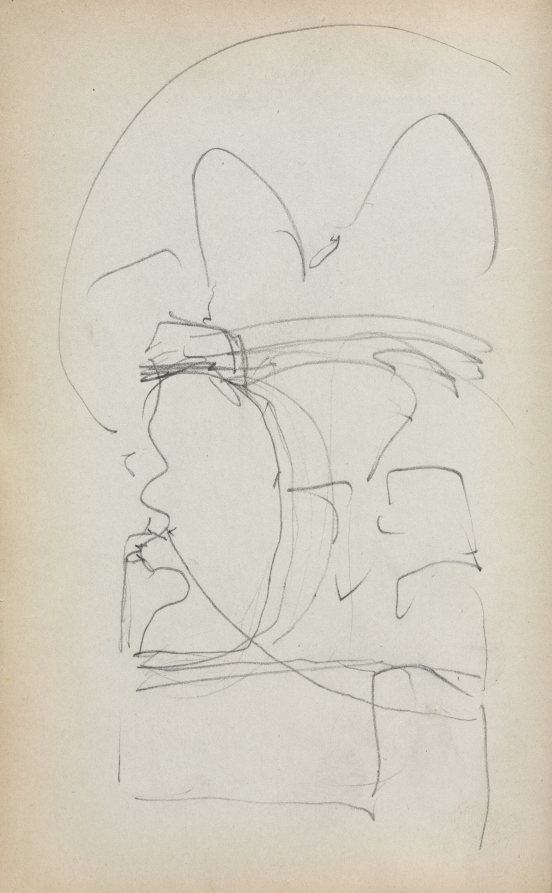
Urban Silhouette Research: Form and Color Deconstruction — Italian Sketchbook, Page 5
I. Preliminary Position: The Sketch as Structural Artifact
Page 5 of the Italian Sketchbook operates as a formal compression device rather than a representational record. The abstract sketch translates two discrete sculptural archetypes—the Bodhisattva and the Amulet in the Form of a Seated Figure with Bovine Head—into a shared morphological grammar. For Addison Fashion NYC, the analytical value resides not in iconography but in mass distribution, contour tension, and the chromatic logic of restraint. The sketch functions as a control specimen: it isolates silhouette from surface, permitting a rigorous reading of how volume behaves under conditions of spiritual and utilitarian pressure. Our objective is a technical deconstruction of form, followed by its translation into the 2026 executive wardrobe.
II. The Bodhisattva Register: Continuous Volume and Suppressed Edge
The Bodhisattva figure establishes a closed, continuous silhouette. Its formal authority derives from an unbroken vertical axis—crown, shoulders, drapery, and lotus base resolving into a single tapered column. The shoulder line is deliberately softened; the descent from clavicle to hem is governed by a controlled convexity that distributes visual weight downward without abrupt interruption. This is a silhouette of containment: no protrusion, no aggressive angle, no competing gesture. The drapery folds function as secondary structure, introducing rhythmic parallel channels that accelerate or decelerate the eye along the vertical axis.
Chromatically, the register reads as low-saturation, high-value neutrality—the tonal territory we designate Slate. The surface is matte, light-absorbing, and devoid of specular interruption. The result is a form that recedes while remaining legible: authority without assertion, presence without noise. For executive application, this register supplies the architectural column—the long coat, the columnar knit dress, the unbroken trouser line—where the body is read as a single, disciplined volume.
III. The Bovine-Headed Amulet Register: Hybrid Mass and Compressed Tension
The amulet presents the inverse problem. Here, two incompatible masses—the bovine head and the seated human torso—are joined without transitional mediation. The silhouette is discontinuous, characterized by a hard horizontal break at the neck and an abrupt shift in density. The head introduces a lateral, horned projection that contradicts the verticality of the seated body; the result is a form under visible structural stress. This is a silhouette of defensive compression: small in scale, dense in mass, designed for proximity and portability rather than contemplation at distance.
The amulet's formal lesson is strategic interruption. Where the Bodhisattva suppresses edge, the amulet weaponizes it. The horn, the ear, the abbreviated limb—each functions as a controlled anomaly that arrests the eye and signals protective function. In chromatic terms, this register corresponds to Onyx: deep, non-negotiable, light-absorbing to the point of optical closure. It is the color of the boundary—the collar, the cuff, the structured shoulder—where the garment asserts a defensive perimeter around the wearer.
IV. The Shared Grammar: A Spectrum, Not a Binary
The critical insight of Page 5 is that these two registers are not opposites but terminal points of a single formal spectrum. Both figures are seated; both employ bilateral symmetry; both compress spiritual function into a bounded sculptural envelope. The difference is one of edge behavior. The Bodhisattva resolves edge into continuity; the amulet converts edge into signal. For Addison Fashion, this yields a dual-register design protocol: a continuous Slate base layer governing the primary silhouette, interrupted by Onyx structural nodes at the perimeter—collar, placket, cuff, hem. The wardrobe becomes a negotiated system between contemplative volume and defensive articulation.
V. Translation to the 2026 Executive Wardrobe
The 2026 executive silhouette, as derived from this sketch, is columnar in primary mass and nodal in secondary structure. The long coat adopts the Bodhisattva's tapered verticality: shoulder softened, waist suppressed, hem extended, executed in a matte Slate wool with sufficient weight to hold the column without rigidity. The drapery rhythm translates into engineered pleating—parallel channels that manage movement and control the eye's descent.
The amulet register supplies the interruption logic. A structured Onyx collar, a compressed cuff, a hard-edged placket: each functions as a protective node, small in area but high in visual density. These are not decorative; they are functional boundaries that define the wearer's spatial perimeter in high-stakes environments. The proportion rule is strict: no more than fifteen percent of total surface area may be allocated to the Onyx register, preserving the primacy of the continuous Slate volume.
Color behavior follows the same discipline. Slate operates as the ground condition—matte, low-contrast, light-absorbing—while Onyx functions as punctuation, deployed only at structural thresholds. The palette is deliberately narrow: a two-value system that eliminates chromatic noise and forces attention onto silhouette and edge. This is the chromatic equivalent of the sketch's own economy—reduction as a strategy of authority.
VI. Conclusion: Form as Doctrinal Position
Page 5 demonstrates that silhouette is an argument. The Bodhisattva argues for continuity, composure, and the suppression of the incidental. The amulet argues for boundary, density, and the strategic deployment of anomaly. The 2026 executive wardrobe requires both arguments simultaneously: the composure to occupy space without assertion, and the boundary discipline to defend it. Addison Fashion's translation is therefore not a quotation of sacred form but a structural appropriation—the conversion of doctrinal mass into wearable architecture, executed in Slate and Onyx, governed by the strict economy of the Minimalist register.