Urban Form: View of the Small Grotto toward the Deer Pond, Bois de Boulogne
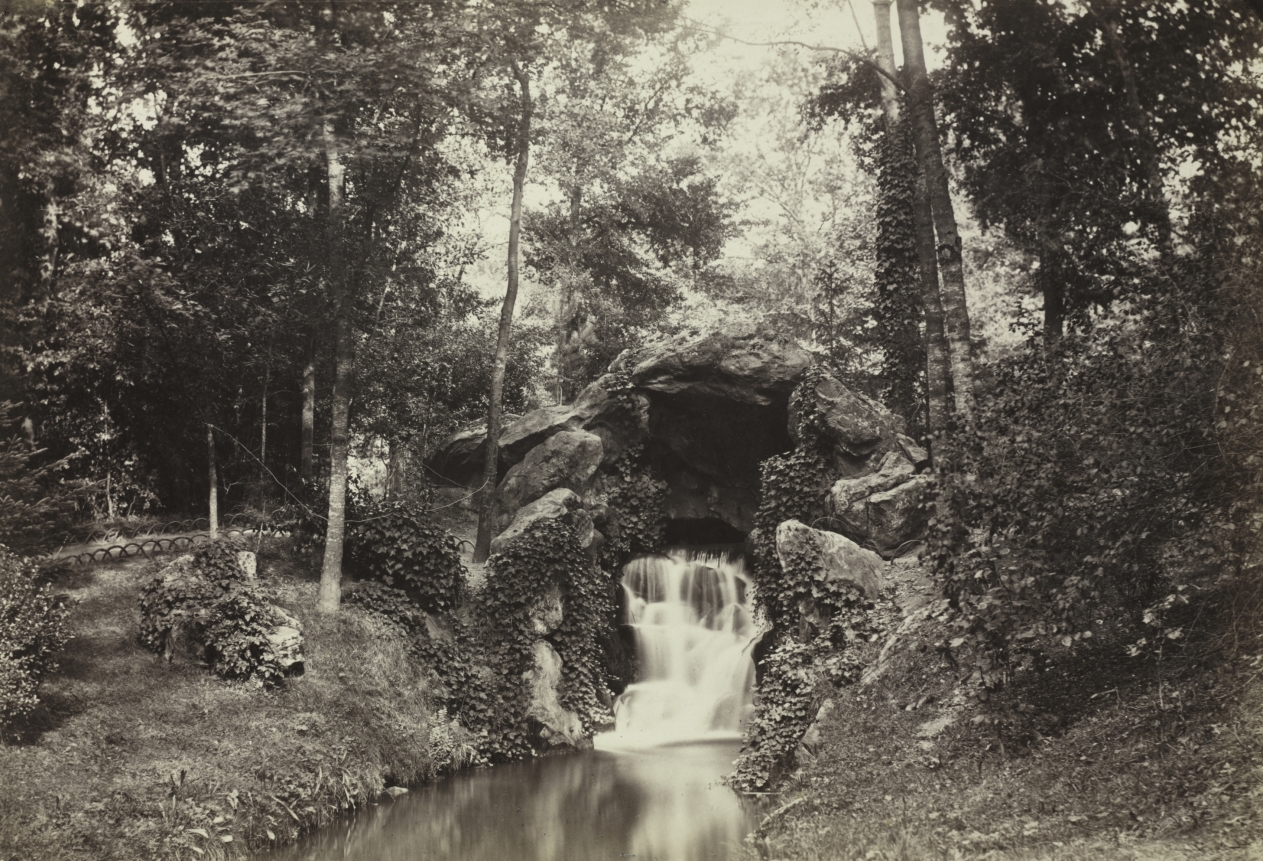
Urban Silhouette Research: Form and Color in the Small Grotto toward the Deer Pond
I. Site Reading: The Grotto as Negative Space
The Bois de Boulogne grotto, viewed toward the deer pond, presents a compositional logic that is unusually instructive for the 2026 executive wardrobe. The grotto is not an object but an aperture—a constructed void framed by rusticated stone, calibrated to admit a controlled volume of light and to direct the eye across a reflective plane. The pond functions as the terminal surface of the composition: it receives, it does not assert. This is the first principle of the collection. The silhouette must operate as architecture around the body, not as decoration upon it. Where the grotto's masonry establishes a hard perimeter, the water within dissolves all edges into reflection. The garment must replicate this duality—a rigid exterior envelope containing a fluid interior volume.
Formally, the grotto's arch is a compressed semicircle, its spring line low, its crown flattened by weathering. The proportion is deliberately non-classical: the opening is wider than it is tall, producing a horizontal emphasis that reads as restraint rather than grandeur. Translated to tailoring, this yields a shoulder line extended but not exaggerated, a lapel broad and low-set, and a torso that terminates in a clean horizontal hem rather than a tapered waist. The result is a silhouette that occupies space laterally while refusing vertical ostentation—authority expressed through width and stillness, not height.
II. The Udumbara Principle: Surface as Controlled Dissolution
The DNA source—the Udumbara Flowers plaque and the Cup and Stand—supplies the surface treatment. The plaque's carver negated the wood's materiality through obsessive incision, producing a floral vortex that hovers between presence and erasure. The cup achieves the same end through opposite means: extreme thinness, extreme plainness, a vessel whose perfection lies in what it withholds. Both objects converge on a single proposition: the most sophisticated surface is one that withdraws its own material claims.
For the 2026 wardrobe, this manifests as a fabric strategy of calculated reticence. Slate-toned wool crepe, dry to the hand and matte under directional light, absorbs rather than reflects—the textile equivalent of the grotto's unpolished stone. Over it, a second layer of technical silk in the same value but a half-step lighter in temperature creates the plaque's effect of layered incision: visible only at close range, disappearing at distance. The palette is monochromatic by design. Slate is the anchor—a blue-grey of low chroma and medium-low value, the color of wet limestone and overcast water. It is a color that refuses to perform, which is precisely its executive utility. Against it, ivory piping at seam lines and a single silver hardware element at the closure provide the only chromatic events, functioning as the cup's glaze highlight functions: a single point of luminance that confirms the whole.
III. The Vessel Logic: Volume, Capacity, and the Executive Body
The Cup and Stand's aesthetic core is the dialectic of void and capacity. The vessel is meaningful not for its walls but for the emptiness they enclose. Applied to silhouette, this demands that the garment be read as a container with intentional internal volume—not a sheath, not a sack, but a calibrated chamber. The 2026 executive jacket therefore carries a floating canvas through the chest, permitting a two-centimeter air gap between fabric and torso at the sternum, while the back panel is cut with a single center seam that follows the spine's curve without cinching. The sleeve is set slightly forward of the natural shoulder, producing a subtle forward pitch that reads as attentiveness—the body inclined toward the room, not retreating from it.
The trouser follows the pond's logic: a wide, unbroken fall from a high waistband, the crease pressed sharp but the fabric allowed to break once at the instep. No cuff. No taper. The hem is finished with a hidden slate grosgrain facing, visible only when seated—a private detail, the equivalent of the cup's unglazed foot ring. Proportionally, the jacket hem sits at the high hip, the trouser rise at the natural waist, creating a compressed vertical interval that elongates the leg while keeping the torso visually compact. This is the grotto's horizontal emphasis made wearable.
IV. Color Discipline: The Slate Register
Slate operates in this collection as a tonal field rather than a single hue. Three values are deployed: a deep slate at 18% lightness for outerwear and trouser, a mid-slate at 32% for shirting and knit, and a pale slate at 58% for the lining and the occasional scarf. The progression is monotonic, producing a value gradient that reads as a single color under interior lighting—the executive equivalent of the grotto's stone, which shifts from shadow to half-light without ever changing material. Silver is restricted to a single functional element per look: a collar stay, a cufflink, a zipper pull. Ivory appears only at the seam, the edge, the inner face—never as a field. This is the discipline of the cup: one glaze, one form, no ornament that does not serve the void.
V. Conclusion: The Silhouette as Act of Restraint
The Small Grotto toward the Deer Pond is, finally, a lesson in compositional subtraction. Its power lies in what it frames and what it withholds—the dark aperture, the still water, the deer that may or may not appear. The 2026 Addison executive wardrobe adopts this posture. The silhouette is wide, low, and quiet. The surface is matte, layered, and self-effacing. The color is slate, resolved into a monotone that rewards proximity and punishes spectacle. In a market saturated with visual noise, the collection proposes that authority is best expressed through the confidence of the unadorned—a garment that, like the grotto, creates a space in which the wearer's presence, not the clothing's, becomes the event.