Urban Form: Mourner from the Tomb of Philip the Bold, Duke of Burgundy (1364–1404)
Urban Silhouette Research: The Mourner as Structural Prototype
I. Form as Doctrine: The Carthusian Vertical
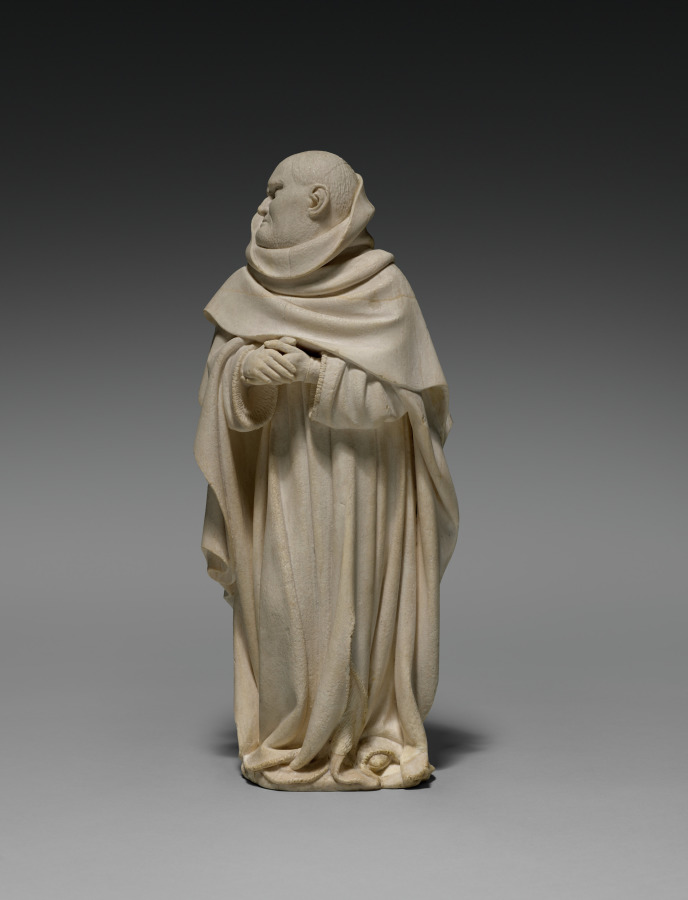
The Mourner from the Tomb of Philip the Bold (Claus Sluter workshop, ca. 1404–1410) is not, strictly speaking, a garment study. It is a theological argument rendered in drapery. The figure belongs to the pleurants—the forty-one alabaster processionists encircling the ducal sarcophagus at Champmol—and its formal logic is governed by a single imperative: the suppression of the body in favor of the columnar silhouette. The mourner does not stand; it ascends. The hooded chaperon collapses the head into a continuous conical volume, eliminating the shoulder line as a horizontal interruption. What remains is an unbroken vertical axis from crown to hem—a monastic monolith in which anatomy is subordinated to architecture.
For the 2026 executive wardrobe, this is the foundational proposition: the silhouette must read as a single decision, not an accumulation of parts. The Addison interpretation rejects the belted waist as a democratic gesture. Instead, we propose a continuous onyx wool-cashmere column coat with a raised, integrated collar that absorbs the neckline into the shoulder mass—a direct quotation of the chaperon's head-to-torso fusion. The result is a garment that photographs as a vertical stroke, legible from thirty meters, which is precisely the distance at which a boardroom reads its occupants.
II. The Drapery System: Channel Folds and Controlled Volume
The technical genius of the Mourner resides in its fold architecture. Sluter's workshop carved drapery not as cloth but as hydraulic channeling—deep, parallel, V-sectioned folds that direct the eye downward in disciplined cadence. These are not the chaotic creases of lived fabric; they are engineered conduits, each fold a load-bearing element that distributes visual weight from the shoulder to the floor. The hem flares with a controlled A-line release, granting the figure stability without sacrificing the vertical thesis.
Translated to tailoring, this demands a fabric with sufficient gram weight and memory to hold a fold without collapse—minimum 480 g/m in a double-faced wool, or a bonded cashmere with a dry, matte hand that refuses sheen. The Addison Pleurant coat employs knife-pleated side panels set into a princess seam, releasing at the knee into a 12-centimeter flare. The pleats are pressed to a permanent edge, functioning as the garment's structural ribs. In movement, they open and close like a bellows—controlled respiration, never flutter. This is the distinction between volume and looseness: the Mourner is voluminous but never loose, and the executive wardrobe must observe the same discipline.
III. Color: The Onyx Monochrome and the Ethics of Restraint
The Mourner's palette is monastic monochrome—alabaster in the original, but its chromatic argument is absolute value suppression. There is no contrast, no accent, no hierarchy of hue. The figure is a single tonal field, and this is its authority. For 2026, we translate this into Onyx: not black as fashion gesture, but black as administrative neutrality. Onyx absorbs light rather than reflecting it, which means the garment's form is read through shadow and edge rather than surface. This is the correct choice for the executive who requires the room to read her structure, not her styling.
The technical specification is a tri-tone onyx stack: a matte wool outer shell (5% light absorption variance), a satin-faced inner lapel (for the single permitted glint at the throat), and a gunmetal-hardware closure positioned off-center to break the bilateral symmetry that would otherwise read as corporate uniform. The monochrome is interrupted only by the skin at the wrist and jaw—the Mourner's sole concession to the human, and ours as well.
IV. The Hood Logic: Headwear as Silhouette Continuum
The chaperon is the Mourner's most radical formal device: it eliminates the head as a separate volume, folding it into the body's mass. The Addison translation is a detachable onyx wool hood-collar that mounts to the coat's interior placket and, when raised, creates an unbroken line from crown to hem. When lowered, it reads as a sculptural shawl collar—dual-function engineering for the executive in transit between the street and the boardroom. The hood is not a casual gesture; it is a privacy architecture, and its inclusion signals that the wearer controls the terms of her own visibility.
V. Conclusion: The Mourner as Wardrobe Thesis
The Mourner endures because it resolves a permanent problem: how to be monumental without being ornamental. Its answer—vertical continuity, channeled drapery, monochrome suppression, and the absorption of the head into the silhouette—constitutes a complete grammar for the 2026 executive wardrobe. Addison Fashion's Pleurant program adopts this grammar wholesale, rejecting the seasonal and the decorative in favor of structural permanence. The garment does not mourn; it asserts. And in the onyx monochrome, it speaks in the only register the modern boardroom respects: quiet, total, and incontrovertible form.