Urban Form: Hinggi
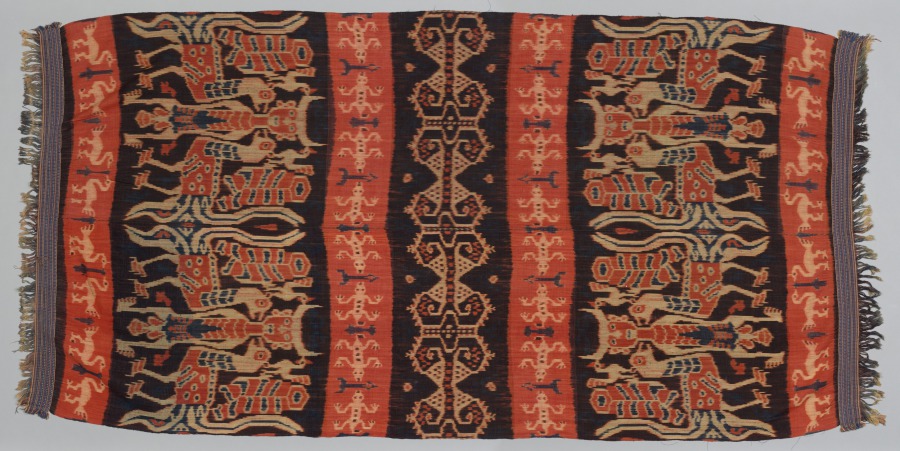
Urban Silhouette Research: Hinggi — Structural Poetics of the Sacred Axis
I. Geometric Integrity: The Architecture of Stillness
The Hinggi proposition derives its authority from a rigorous geometric discipline that operates on two distinct but convergent axes. The Bodhisattva form establishes a vertical hierarchy governed by the law of the isosceles triangle: the crown of the head as apex, the shoulders as the widest horizontal register, and the folded legs as a stable base. This is a silhouette of contained ascent — the shoulders are not broadened for dominance but calibrated for balance, and the drapery falls in parabolic arcs that echo the descent of gravity without surrendering to it. The Amulet in the Form of a Seated Figure with Bovine Head, by contrast, operates on a cubic logic: the seated figure inscribes itself within an implied rectangular block, its bovine head projecting forward as a volumetric mass that breaks the frontal plane. Where the Bodhisattva is radial and concentric, the amulet is orthogonal and frontal. Together they define a dual-axis geometry — one axis of interiority, one of exteriority — that becomes the structural grammar for the 2026 executive silhouette.
II. The 2026 Silhouette: A Synthesis of Inward and Outward Armor
The 2026 executive wardrobe must reconcile two opposing demands: the need for psychological composure and the need for territorial defense. The Hinggi research resolves this through a layered structural system. The base layer adopts the Bodhisattva's concentric drape — a fluid, columnar understructure in matte silk or fine-gauge wool that follows the body's vertical axis without clinging. Over this, the outer layer borrows the amulet's cubic frontal mass: a tailored shoulder that is squared but not aggressive, a chest panel that reads as a single uninterrupted plane, and a hemline that terminates with the finality of a plinth. The result is a silhouette that is soft at the core and hard at the perimeter — a garment that protects without imprisoning, that signals authority through geometric restraint rather than ornament.
III. Structural Poetics: The Tension of the Fold
The poetics of this silhouette reside in the fold as a site of meaning. The Bodhisattva's drapery is not decorative; it is didactic — each fold marks a transition between states of being, from the worldly to the transcendent. In the 2026 executive context, the fold becomes a functional hinge: a single deep pleat at the back of a coat, a controlled gather at the wrist, a diagonal seam that traces the path of a shoulder blade. These are not embellishments but structural events that articulate movement and stillness within the same garment. The amulet's contribution is the seam as boundary — a hard edge that separates the self from the chaos of the urban environment. The Hinggi silhouette therefore operates on a dialectic of soft interior and hard exterior, where the fold is both a gesture of openness and a line of defense.
IV. Urban Materiality: Onyx as the Ground Tone
The material palette is anchored in Onyx — a black that is not flat but stratified, with subtle variations in sheen that mimic the polished surface of stone. This is the color of the amulet's basalt, the color of the Bodhisattva's shadowed robes. It is a color that absorbs light and returns it with calculated restraint. The fabrics must follow this logic: dense wool crepe for the outer shell, matte silk for the inner column, and bonded leather for the structural accents at the shoulder and hem. The surface treatment is minimal but not inert — a slight nap on the wool, a faint sheen on the silk, a precise edge on the leather. This is urban materiality at its most disciplined: nothing that distracts, everything that signifies.
V. Conclusion: The Sacred Axis in the Executive Wardrobe
The Hinggi research delivers a silhouette that is architectural in its geometry, poetic in its folds, and urban in its materiality. It synthesizes the Bodhisattva's inward radiance with the amulet's outward fortification, producing a garment that is both a meditation on composure and a tool for survival. For the 2026 executive, this is not merely clothing — it is a structural philosophy worn on the body, a quiet assertion that authority is best expressed through geometric integrity and material restraint. The sacred axis becomes the urban axis; the silhouette becomes the self.