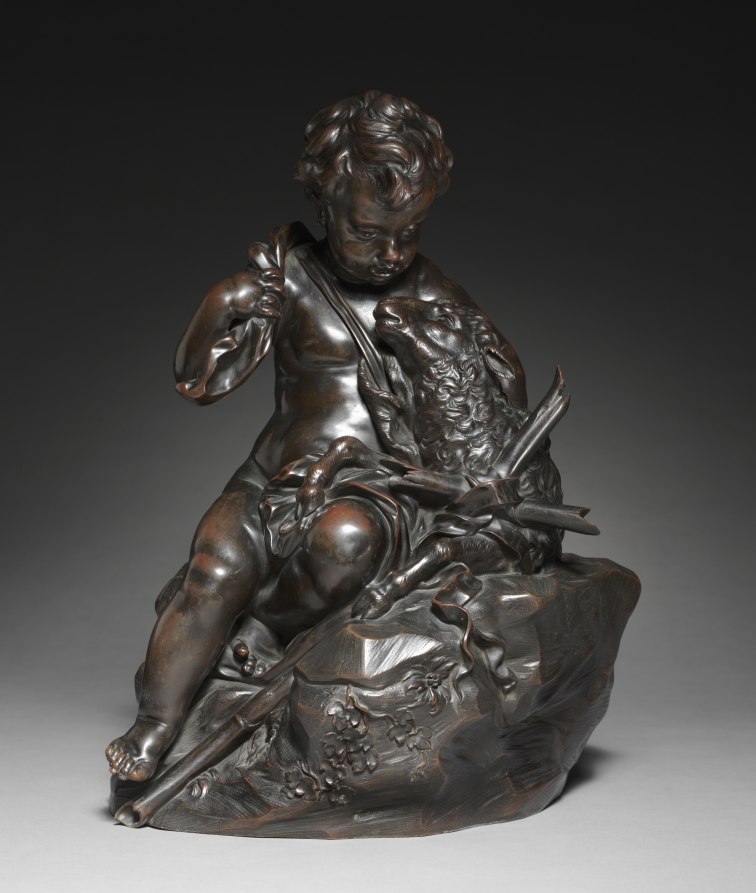
Urban Form: Young Saint John and the Lamb
Urban Silhouette Research: The Container as Silhouette — Onyx Minimalism and the 2026 Executive Form
The 2026 executive silhouette does not announce itself. It contains. This is the central thesis derived from the unlikely convergence of two artifacts: the late-Renaissance portrait of Saint Philip Neri and the Shang-Zhou bronze zun-vessel. Both are, in the strictest structural sense, containers — one of grace, one of cosmic order. For Addison Fashion, the operative question is not what they depict but how their geometry organizes volume, aperture, and edge. The answer defines a minimalist silhouette of severe restraint and latent interiority, rendered here in Onyx.
Geometric Integrity: The Portrait's Enclosed Volume
The portrait's compositional architecture is a study in compressed mass against void. The figure occupies a near-triangular footprint: broad at the shoulders, tapering through the hands to a single point of gesture. The dark ground functions as negative space of absolute density — not emptiness but a wall. The face reads as the sole aperture, a small luminous opening in an otherwise sealed volume. This is the geometry of the monolithic column with a single fenestration: the body as load-bearing mass, the countenance as the only permitted light source.
Translated to tailoring, this yields a silhouette of continuous vertical fall — a shoulder line held rigid and horizontal, a torso that does not taper at the waist but descends in an unbroken plane, and a hem that terminates with the finality of a plinth. The 2026 executive jacket adopts this logic: no suppressed waist, no darted interruption. The closure is concealed; the seam is a whisper. What remains is a single, deliberate opening — a collar, a cuff, a slit — through which the wearer's presence, like the saint's illuminated gaze, becomes the only point of exposure.
The Bronze Vessel: Segmented Rhythm and Ritual Weight
The Shang-Zhou zun proposes the inverse discipline. Where the portrait compresses, the vessel articulates. Its geometry is a stacked register system: foot, body, neck, each zone bounded by raised flanges that read as structural ribs. The taotie and thunder-scroll patterns are not surface ornament but a grid of controlled intervals — a rhythm of density and relief that gives the mass its ceremonial authority. The vessel's silhouette is legible from a distance because its edges are indexed: every transition is marked, every volume is named.
For Addison, this translates into the architectural seaming that distinguishes the 2026 executive coat from the merely plain. A horizontal yoke at the shoulder. A flange-like placket. A hem band that grounds the garment with the weight of a bronze foot-ring. The minimalism is not absence; it is legible structure. Each seam is a register boundary, each panel a ritual zone. The wearer moves through the urban field as the vessel moves through the rite — with measured, public gravity.
Materiality: Onyx as the Ground of Both
The unifying chromatic decision is Onyx — a black of mineral depth rather than flatness. In the portrait, the ground is a darkness that absorbs and thereby amplifies the single light. In the bronze, patina and shadow collect in the recesses of the relief, giving the metal a stratified darkness that reads as time itself. Onyx in cloth must perform the same function: a matte, light-hungry surface that refuses reflection and instead records the topography of the body beneath. Wool crepe, dense double-faced cashmere, bonded technical twill — materials that hold an edge without shine, that crease as memory rather than flaw.
Structural Poetics: The Container as Executive Form
The synthesis is a silhouette that is simultaneously sealed and indexed: a monolithic vertical mass, interrupted only by deliberate apertures and register seams. The shoulder is architectural, the waist is unresolved, the hem is terminal. This is the 2026 executive posture — not a display of personality but a vessel for authority, legible in its structure, silent in its surface, and dark enough to hold whatever light the wearer brings to it. The garment does not decorate the body. It contains it, as the portrait contains grace and the bronze contains order.