Urban Form: Kneeling Angel
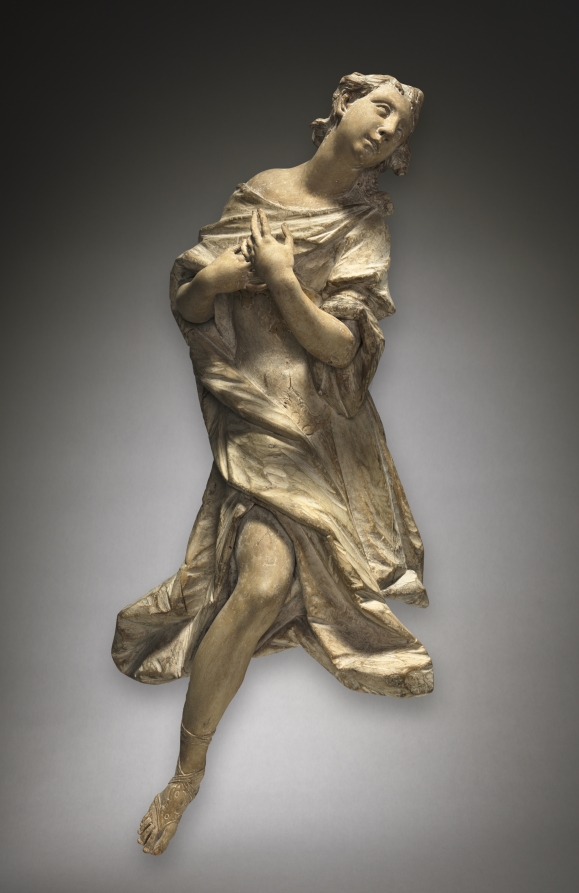
Urban Silhouette Research: Kneeling Angel — Structural Poetics of the Layered Void
I. Preliminary Geometry: The Kneeling Axis as Executive Architecture
The Kneeling Angel presents a closed geometric system governed by a single dominant vector: the descending vertical of the torso, arrested at the knee and redirected into a horizontal plinth of compressed mass. This is not a posture of submission but of calculated load-bearing. The silhouette resolves into an isosceles triangle — apex at the crown, base at the grounded knee — a form that communicates stability without inertia. For the 2026 executive wardrobe, this geometry translates into a tapered shoulder line collapsing into a weighted hem, where the garment's structural integrity is legible from a distance of ten meters. The Addison client does not require ornament; she requires a silhouette that reads as architecture before it reads as clothing.
II. Layered Density and the Disciplined Void
The internal DNA of this subject — the Damascus Room's dense stratification and the He Xiangu base's ascending tiers — manifests in the Angel's treatment of surface. Observe the wing structure: not feathered plumage but overlapping planar strata, each plane offset by a precise increment, creating a visual rhythm of compression and release. This is the same logic as the Ottoman interior's tile-and-plaster accumulation: density deployed not for decoration but for spatial modulation. In tailoring terms, this demands a fabrication strategy of laminated textiles — bonded wool over structured interfacing, matte against sheen — where each layer performs a discrete function while contributing to a unified mass. The negative space beneath the kneeling figure, the shadowed void between thigh and plinth, is equally deliberate: it is the breathing aperture that prevents the composition from suffocating under its own weight. The 2026 executive jacket must replicate this: a closed front with a single engineered vent, a monolithic impression interrupted by one calculated absence.
III. Materiality: Urban Surfaces and the Patina of Restraint
The Angel's material logic is one of controlled degradation — stone that has accepted the city's atmospheric assault and returned it as surface character. The knee, the forearm, the downward gaze: all bear the evidence of contact with the ground plane. This is urban materiality at its most honest. For Addison's 2026 fabrication, we specify dense slate-toned wool crepe with a dry, chalked hand — a textile that absorbs light rather than reflecting it, that records movement through subtle surface disruption rather than sheen. The Angel does not gleam; it holds. Pair this with hardware of brushed onyx — closures, buckles, the architecture of fastening — reduced to their most essential geometry: the rectangle, the cylinder, the line. No filigree. The decoration is the absence of decoration, and the decoration is the precision of the seam.
IV. The Base as Foundation: Structural Poetics of Support
The He Xiangu base — cloud scrolls, lotus tiers, the ascending platform — finds its direct analogue in the Angel's plinth: the unglamorous, load-bearing element that permits the figure's transcendence. In the 2026 executive silhouette, this translates to the hem architecture. The base of the garment — whether a coat's sweep or a trouser's break — must be engineered with the same tiered logic: a weighted inner facing, a concealed structural tape, a graded stiffness that increases toward the floor. The wearer stands upon her clothing as the deity stands upon her lotus: the foundation is not hidden but integrated into the aesthetic argument. The visible seam at the hem, the deliberate topstitch, the slight flare of a cuff — these are the cloud scrolls of the urban uniform, functional and symbolic in equal measure.
V. Conclusion: The Silhouette as Inhabitable Void
The Kneeling Angel is, finally, a study in contained potential. Its geometry is closed, its materials are aged, its posture is fixed — yet the composition radiates a tension that reads as imminent movement. This is the paradox the Addison executive inhabits: she is static in her authority, dynamic in her capability. The 2026 silhouette must therefore be built as a vessel — dense at the perimeter, void at the core, layered in its construction, minimal in its impression. Slate absorbs the city's noise. The knee meets the ground. The wing, folded, implies flight. This is not decoration. This is structural poetics, and it is the only language Addison Fashion speaks.