Urban Form: Kneeling Angel
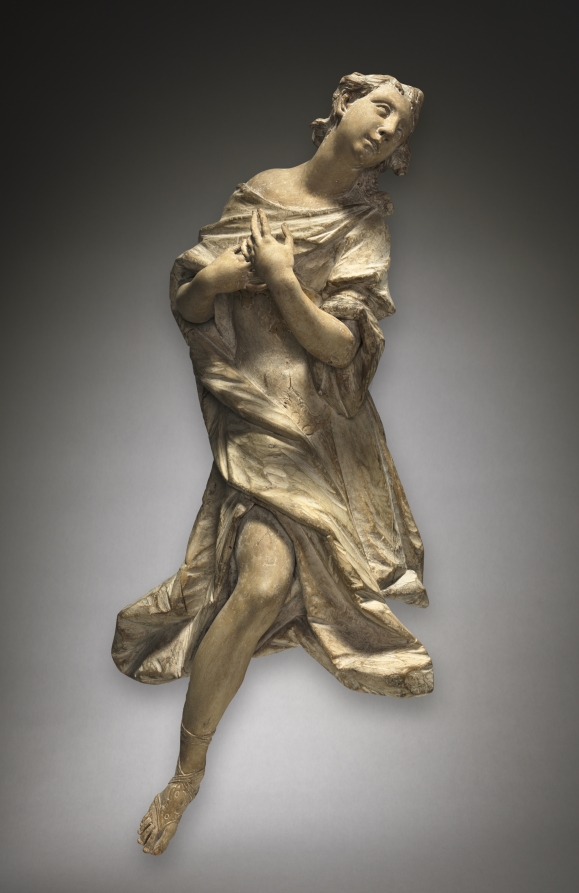
Urban Silhouette Research: The Kneeling Angel Protocol
Formal Deconstruction of the Bodhisattva Silhouette
The Bodhisattva archetype presents a masterclass in controlled volume distribution. The seated figure’s silhouette operates on a principle of centripetal mass—every drape, every cascading fold of the robe converges toward the thoracic core, creating a visual gravity well that anchors the entire composition. For the 2026 executive wardrobe, this translates into a tapered A-line construction in outerwear: shoulders remain rigorously structured, while the lower torso and hem expand with calculated fluidity. The Slate colorway—a cool, desaturated grey-blue—absorbs light rather than reflecting it, mimicking the stone medium’s matte authority. This is not passive neutrality; it is strategic optical absorption, allowing the wearer to command space without chromatic aggression.
The mudra—the hand gesture—functions as a kinetic punctuation mark within the static form. In tailoring terms, this manifests as asymmetric closure systems: a single exposed button at the wrist, a diagonal seam across the placket, or a deliberately offset lapel. These micro-interventions disrupt the monotony of the business silhouette while preserving its hieratic stillness. The 2026 executive does not gesture broadly; she gestures precisely, and her garment must encode that discipline.
The Bovine Hybrid: Tension as Structural Principle
The Bovine-Headed Amulet introduces a fundamentally different formal logic: hybridized contradiction. The bovine cranium—broad, horned, weighted—sits atop a compact, cross-legged base. The silhouette is top-heavy yet stable, a deliberate violation of classical proportion that generates visual friction. For Addison’s 2026 collection, this principle informs the oversized shoulder-to-hem ratio in knitwear and soft tailoring: exaggerated shoulder padding (but executed in Slate wool-silk blends, not structural foam) tapering to a narrow, cropped hem. The result is a predatory elegance—the wearer appears capable of both stillness and sudden velocity.
The amulet’s miniaturization—its function as a portable, personal object—is equally instructive. The 2026 executive wardrobe demands modularity without fragmentation. Detachable collars, reversible cuffs, and concealed magnetic closures allow a single garment to shift register from boardroom to gallery opening without visible transformation. The Slate palette facilitates this chameleon function: it reads as authoritative under fluorescent light, contemplative under tungsten, and severe under daylight. It is the chromatic equivalent of a blank signature—present, intentional, yet refusing to overdetermine the wearer’s identity.
Color as Spiritual Technology: Slate and the Aesthetics of Restraint
The Bodhisattva’s stone medium and the amulet’s bronze patina both operate within a restricted chromatic register—cool, mineral, non-organic. Slate is the 2026 translation of this mineral logic into textile. Unlike black, which absorbs all light and thus all visual information, Slate retains a residual luminosity—a 12-18% reflectance value that allows the garment to register subtle shifts in ambient light. This is critical for the executive who moves between environments: the same Slate blazer appears charcoal in a dimly lit boardroom and gunmetal in a glass-walled corner office. The color is context-responsive without being context-dependent.
Furthermore, Slate’s low chroma (approximately 8-12% saturation) functions as a visual silencer. In the dense visual field of urban professional life—screens, signage, the chromatic noise of transit—Slate operates as a negative space. It does not compete; it frames. The wearer becomes the figure, the garment the ground. This is the Bodhisattva’s silence translated into sartorial terms: authority through withdrawal, presence through restraint.
From Sacred Object to Executive Armor: The 2026 Synthesis
The Kneeling Angel—the subject of this research—emerges as the synthesis of both archetypes. The kneeling posture implies readiness without aggression: the body is lowered, but the spine remains vertical. For 2026, this informs the mid-length column silhouette in Slate double-faced wool: a garment that falls just below the knee, with a concealed back vent allowing for stride without exposure. The Bodhisattva’s stillness is encoded in the garment’s gravitational drape; the amulet’s protective function is encoded in interior pocketing—discreet, RFID-blocking, sized for a phone and a single card. The angel kneels, but she is operational.
The Slate colorway unifies the collection’s dual inheritance: the philosophical gravity of the Bodhisattva and the apotropaic pragmatism of the bovine amulet. It is a color that promises nothing and everything—precisely the contract the 2026 executive requires. The silhouette is Minimalist not by absence, but by compression: every seam, every closure, every millimeter of drape is load-bearing. Nothing is decorative. Nothing is accidental. The garment kneels, and in kneeling, holds.
Technical Summary: Slate. Minimalist. Tapered A-line outerwear with asymmetric closure; hybridized shoulder-to-hem ratios in knitwear; modular, context-responsive construction; interior utility pocketing. The Kneeling Angel protocol is operational.