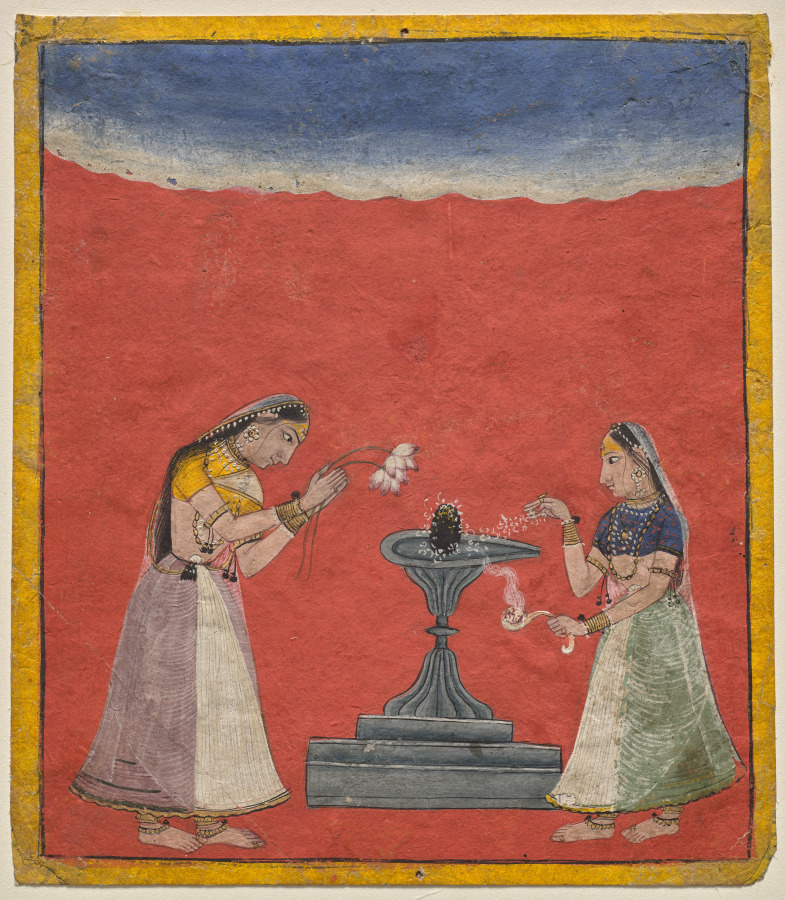
Urban Form: Women worshiping a Shiva linga: Devagandhari Ragini of Hindol Raga, from a Ragamala
Urban Silhouette Research: Form, Color, and the Devotional Body as Structural Precedent
I. Preliminary Framing: The Ragamala as Silhouette Archive
The subject under examination—Women Worshiping a Shiva Linga: Devagandhari Ragini of Hindol Raga, a leaf from a Ragamala series—presents itself to the Addison studio not as a devotional artifact but as a compendium of resolved formal problems. Our mandate is technical: to extract from its compositional logic a set of transferable propositions for the 2026 executive wardrobe. The painting operates within a constrained chromatic register—mineral pigments suspended in a warm ground—and a compressed spatial field. These constraints are precisely what render it instructive. Scarcity of means, in our reading, is not a limitation but a discipline, and the Ragamala leaf demonstrates how a small number of formal decisions, executed with conviction, can generate a complete visual system.
II. Chromatic Architecture: The Slate Proposition
The palette is governed by a cool, desaturated field—a slate-toned ground against which figures are articulated in ivory, muted ochre, and restrained accents of deep mineral red. This is not decorative color; it is structural color, deployed to separate planes and establish hierarchy without recourse to line alone. For the 2026 wardrobe, we adopt this principle directly. Slate functions as the base register—a neutral that is neither warm nor yielding, capable of absorbing adjacent tones without competing with them. Ivory is reserved for the figure-ground reversal: the garment that advances while the environment recedes. The accent—a single, controlled intervention of deep red or oxidized copper—is rationed to one element per look, typically at the wrist, the throat, or the hem. The discipline is arithmetic: one accent, one focal point, no negotiation.
Critically, the painting does not permit its colors to sit flatly adjacent. Pigment boundaries are softened by the ground itself, producing optical vibration at the seams. We translate this into fabric adjacency: slate wool against ivory silk, matte against low sheen, so that the transition between tonal zones reads as a gradient rather than a border. The executive wardrobe of 2026 will be judged at these seams.
III. Silhouette Logic: Verticality, Containment, and the Devotional Column
The compositional armature is vertical and columnar. The worshiping figures are rendered as contained volumes—shoulders squared, torsos elongated, drapery falling in unbroken verticals to the ground plane. There is no waist emphasis, no lateral flourish. The silhouette is a single continuous descent, interrupted only where the arms rise in supplication. This is the formal ancestor of the column dress and the elongated tunic that will define the Addison 2026 tailoring program.
We extract three propositions:
1. The uninterrupted vertical. Garments should read as a single gesture from shoulder to hem. Darts, seams, and closures are concealed or subordinated to the vertical axis. The body is not cinched; it is housed.
2. Containment at the shoulder. The figures' shoulders are structurally resolved—defined but not exaggerated. In tailoring terms, this mandates a soft, extended shoulder with minimal padding, permitting the garment to hang from the acromion rather than grip it. The result is authority without aggression.
3. The raised-arm aperture. Where the figures lift their arms, the silhouette opens—a momentary breach in the vertical field. Translated to the wardrobe, this becomes the deliberate vent or slit: a controlled aperture at the sleeve or side seam that permits movement while preserving the column's integrity. The aperture is not ornament; it is functional release.
IV. The Ground Plane and the Problem of Negative Space
The painting's most sophisticated maneuver is its treatment of the ground. The figures do not occupy a room; they occupy a field—a flat, unmodulated plane that refuses perspectival depth. This is a deliberate refusal of illusion, and it produces a specific effect: the figures are pressed forward, rendered immediate, stripped of atmospheric cushioning.
For the 2026 collection, this translates into a rejection of transitional layering. The executive wardrobe will not be built from nested, graduated pieces. It will be built from discrete, fully resolved garments that sit against one another without mediation—a slate column dress beneath an ivory overcoat, the two planes meeting cleanly, no interstitial scarf or belt to soften the junction. The negative space between garments becomes as considered as the garments themselves.
V. Materiality and the Mineral Register
The pigments of the Ragamala leaf are mineral—stone ground into suspension—and they carry a matte, light-absorbing quality that synthetic dyes cannot replicate. This is the material directive for 2026: surfaces that absorb rather than reflect. Slate wool crepe, ivory silk faille, brushed cashmere in oxidized tones. The executive wardrobe will be tactilely legible at close range and chromatically silent at distance—a reversal of the logo-driven visibility that has dominated the previous cycle. Restraint, here, is not modesty; it is a claim to permanence.
VI. Conclusion: The Devotional Posture as Executive Posture
The Ragamala leaf depicts worship, but its formal lesson is one of composure under constraint. The figures are still, vertical, and chromatically disciplined. They do not gesture broadly; they do not compete with their ground. This is, in precise terms, the posture the Addison 2026 wardrobe is engineered to produce: a silhouette that holds its line, a palette that holds its register, and a material presence that rewards sustained attention over instantaneous recognition. The collection will be built on these three commitments, and it will be judged, as the painting is judged, at the seams.