Urban Form: Commemorative figure (lefem)
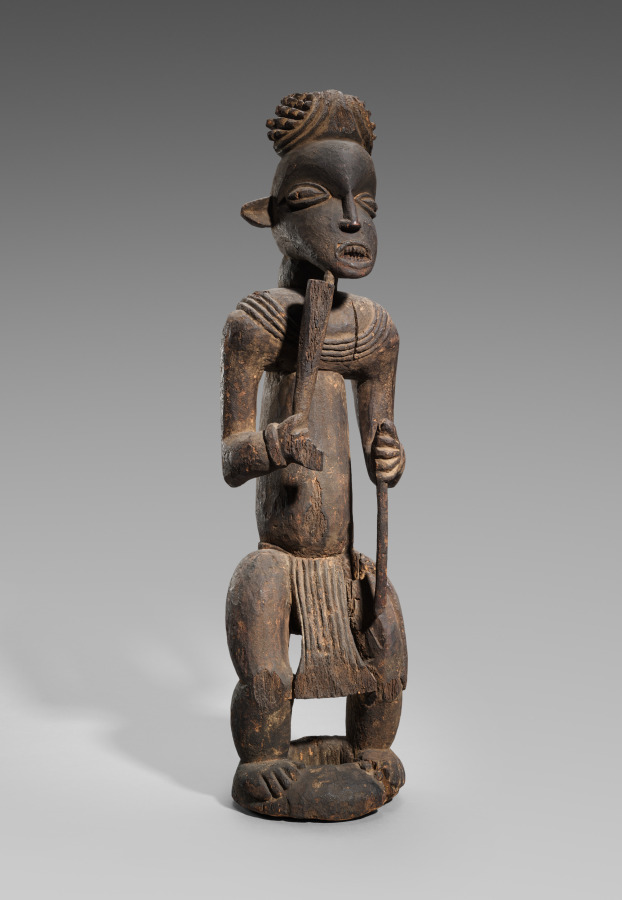
Urban Silhouette Research: Structural Poetics of the Commemorative Figure
I. Geometric Integrity and the Architecture of Authority
The commemorative figure under examination presents a dual-axis geometry that is, in strictly technical terms, a masterclass in controlled volumetric tension. The bronze Jeanne d'Arc operates on a helical vector—a spiral composition that ascends from the planted left foot through the armored torso to the upturned face, terminating in the raised banner. This is not decorative movement; it is structural escalation. The silhouette reads as a tapered column with a directional apex, a form that Addison Fashion identifies as the ascendant executive line for 2026. The shoulder-to-hip ratio is compressed, the waist is cinched by the armor's articulation, and the resulting profile is a narrow, vertical wedge—precisely the geometry that defines the modern power shoulder without recourse to aggressive padding.
The Jade Axe, by contrast, delivers a static orthogonal discipline. Its silhouette is a broad, symmetrical trapezoid—a form of contained lateral authority. The blade edge is a single, unbroken horizontal, and the haft is a vertical axis of absolute restraint. Where the bronze figure spirals, the jade form anchors. For 2026, this translates into the planar executive silhouette: a shoulder line that extends without taper, a torso that reads as a single carved block, and a hem that terminates in a clean, ceremonial horizontal. The geometric integrity here is one of subtraction—every curve is resolved into a plane, every ornament into a ritual mark.
II. Materiality as Urban Armor: Bronze, Jade, and the 2026 Wardrobe
The material dialectic between cast bronze and polished jade is the central research finding for Addison Fashion's 2026 material strategy. Bronze, with its patinated surface and micro-fissures, speaks to the urban condition of accumulated time—the executive who carries the visible record of negotiation, friction, and endurance. The 2026 wardrobe must therefore incorporate slate-toned technical fabrics with a low-luster finish, matte enough to absorb light but structured enough to hold a crease. The bronze figure's armor plates suggest articulated tailoring: seams that follow the body's mechanical logic, not its soft contours. Think paneled wool crepe, bonded leather trims, and magnetic closures that replace visible hardware with silent precision.
Jade, conversely, represents compressed geological authority—a material that has endured pressure to achieve density. Its surface is cool, non-porous, and reflective without being glossy. For 2026, this translates into high-twist worsteds, silk-cotton blends with a papery hand, and resin-finished linens that hold a sculptural shape without stiffness. The jade axe's taotie motif—abstracted to interlocking geometric bands—informs the season's engineered jacquards: patterns that read as texture at close range and as solid color at a distance. This is the essence of urban materiality: a surface that rewards proximity but performs in the plaza.
III. Structural Poetics: The Silhouette as Civic Statement
The commemorative figure's most significant contribution to the 2026 executive silhouette is its resolution of the tension between motion and monument. The bronze Jeanne is caught mid-ascent—one foot forward, banner lifted, gaze fixed on a point beyond the frame. This is kinetic monumentality: a form that implies trajectory without losing its architectural stillness. For tailoring, this means asymmetric closures, diagonal seam lines that suggest forward motion, and hems that are weighted but not rigid. The silhouette must read as poised for departure while remaining ceremonially grounded.
The jade axe offers the counter-principle: static monumentality. Its power lies in absolute symmetry and the refusal of narrative. The 2026 wardrobe requires both registers. The ascendant line—tapered, helical, directional—serves the executive in motion: the boardroom, the transit corridor, the public address. The planar line—broad, symmetrical, carved—serves the executive in stillness: the negotiation table, the ceremonial signing, the portrait. Addison Fashion's 2026 silhouette is therefore modular by design: a single wardrobe system that can shift from kinetic to static through the addition or removal of a single structural layer—a bronze-weight overcoat over a jade-density column dress, or a planar shoulder yoke over a helical bias-cut trouser.
IV. Conclusion: The Commemorative Figure as Urban Blueprint
The commemorative figure is not a historical artifact but a geometric prototype. Its dual-axis composition—helical ascent and orthogonal anchor—defines the 2026 executive silhouette as a system of controlled tensions: between motion and stillness, between patinated time and compressed eternity, between the visible record of struggle and the silent authority of order. Addison Fashion's urban silhouette for 2026 is therefore neither purely tailored nor purely fluid. It is architecturally minimal, materially stratified, and poetically unresolved—a silhouette that holds its contradiction as a form of strength. The executive who wears it does not choose between the flame and the ice crystal. She wears both, in slate, and walks.