Minimalist
Slate
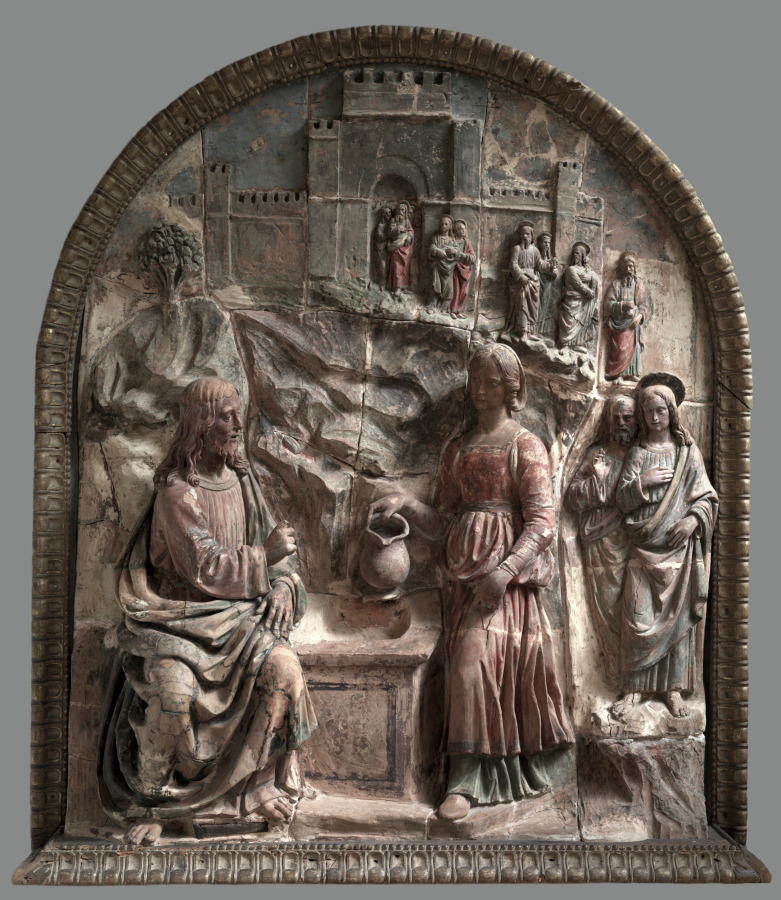
Urban Form: Christ and the Samaritan Woman at the Well
## Urban Silhouette Research: Form as Moral Geometry
### I. The Well as Negative Space: A Study in Containment
The Samaritan woman at the well presents Addison Fashion with its central structural proposition for 2026: the garment as vessel, not surface. In the canonical composition, the well functions as the organizing void around which all human gesture orbits—a masonry cylinder whose interior is never rendered, only implied. This is the first principle of the Addison silhouette: **the body is defined by what the garment refuses to enclose.** The well does not display its water; it disciplines access to it. So too must the executive wardrobe discipline access to the body—through a deliberate architecture of aperture, drape, and controlled negative space.
The compositional axis runs diagonally from Christ's seated repose to the woman's standing tension. This diagonal is not incidental; it is a load-bearing vector. Translated to tailoring, it mandates an asymmetric shoulder line—one plane dropped, one raised—that reads as intellectual composure rather than casual disarray. The 2026 Addison blazer will carry a 1.5-centimeter differential between left and right shoulder pitch, invisible at rest, decisive in motion.
### II. Chromatic Restraint: The Slate Register
The palette of the source is a study in desaturated moral weight: the well's stone, the rope's fiber, the water's depth—all resolve into a narrow band of cool neutrals interrupted only by the ochre of the woman's garment and the muted crimson of Christ's robe. Addison extracts the dominant register: **Slate**, in three calibrated values.
- **Slate 01 (Foundation):** A near-black graphite with 4% blue undertone, deployed across suiting and outerwear. This is the color of institutional authority without the aggression of pure black.
- **Slate 02 (Transition):** A mid-tone mineral grey at 38% luminance, reserved for secondary layers—the shirt, the knit, the scarf—where it functions as chromatic breathing room.
- **Slate 03 (Aperture):** A pale, almost chalked slate at 72% luminance, used exclusively at points of exposure: collar interiors, cuff linings, the underside of a lapel. These are the well's interior—glimpsed, never displayed.
The ochre and crimson of the source are **refused**. Their emotional legibility is too immediate for the executive register. What remains is the discipline of restraint: color as structural argument, not decoration.
### III. Drape Mechanics: The Rope and the Robe
Two textile behaviors govern the composition. First, the **rope**: a linear, tensioned element that converts gravity into direction. Second, the **robe**: a voluminous, gravity-surrendering element that converts the body into mass. Addison's 2026 construction resolves this dialectic through **dual-density layering**.
The outer shell—coat, blazer, or cape—employs a bonded wool-cashmere at 480 grams per square meter, cut with a 12-degree forward pitch at the shoulder seam to produce a controlled cascade rather than a collapse. The inner layer—the shirt or base—uses a 120-gram crepe de chine with a 2% elastane core, tensioned to read as the rope: linear, deliberate, unyielding. The visual result is a garment that appears to hang from a single point of suspension, like the rope descending into the well.
### IV. The Gesture of the Hand: Cuff and Closure
Christ's hand rests on the well's rim—a gesture of contact that is also a gesture of claim. The sleeve in the source is rolled, exposing the forearm: the body's most articulate surface. Addison translates this into the **open cuff**: a 4-centimeter vent at the wrist, unbuttoned, with an interior facing in Slate 03. The executive hand, whether at a keyboard or a boardroom table, is perpetually mid-gesture—and the cuff must accommodate that perpetual incompletion.
Closure systems follow the same logic. Buttons are recessed, magnetic, or absent. The garment closes through **overlap and weight**, not hardware—a 6-centimeter placket that folds left over right, held by a single concealed snap at the sternum. This is the well's masonry: no visible mortar, only the logic of stacked stone.
### V. The 2026 Executive Wardrobe: A Provisional Inventory
The research yields a five-piece core:
1. **The Well Coat** — knee-length, Slate 01, bonded wool, asymmetric shoulder, open cuff.
2. **The Samaritan Blouse** — crepe de chine, Slate 02, rope-tensioned seams, extended placket.
3. **The Diagonal Trouser** — high-rise, wide-leg, Slate 01, with a 3-centimeter offset waistband.
4. **The Aperture Knit** — fine-gauge merino, Slate 02, with Slate 03 interior collar.
5. **The Vessel Bag** — structured, Slate 01, unlined interior in Slate 03, closure by overlap.
### VI. Conclusion: Form as Ethical Position
The source composition is, finally, a negotiation between revelation and reserve—between the impulse to display and the discipline to withhold. Addison's 2026 silhouette adopts the same negotiation as its governing principle. The executive wardrobe is not a costume of authority; it is an **architecture of access**, determining what the world may see and what remains interior. In Slate, in negative space, in the open cuff and the recessed closure, the garment performs the well's original function: it holds depth without displaying it.
Technical Insight
NYC Perspective: Translating Slate tones into Minimalist silhouettes.