Urban Form: Avenue of the Banian Trees, Seringham, India
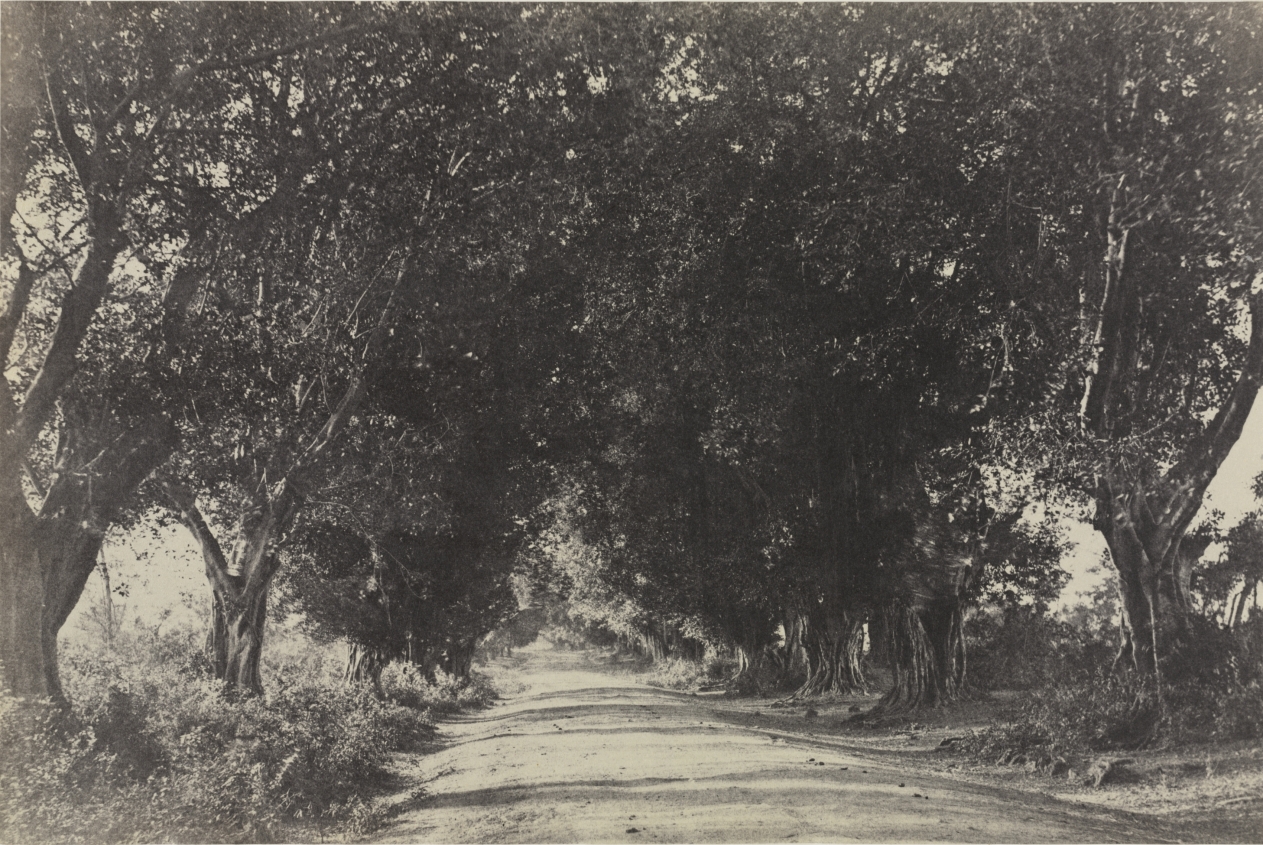
Urban Silhouette Research: Avenue of the Banian Trees, Seringham — Structural Poetics of the Liminal Corridor
I. Geometric Integrity: The Colonnade as Armature
The compositional spine of the Seringham avenue is not the foliage but the receding perpendicular—a disciplined file of banian trunks that establishes a vanishing corridor of extraordinary severity. Each trunk functions as a vertical load-bearing element; the canopy above performs as a continuous tensile membrane, closing the volume without sealing the sightline. The resulting geometry is a hypostyle logic translated into organic matter: repetition without monotony, rhythm without ornament. For the 2026 executive silhouette, this is the governing principle—garments must be read as structural members, not surfaces. The shoulder line assumes the authority of the trunk; the drape of the canopy becomes a controlled, load-distributing volume. Nothing is decorative. Everything bears weight.
II. The Liminal Corridor and the Disciplined Void
What distinguishes this avenue is its negotiation of negative space as architecture. The interval between trunks is neither open nor closed; it is a calibrated aperture, admitting light in striated bands that striate the ground plane into a measurable grid. This is the same restraint found in the Guanyin's floating void—space activated, not filled. The 2026 executive wardrobe must adopt this aperture discipline: a tailored coat whose side seam opens to a precise, engineered gap; a column dress interrupted by a single horizontal release. The void is not absence. It is the most expensive material in the composition, and it must be cut with the same rigor as the cloth.
III. Materiality: Urban Weathering and the Patina of Authority
The banian's surface is a record of endurance—bark fissured, roots descending as secondary columns, the whole mass darkened by humidity into a near-slate tonality. This is materiality as biography. The Addison position for 2026 rejects the pristine. We specify slate-toned wool with a dry, mineral hand; matte technical silk that absorbs rather than reflects; leather finished to a low, smoked sheen. The palette is drawn directly from the avenue's shadow register—Slate, Onyx, Ivory—deployed in tonal blocks so that the garment reads as a single geological stratum rather than an assembly of parts. Urban materiality is not about gloss. It is about the patina that accrues to authority over time.
IV. The Descending Root: Asymmetry as Structural Honesty
The banian's aerial roots descend without symmetry, each finding its own anchor. This irregularity is not chaos; it is load-path honesty—structure following necessity rather than convention. The 2026 silhouette absorbs this lesson in controlled asymmetry: a single draped panel weighted to one hip; a collar extended on one side only; a hem that releases its length at a calculated diagonal. The asymmetry must never appear accidental. It must read as the visible trace of a structural decision—the root that had to descend where the branch required it.
V. The Renaissance Gaze and the Executive Interior
The internal DNA of this research insists on the dialogue between the San Secondo portrait and the Potalaka Guanyin—the downward, inward humanism and the upward, outward void. The avenue of Seringham resolves both. Its corridor is inward in its compression, outward in its vanishing point. The executive silhouette of 2026 must perform the same double movement: a closed, self-possessed interior—the lowered gaze, the withheld gesture—carried within an outward-facing architectural shell. The garment is a portable cloister. It shields the interior life while projecting a measured, legible front to the urban field.
VI. Conclusion: The Corridor as Garment
The Avenue of the Banian Trees is, in essence, a wearable architecture—a sequence of vertical members, a tensile canopy, a disciplined void, and a weathered surface. The 2026 Addison executive silhouette is its translation into cloth: Minimalist in category, Slate in color, severe in line, generous in interval, and honest in its structural descent. We do not ornament the body. We engineer the corridor around it—and in that corridor, the wearer moves as the avenue moves: with rhythm, with restraint, and with the quiet authority of a structure that has already endured.