Urban Form: Carving from an Overmantel
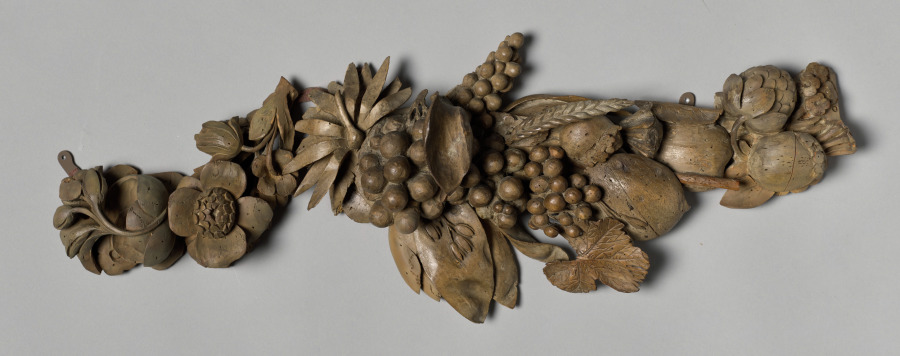
Urban Silhouette Research: Carving from an Overmantel — Form, Void, and the Architecture of Restraint
I. Thesis: The Overmantel as Structural Precedent
The overmantel is a threshold object — an architectural capstone that mediates between the interior volume of a room and the symbolic weight of the wall it adorns. As a design source for Addison Fashion's 2026 executive wardrobe, it offers a rigorous proposition: that garment architecture should function as a frame for the body rather than a description of it. The two artifacts under analysis — the "優曇鉢華" wooden plaque and the Han-dynasty Divine Beast, Chariot, and White Tiger Mirror — present a dialectic of void and density that maps directly onto the tailoring decisions facing the modern female executive. One is nearly empty; the other is saturated to the edge of legibility. Both achieve authority. This is the central insight for the collection.
II. The Plaque: Negative Space as Executive Posture
The "優曇鉢華" plaque operates through subtraction. Its calligraphic strokes — clerical-to-regular script, deliberately unrefined — occupy perhaps fifteen percent of the wooden ground. The remaining surface is activated emptiness: grain, patina, and shadow performing the labor that ornament would otherwise perform. In silhouette terms, this translates to a columnar, near-monastic line — a single-breasted overcoat with a concealed placket, a shoulder seam set slightly inward to create a clean vertical descent, and a hem that terminates without flourish. The garment's power resides in what it refuses to state.
For the 2026 executive, this is the boardroom armor of omission. The plaque's aesthetic logic — 空寂, the disciplined void — argues against the embellished lapel, the decorative belt, the visible logo. Instead, Addison proposes a wool-cashmere blend in Onyx, milled to a matte finish that absorbs rather than reflects light, with a hand-finished edge that reads as intentional only upon close inspection. The executive wearing this garment signals confidence through reduced surface area of visual information. She is not decorated; she is framed.
III. The Mirror: Controlled Density and the Discipline of Fullness
The White Tiger Mirror inverts the plaque's logic. Its 滿工 — full-field relief — packs the rear surface with chariots, musicians, the Queen Mother of the West, and a white tiger whose spine forms a continuous S-curve across the register. Yet the composition does not collapse into chaos because the density is rhythmically governed: figure groups alternate with directional flow lines, and the tiger's body functions as a structural spine that organizes the surrounding mass. Density, here, is not accumulation; it is choreography.
Translated to tailoring, this licenses the engineered print and the structured drape — but only where the pattern is subordinated to a governing seam. Addison's interpretation: a silk-blend blouse with a tonal jacquard derived from the mirror's chariot-wheel motif, cut on a bias that allows the pattern to rotate around the body's axis rather than sit flat against it. The tiger's spine becomes the garment's princess seam — a single continuous line from shoulder to hem that organizes every adjacent element. The lesson is precise: the executive wardrobe may accommodate visual complexity, provided that complexity is architecturally anchored.
IV. The Dialectic: Void and Saturation in a Single Wardrobe
The critical finding of this research is that the plaque and the mirror are not opposites but complementary registers of the same aesthetic system. The plaque's void and the mirror's fullness both serve the principle of 象外之象 — the image beyond the image. In wardrobe terms, this means the 2026 executive requires both registers operating in sequence: the Onyx column coat for the negotiation, the jacquard blouse for the presentation, the unadorned trouser for the transit between them. The wardrobe is not a collection of statements but a calibrated system of visual pressure — now evacuated, now saturated, always controlled.
V. Color Specification: Onyx as Ground and Figure
Onyx is selected not as a neutral but as a chromatic constant capable of hosting both registers. Its near-black depth absorbs the plaque's matte wool and the mirror's tonal jacquard without competition, functioning as the unifying substrate across the collection. Where the plaque requires a surface that reads as void, Onyx delivers depth without reflection; where the mirror requires a ground against which tonal relief can register, Onyx provides maximum contrast at minimum chroma. The result is a wardrobe that reads as monolithic at distance and articulated at proximity — the exact perceptual behavior of the source artifacts.
VI. Conclusion: The Overmantel Principle
Addison Fashion's 2026 executive line derives from a single architectural insight: the overmantel frames the room's most important object by controlling the space around it. Applied to the body, this yields a wardrobe philosophy of deliberate framing — garments that establish a disciplined perimeter of void or governed density around the wearer, allowing her presence to occupy the center. The plaque teaches restraint; the mirror teaches choreography. Onyx unifies both. The executive who wears this collection is not adorned. She is architecturally situated — and that is the coldest, most durable form of authority available.