Urban Form: Eighteen Views of Rome: The Piazza Farnese (recto)
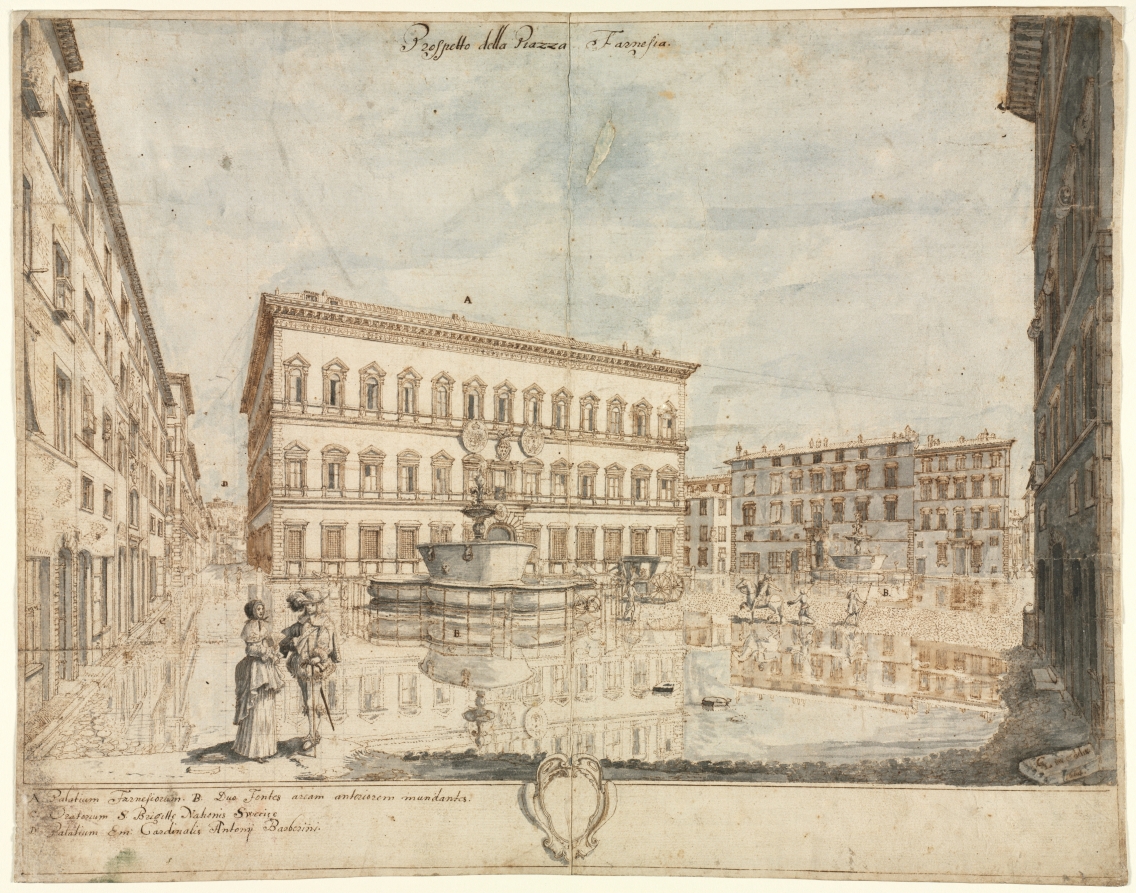
Urban Silhouette Research: The Piazza Farnese as Structural Prototype
The recto of Eighteen Views of Rome: The Piazza Farnese presents an architectural proposition rather than a topographical record. Its value to Addison Fashion lies not in its antiquarian subject but in its geometric integrity—the manner in which a civic square is resolved into a system of planes, intervals, and controlled voids. This is the grammar of the 2026 executive silhouette: authority achieved through subtraction, presence asserted through proportion rather than ornament.
The Façade as Tailored Plane
Observe the palazzo elevation. Its logic is relentlessly vertical: bays repeated with the discipline of a seam allowance, cornices acting as horizontal stay-stitching that prevents the composition from drifting. The façade does not decorate; it structures. Translated to the body, this becomes the governing principle of the Addison tailored jacket for 2026—a shoulder line engineered rather than padded, a lapel whose width is determined by the golden ratio of the wearer's torso, a waist suppressed by darting so precise it reads as architectural intent rather than fit.
The drawing's ink economy is instructive. Where a lesser hand would render shadow, this view renders edge. Every boundary is a decision. The executive wardrobe must operate identically: a seam is not a closure but a declaration. We specify a slate wool-silk with a dry, matte hand—materiality that absorbs light the way aged paper absorbs ink, refusing the vulgarity of sheen.
The Piazza as Negative Space
The square itself is the more radical element. It is a void held in tension by surrounding mass—an urban ma, the interval that gives form meaning. This is the central lesson for the 2026 silhouette: the space between garments is as designed as the garments themselves. The Addison executive does not dress in layers; she dresses in intervals. A column of ivory silk beneath a slate overcoat creates a vertical void that lengthens the figure, while the coat's volume is calibrated to preserve air around the body—never oversized, never close, but architecturally adjacent.
Note how the piazza's paving lines converge toward the fountain, pulling the eye through the composition. This is directional dressing. A single seam—running from shoulder to hem on a bias—can perform the same function, drawing the gaze downward and establishing a vanishing point at the floor. The effect is not decorative but structural poetics: the garment becomes a perspective device.
Materiality and the Weight of Time
The internal DNA of this research insists that objects and paintings bear time silently. The Piazza Farnese bears it visibly—stone eroded, ink faded, yet the geometry intact. For 2026, Addison translates this into urban materiality: fabrics that record wear as patina rather than damage. Slate-toned cashmere with a faint chalk stripe. Bonded wool that holds a crease like carved travertine. A trench in coated cotton whose surface will, over seasons, develop the soft sheen of handled paper.
The fountain at the square's center is the counter-argument to stillness—water in perpetual motion, contained by stone. This dialectic governs our accessory logic: a rigid calfskin tote, architectural in profile, softened by a single fluid strap; a belt whose buckle is a perfect square, its leather already beginning to curve. Containment and flow, resolved in a single object.
The 2026 Silhouette, Defined
The definitive executive silhouette emerging from this analysis is a vertical column interrupted by one horizontal. The column: a long, narrow overcoat or dress, its shoulder squared by construction, its waist marked by a single seam. The interruption: a belt, a cropped jacket, a bag carried at the hip—one decisive horizontal that prevents the vertical from becoming a monolith. This is the piazza's own logic: repeated bays, one cornice.
Color remains within the slate register—graphite, ash, wet stone—relieved only by ivory at the collar or cuff, the way the drawing's paper relieves its ink. No print. No logo. The geometry must speak, and geometry whispers.
The Piazza Farnese endures because it was drawn with conviction. The 2026 Addison executive will endure for the same reason: her silhouette is not a trend but a structure, and structures do not expire—they weather.