Urban Form: Mourner from the Tomb of Philip the Bold, Duke of Burgundy (1364–1404)
Urban Silhouette Research: The Mourner as Structural Paradigm
I. Provenance as Formal Premise
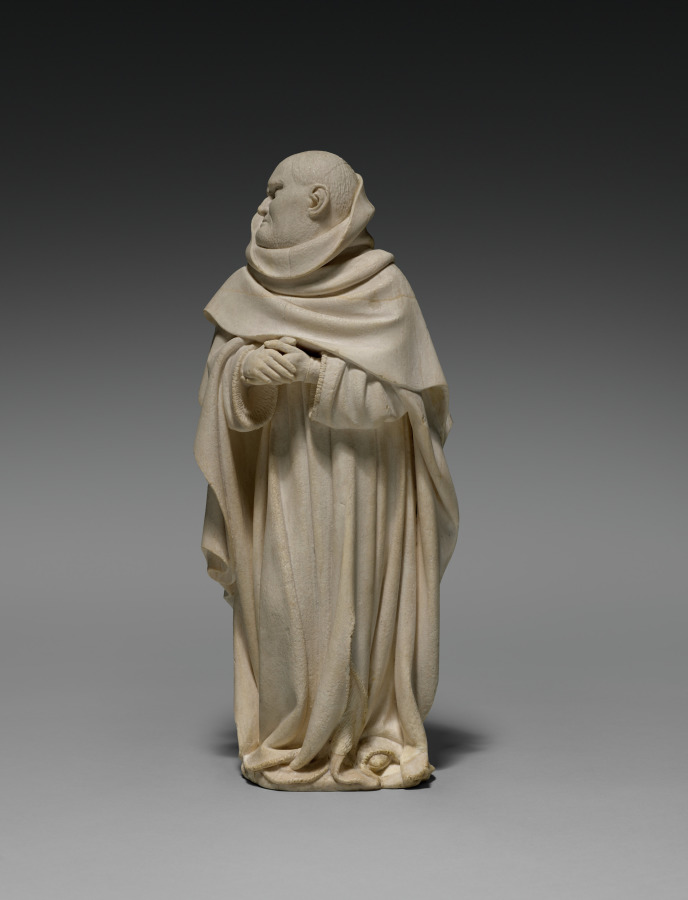
The subject under examination—a mourner from the Tomb of Philip the Bold, Duke of Burgundy (1364–1404)—belongs to the celebrated pleurant program commissioned for the Chartreuse de Champmol. Executed under the direction of Claus Sluter and his workshop, these alabaster figures constitute one of the most consequential formal achievements of late-medieval sculpture: a procession of grief rendered not as theatrical excess but as disciplined, repetitive, architecturally subordinate form. For the purposes of Addison Fashion's 2026 executive wardrobe, the mourner is not a historical curiosity but a structural precedent—a masterclass in the management of volume, drapery, and negative space that maps with unusual precision onto the requirements of the contemporary urban silhouette.
II. Form: The Architecture of Concealment
The mourner's silhouette is fundamentally columnar and closed. The figure is enveloped in a heavy, floor-length mantle whose folds are carved as continuous, near-vertical channels—a system of parallel ridges that reads as both textile and tectonic. There is no waist emphasis, no articulation of the body beneath; the garment operates as a single volumetric mass, tapering only marginally toward the hem. This is the essential grammar of the fluid-over-tailored silhouette: the body is acknowledged, then subordinated to a larger geometric proposition.
Critically, the drapery is not chaotic. The folds are rhythmic, evenly spaced, and directional—each channel terminating in a controlled break at the base. This is the formal distinction between volume and bulk: bulk accumulates without logic; volume is engineered. For 2026, this translates into garments cut from dense, gravity-responsive cloth—double-faced wool, bonded crepe, heavy silk faille—where the fold structure is built into the pattern rather than improvised by the wearer. The executive wardrobe of the coming season should pursue this principle: silhouettes that hold their own architecture, independent of posture or movement.
The hood and head covering further extend the column. The face is recessed within a deep cowl, creating a shadowed aperture that functions as the figure's only point of visual relief. This is a lesson in focal compression: the mourner generates impact not through surface incident but through the disciplined withholding of it. Applied to tailoring, the principle argues for garments whose interest is concentrated at a single, deliberate locus—a collar line, a closure, a cuff—while the remainder of the surface remains austere.
III. Color: The Slate Register
The alabaster medium yields a chromatic register that is neither white nor grey but a cool, mineral slate—light-absorptive, low-saturation, and structurally legible. Under raking light, the fold channels read as gradations of tone; the figure's volume is communicated entirely through value shift rather than hue. This is monochrome deployed as information, not as restraint for its own sake.
For the 2026 executive wardrobe, Slate functions as the season's governing neutral precisely because it performs this dual role: it is sober enough for the boardroom and complex enough to sustain the sculptural silhouettes described above. The color's slight blue-grey bias reads as deliberate rather than default—a distinction of consequence in a market saturated with undifferentiated greige. Recommended applications include tonal layering within a single value family (slate over graphite over pewter), where differentiation is achieved through texture and sheen rather than contrast, mirroring the mourner's reliance on surface modulation over coloristic incident.
IV. The Processional Logic: Repetition and Restraint
The mourner does not stand alone; it belongs to a sequence of some forty figures, each individuated yet governed by a shared formal contract. This processional logic—repetition with controlled variation—is the operative principle for a coherent executive wardrobe. The 2026 collection should be conceived as a system: a fixed vocabulary of columnar coats, elongated tunic layers, and narrow underlayers, varied only in proportion and closure detail. The result is a wardrobe that reads as intentional and cumulative rather than assembled.
Equally instructive is the figure's subordination to architecture. The mourners were designed to occupy the arcade of the tomb's base—a low, repetitive, marginal zone—and their formal restraint is a direct response to that placement. The contemporary executive operates within an analogous architecture of constraint: the meeting room, the transit corridor, the public threshold. Garments designed for this environment must likewise accept their architectural conditions and achieve presence through proportion and discipline rather than assertion.
V. Conclusion: The Cold Poetics of Restraint
The mourner offers Addison Fashion a thesis for 2026: that the most authoritative urban silhouette is the one that withholds. Its columnar mass, rhythmic fold structure, and mineral monochrome constitute a complete formal system—one that treats concealment as composition and restraint as signal. In a market that continues to equate visibility with value, the mourner's lesson is corrective. The executive wardrobe of the coming season should be built on this foundation: Slate-toned, architecturally resolved, and governed by the cold, exacting poetics of the processional figure—present, legible, and entirely undisclosed.