Urban Form: Seated Male Figure
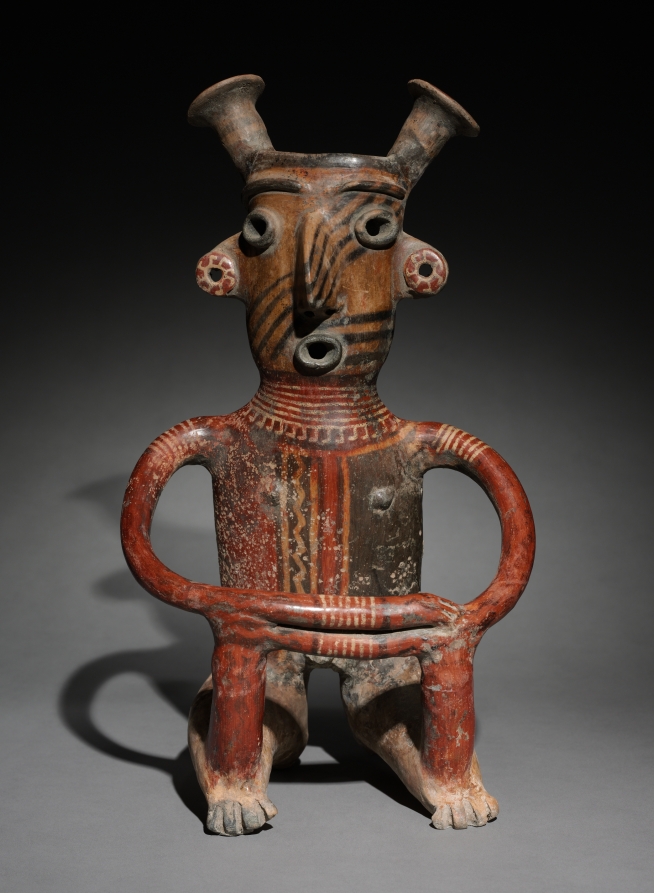
Urban Silhouette Research: The Seated Male Figure as Structural Artifact
I. The Seated Posture as Architectural Proposition
The seated male figure constitutes the most diagnostically revealing silhouette in the executive wardrobe. Unlike the standing form—which projects linearity, verticality, and the fiction of uninterrupted momentum—the seated posture introduces compression, torsion, and the collapse of the shoulder line. It is within this collapse that garment engineering is either validated or indicted. Our research treats the seated figure not as a passive subject but as a load-bearing structure under duress, and the tailored jacket as its primary exoskeleton.
The DNA source presents two opposing states: the Vermeer sleeper, whose form dissolves into the horizontal plane of the table—a body surrendered to gravity—and the Daoist immortal He Xiangu, whose drapery is suspended in perpetual lift, never touching ground. For Addison's 2026 executive wardrobe, the seated male occupies the dialectical midpoint: a body at rest whose garment must nonetheless perform the illusion of lift. The silhouette must resolve the contradiction between gravitational honesty and aspirational line.
II. Form: The Collar, the Shoulder, the Break
Three structural zones govern the seated silhouette. First, the collar-to-nape transition. When the torso inclines forward—as it does across a conference table or a trading desk—the jacket collar migrates posteriorly, exposing the shirt band and creating a gap that reads as negligence. Our 2026 pattern corrects this through a raised collar stand with an extended fall, anchoring the neckline against forward pitch. The result is a seated posture that retains its closure, its authority, its sealed perimeter.
Second, the shoulder line under compression. The seated figure shortens the visible torso by approximately fifteen percent; the shoulder therefore carries disproportionate visual weight. We specify a minimally padded, softly constructed shoulder with a forward-rotated sleeve pitch of eight degrees—accommodating the natural kyphosis of desk labor while preserving a clean lateral profile. The shoulder must not square the body into a mannequin rigidity; it must trace the wearer's actual architecture with disciplined restraint.
Third, the break of the trouser. Seated, the leg shortens and the knee rises; fabric pools at the thigh and gathers at the ankle. Our solution is a tapered leg with a reduced hem circumference and a slight forward crease displacement, producing a continuous vertical read even in repose. The trouser becomes a column rather than a drape—He Xiangu's ribbon rendered in worsted wool.
III. Color: Slate as Temporal Neutral
Slate is selected not for safety but for its optical ambiguity. It occupies the precise midpoint between the cool grey of Vermeer's shadowed interior and the mineral blue-grey of ink-washed silk. Under office lighting—fluorescent, LED, or the cold wash of a screen—slate shifts register without losing composure. It absorbs shadow rather than reflecting it, which means the seated figure retains depth in the torso where a lighter ground would flatten into clerical anonymity.
Critically, slate permits tonal stratification: a slate jacket over an ivory shirt over an onyx trouser produces a vertical value gradient that elongates the seated form. The eye reads the lightest plane at the collar and the darkest at the base, simulating the light-fall logic of the Vermeer interior—attention drawn upward, toward the face, toward the point of cognition. This is color deployed as hierarchy, not decoration.
IV. The 2026 Executive Wardrobe: Conclusions
The seated male figure demands a wardrobe that treats rest as a structural condition rather than an absence of action. The 2026 Addison silhouette therefore prioritizes: anchored collars, forward-rotated sleeves, tapered columns, and a slate tonal system that maintains legibility across the full range of seated environments—the boardroom, the town car, the terminal lounge.
The philosophical inheritance is explicit. Vermeer's sleeper teaches us that stillness is not vacancy; it is concentrated presence. He Xiangu teaches us that lift is a matter of line, not levitation. The executive seated in slate embodies both: a body at rest, a garment in suspension, a silhouette that refuses to slump. Form is discipline made visible. Color is time made wearable. The wardrobe does not decorate the executive; it structures the executive's stillness into authority.