Urban Form: The Archangel Gabriel from an Annunciation Group
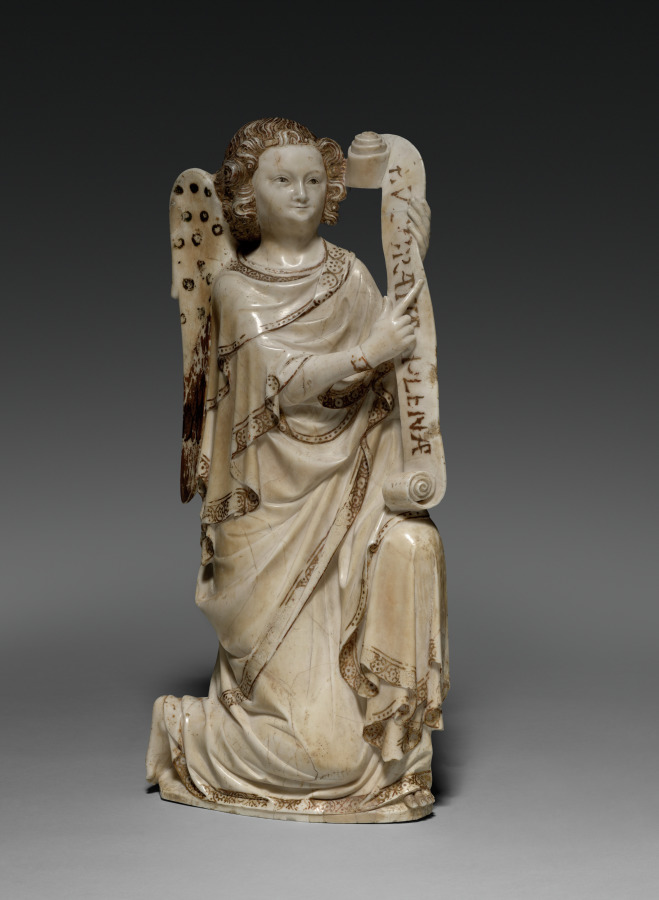
Urban Silhouette Research: The Archangel Gabriel from an Annunciation Group — Form, Color, and the Architecture of Concealment
I. Preliminary Positioning: The Object as Strategic Envelope
The Archangel Gabriel, extracted from an Annunciation group, is not a figure to be read as narrative but as a structural proposition. In the Addison research framework, we treat the sculpted body as a case study in contained volume — a form that withholds its interiority behind a disciplined exterior. The Annunciation group, as a typology, is fundamentally about interruption and arrival: a messenger enters a closed room, and the entire composition pivots on the threshold between concealment and disclosure. This is the operative tension we translate into the 2026 executive wardrobe. The angel is not ornament; the angel is a delivery system for presence.
The DNA source — the Persian lacquered qalamdan and the Chinese carved-lotus covered jar — establishes the governing aesthetic principle: beauty resides in the negative space between viewer and object, in the breath-gap of concealment. The angel, like the pen box and the jar, is a vessel. The drapery conceals the body; the body conceals the intention; the intention conceals the message. Our task is to reverse-engineer this layered withholding into garment architecture that performs the same function for the urban executive: to contain, to delay, to release on command.
II. Formal Deconstruction: The Silhouette as Annunciatory Instrument
The angel's silhouette is defined by vertical insistence and lateral restraint. The columnar drapery establishes a primary axis — a spine of fabric that descends without interruption, interrupted only by the diagonal sweep of the announcing arm and the counter-diagonal of the wing. This is a triangulated geometry: the vertical body, the diagonal gesture, the recessive wing-plane. In tailoring terms, this translates to a columnar coat or elongated jacket whose shoulder line is suppressed rather than emphasized, whose waist is indicated by a single diagonal seam rather than a belt, and whose back panel carries a recessive volume — a wing-like extension of fabric that reads as shadow rather than structure.
The drapery itself is the critical formal device. It is not fluid in the sense of liquidity; it is fluid in the sense of controlled cascade — fabric that falls in calculated folds, each fold a decision, each shadow a deliberate occlusion. The angel's garment does not cling; it architects a perimeter around the body, creating a zone of ambiguity between the wearer and the world. For the 2026 executive wardrobe, this mandates a minimalist column silhouette in which the fabric's weight and fall — not its cut — generate the shape. The garment should read as a single gesture, not a compilation of details.
The wing is the most technically instructive element. It is a plane of concealment — a large, flat surface that both protects and obscures. In garment terms, this is the cape-back or the extended shoulder plane: a panel that sits behind the body, visible only in motion, creating a silhouette that is frontal and narrow, posterior and expansive. This asymmetry of front-to-back volume is the angel's signature, and it is the precise mechanism by which the executive wardrobe achieves authority without aggression: the wearer presents a controlled front and carries a recessive, protective volume behind.
III. Color Analysis: The Onyx Discipline
The angel's palette, as rendered in the Annunciation group, is tonal rather than chromatic — a discipline of darks and near-darks interrupted by a single plane of light. This is the Onyx principle: a near-black that is not flat but layered, absorbing light at the surface and releasing it only at the fold. The qalamdan's lacquer layers and the celadon jar's milky translucency both operate on this principle — light is not reflected; it is ingested and returned as a slower frequency. Onyx, in our application, is not a color but a light-management strategy.
The angel's flesh tones and the gold of the announcing gesture function as controlled interruptions — the equivalent of the lacquer's gold leaf or the jar's incised petal edges catching light. In the wardrobe, this translates to a single point of metallic or skin-tone release: a cuff, a collar edge, a single visible seam. The discipline is that the interruption must be minimal and positional — it must occur at the point of gesture, not at the point of display.
The color logic is therefore monastic in its restraint and mercantile in its precision. The executive who wears Onyx in this framework is not wearing black; she is wearing a controlled absence of color that functions as a controlled presence of authority. The angel does not announce with brightness; the angel announces with the weight of what is withheld.
IV. Application: The 2026 Executive Wardrobe as Annunciation Group
The translation into the 2026 NYC executive wardrobe is a matter of structural discipline. The angel's form yields three garment archetypes: the columnar overcoat with suppressed shoulder and recessive back-plane; the diagonal-seam jacket that indicates gesture without exposing the body; and the layered undergarment that functions as the concealed interior — visible only at the collar and cuff, the equivalent of the pen box's hidden compartment. Each piece is designed to delay disclosure: the coat opens to reveal the jacket; the jacket opens to reveal the underlayer; the underlayer is the final, minimal surface.
This is the Annunciation logic applied to dressing: the wearer is the messenger, and the message is delivered through the choreography of concealment and release. The wardrobe does not shout; it arrives. In the urban executive context — where visibility is currency and restraint is power — the angel's silhouette provides the precise formal grammar: vertical, tonal, recessive, and deliberate. The Onyx palette ensures that the garment absorbs the city's noise and returns only a slow, considered signal. This is not minimalism as absence; it is minimalism as compression — the same compression that allows the qalamdan to hold a world of color within a dark shell, and the lotus jar to hold fragrance within a sealed curve. The executive wardrobe, in this research, becomes a portable architecture of withheld light — and the wearer, like the angel, is the threshold between the concealed and the announced.