Urban Form: Saddled Arabian Horse in Courtyard
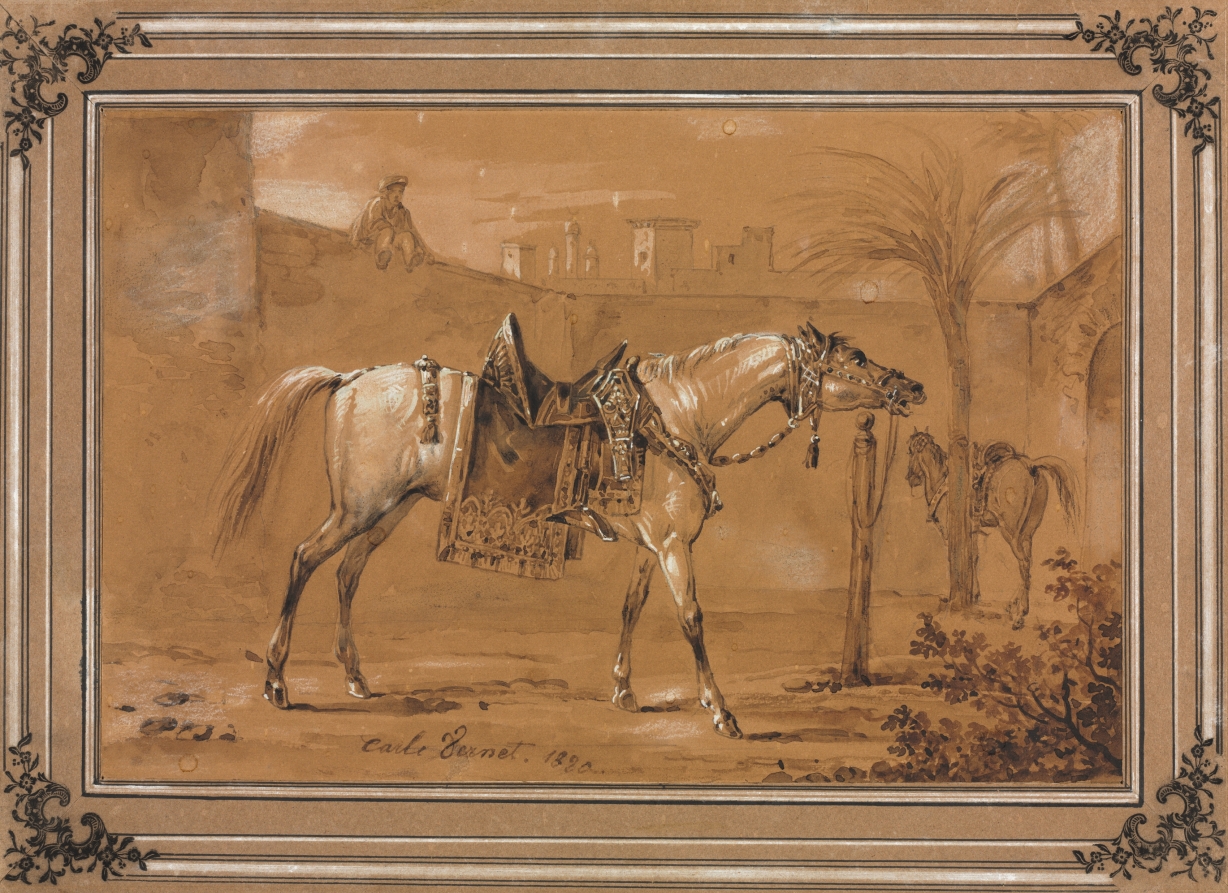
Urban Silhouette Research: The Saddled Arabian Horse in Courtyard — Structural Poetics of the 2026 Executive Form
I. Geometric Integrity: The Courtyard as Containment Field
The artwork’s compositional armature is a study in architectural containment. The courtyard operates not as a passive backdrop but as a rectilinear frame — a negative-volume chamber whose planar walls establish the governing grid. Within this enclosure, the saddled Arabian horse functions as the singular organic interruption: a curvilinear mass that resists, and thereby defines, the surrounding orthogonals. This dialectic between the rigid perimeter and the animate center is the precise mechanism we are translating into the 2026 executive silhouette. The geometry is not decorative; it is load-bearing. Every axis of the courtyard — the paving joints, the shadow lines cast by the parapet, the vertical seam of the far wall — converges to calibrate the horse’s stance. The animal is positioned off-center, generating an asymmetric tension that reads as deliberate rather than accidental. For Addison Fashion, this translates into a garment whose structural poetics derive from controlled imbalance: a shoulder line that advances, a hem that recedes, a waist seam that refuses the median. The silhouette must appear placed within its environment — an object of consequence, not of drift.
II. The Saddle as Engineered Interface
The saddle is the artwork’s most instructive detail. It is neither ornament nor afterthought; it is an engineered interface between the organic and the constructed — a rigid shell contoured to a living form. Its geometry is disciplined: the cantle and pommel establish a shallow arc, the stirrup leathers drop as precise verticals, the girth wraps as a horizontal band. This tri-axial logic — arc, vertical, horizontal — is the grammar of the 2026 executive wardrobe. We read the saddle as a tailored module superimposed upon a fluid substrate, and we extract from it a principle of layered structuralism: the outer garment as a shaped, semi-rigid envelope; the underlayer as the supple body it disciplines. The saddle’s leather — worn, darkened at points of contact, matte where untouched — introduces urban materiality as a narrative of use. Surfaces must evidence their own construction: seams that read as seams, edges that acknowledge their cut, hardware that performs a function rather than simulates one. The 2026 executive does not conceal mechanism; she composes it.
III. Materiality: Stone, Hide, and the Patina of Consequence
The courtyard’s material register is cool, mineral, and absolute — stone pavers, plaster walls, shadow. Against this, the horse and saddle introduce animal warmth: hide, hair, leather, the dull sheen of metal fittings. This is the chromatic and tactile dialectic we formalize as Ivory against mineral grey — a palette of restraint in which the single warm-neutral note carries the entire emotional load. The artwork’s patina is critical: the courtyard is not pristine, and the saddle is not new. Wear is legible as evidence of tenure — the mark of an object that has occupied its position with authority over time. For Addison Fashion, this mandates a material philosophy of honest aging: dense wool crêpe that holds a crease, calf leather that darkens at the elbow and the seat, brushed silver hardware that dulls rather than flakes. The 2026 silhouette must be built to accrue — to record its wearer’s urban passage as a form of structural biography.
IV. The Silhouette Defined: Asymmetric Column with Saddle-Shoulder
Synthesizing the artwork’s geometry, we define the 2026 executive silhouette as an asymmetric column with a saddle-shoulder. The column derives from the courtyard’s vertical containment: a continuous, unbroken line from shoulder to hem, interrupted only by a single horizontal seam at the waist — the girth line. The saddle-shoulder is the signature move: a shoulder that is shaped, slightly raised, and structurally independent of the sleeve, echoing the cantle’s disciplined arc. The asymmetry is calibrated, not theatrical — a front panel that overlaps by a precise margin, a collar that stands fractionally higher on one side. Volume is distributed with the horse’s mass logic: weight forward, release behind. The result is a garment that reads as inhabited architecture — a form that has claimed its courtyard and will not be displaced.
V. Urban Poetics: The Executive as Centered Presence
Finally, the artwork’s deepest lesson is one of stance. The saddled horse in the courtyard is not in motion; it is held — a poised mass, fully aware of its enclosure, commanding the negative space around it. This is the poetics we assign to the 2026 executive: not velocity, but gravity. The silhouette must communicate that its wearer occupies the center of a defined field and that the field conforms to her. In a urban context of noise and compression, the Addison executive form is a quiet structural assertion — Ivory against stone, seam against shadow, a geometry of consequence. The courtyard does not diminish the horse. The city will not diminish her.