Urban Form: Crossbow Support
Urban Silhouette Research: Crossbow Support — Form, Color, and the Aesthetics of Suspended States
I. Thesis: The Silhouette as Epistemic Artifact
The 2026 executive wardrobe is not a system of garments but a system of states. Our research departs from a comparative visual analysis of two canonical works—Vermeer's A Maid Asleep and the anonymous Figure of Daoist Immortal He Xiangu—to construct a formal grammar for what we term Crossbow Support: a structural logic in which tension is distributed across opposing vectors rather than resolved at a single point. The silhouette, in this framework, functions as an epistemic artifact—it does not merely clothe the body but encodes the body's relationship to time, gravity, and interiority. The executive who wears it is neither dormant nor in flight; she is suspended, and the garment must articulate that suspension with precision.
II. Form: The Dormant Vector and the Ascendant Vector
Vermeer's composition operates through compressive focus. The sleeping maid's form is weighted, folded, and pulled downward by the gravitational logic of the table; her drapery cascades in soft, continuous folds that absorb light rather than reflect it. The silhouette is closed—shoulders rounded, spine curved, volume concentrated at the base. This is the dormant vector: mass organized around a center of gravity that has surrendered to rest. In tailoring terms, it corresponds to the dropped shoulder, the unstructured blazer, the fabric that pools rather than holds.
He Xiangu's figure inverts this logic entirely. Her form is distributive—ribbons and sleeves extend outward in linear flows that resist closure; the body is legible only through the 气韵 (spirit resonance) of its contours. There is no gravitational anchor; the silhouette is open, defined by negative space and directional line. This is the ascendant vector: mass organized around a trajectory rather than a center. In tailoring terms, it corresponds to the extended shoulder line, the floating panel, the seam that follows motion rather than anatomy.
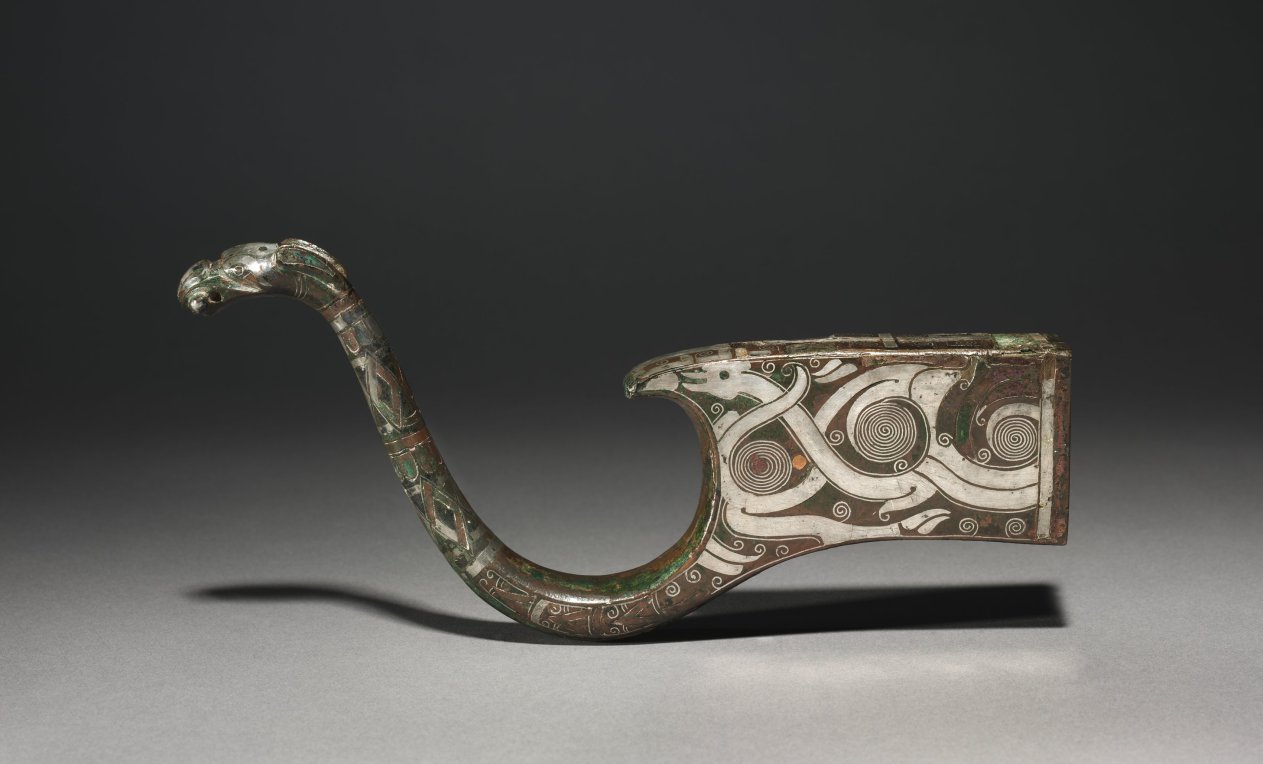
Crossbow Support emerges at the intersection of these two vectors. The 2026 executive silhouette must simultaneously anchor and extend—a structured shoulder that releases into a fluid drape, a defined waist that dissolves into a linear hem. The crossbow metaphor is precise: the limbs of the bow store compressive energy while the string distributes tensile force across the arc. Our prototypes achieve this through a dual-construction blazer: a canvassed shoulder and upper chest (dormant vector) married to an unlined, bias-cut lower panel (ascendant vector). The seam line between them is not a resolution but a hinge—the point at which the garment's two temporalities meet.
III. Color: Slate as the Chromatic Register of Suspension
Vermeer's palette in A Maid Asleep is a study in attenuated warmth—ochres and umbers muted by shadow, reds desaturated into the brown of the wine glass. He Xiangu's palette is attenuated coolness—mineral greens, pale silks, the blue-grey of distant cloud. Neither work commits to saturation; both operate in the register of the intermediate. Slate is the chromatic synthesis of these two attenuations: a blue-grey that carries the coolness of the immortal's sky and the shadow-density of the maid's interior. It is neither warm nor cold but structurally neutral—a color that reads as depth rather than hue.
In the executive wardrobe, Slate functions as a chromatic hinge parallel to the formal hinge described above. It absorbs light at the shoulder (where the canvassed construction creates shadow) and reflects it at the hem (where the bias-cut silk catches ambient light). The result is a garment that shifts tonally across the body—not through print or gradient, but through the interaction of surface and structure. This is color as topography, not decoration.
IV. Application: The 2026 Executive Wardrobe
The Crossbow Support silhouette translates into three core pieces. First, the hinged blazer: structured shoulder, floating hem, Slate wool-silk blend with a matte finish that suppresses reflection at the top and permits it at the base. Second, the suspended trouser: a high-rise, wide-leg cut in Slate crepe, with a waistband that sits above the natural waist to create the ascendant line, and a hem that breaks just above the floor to preserve the dormant weight. Third, the transitional shell: a collarless, knee-length layer in Slate technical silk, cut with a single diagonal seam that runs from the left shoulder to the right hem—a literal crossbow line that divides the garment into dormant and ascendant zones.
The wardrobe is not a collection of separates but a system of states. Each piece is designed to be worn in combination, and the combinations produce different ratios of dormancy to ascendance. A full Slate ensemble reads as suspended stillness; a Slate blazer over an Ivory shell reads as ascendant motion checked by a dormant frame. The executive controls her own temporal register through composition.
V. Conclusion: The Ethics of the Suspended Silhouette
Both Vermeer and the He Xiangu painter ask the viewer to consider what it means to be between states—between sleep and waking, between earth and sky. The Crossbow Support silhouette asks the same of the wearer. It is not a garment of action or of rest but of poised potential—the moment before the crossbow releases, when both limbs are bent and the string is taut. In the context of the 2026 executive wardrobe, this is the only honest silhouette: a form that acknowledges the executive's dual condition as both anchored operator and ascendant strategist, and refuses to resolve the tension between them.