Urban Form: Heroic Head of Pierre de Wissant, One of the Burghers of Calais
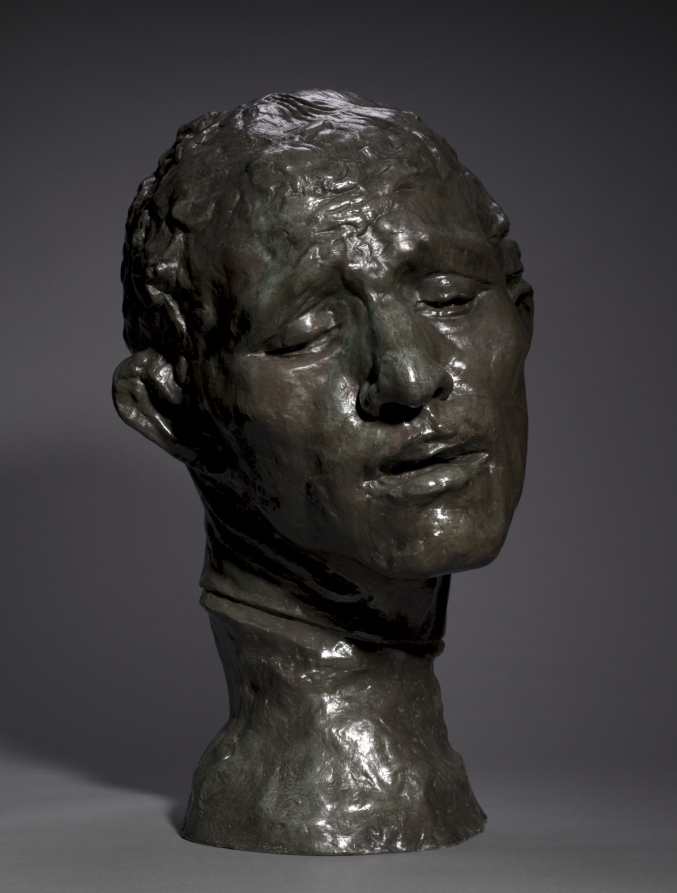
Urban Silhouette Research: The Heroic Head of Pierre de Wissant as Minimalist Armature
I. Formal Deconstruction: The Head as Structural Proposition
Rodin's Heroic Head of Pierre de Wissant—the isolated cranium from the Burghers of Calais ensemble—operates in our research not as a portrait but as a geometric thesis. Stripped of its civic narrative and its body, the head resolves into a closed system of planes: the frontal mass, the temporal recession, the occipital curve. What concerns Addison Fashion is the compression of volume into silhouette. The sculpture demonstrates how a form of considerable mass can be read as a single, decisive contour when the interior modeling is subordinated to an exterior boundary. This is the governing principle of the 2026 executive wardrobe: mass without bulk, presence without ornament.
The head's surface is not smooth; it is faceted by emotion. Rodin leaves the brow, the cheekbone, and the jaw as distinct planes that catch and refuse light in alternation. Translated to garment architecture, this suggests paneled construction—seams that function as structural hinges rather than decorative gestures. A shoulder seam that articulates the deltoid plane; a yoke that registers the scapular ridge. The silhouette remains continuous, but the surface carries tectonic information. For the executive woman, this is the difference between a jacket that merely fits and a jacket that describes the body's architecture in negative space.
II. Color Logic: Slate as the Chromatic Equivalent of Patinated Bronze
The patina of the Wissant head—that oxidized, blue-grey bronze—provides our chromatic anchor. Slate, in the Addison vocabulary, is not a neutral. It is a temperature-bearing grey with sufficient blue undertone to read as deliberate rather than default. Against the New York grid—limestone, glass, wet asphalt—Slate functions as chromatic camouflage with authority: it neither competes with the urban field nor dissolves into it. It holds its edge.
In the 2026 wardrobe, Slate operates across three value registers. At the darkest register, it approximates Onyx and serves the evening tailoring—a double-faced wool coat, a column dress in bonded crepe. At the mid-register, it becomes the daylight uniform: the architectural blazer, the wide-leg trouser in wool-silk suiting. At the lightest register—a Slate washed toward Silver—it serves the transitional layer: the tissue-weight trench, the collarless shirt in washed silk. The discipline lies in monochromatic continuity: a single hue, three values, no interruption. This is the chromatic analogue of Rodin's surface: variation within a closed system.
III. The Eastern Corollary: Ikkyū's Brush and the Wabi-Sabi of Executive Dress
The DNA source invokes Ikkyū Sōjun's Three-Phrase Teaching Poem and the Tiled Inkstone Inscription—two objects that privilege process over product and trace over monument. Ikkyū's brushwork, in its refusal of polish, records the velocity of the hand. The inkstone, in its acceptance of wear, records the duration of use. Both objects propose an aesthetic of controlled imperfection that the Addison 2026 wardrobe absorbs as a material philosophy.
This manifests in fabric selection. We specify dry-handle wool—a suiting cloth with minimal finish, whose surface registers the weave and the occasional slub. We specify washed silk that holds a memory of crease. We specify bonded cotton whose matte face refuses the sheen of performance fabrics. These are materials that age visibly and gracefully, that record the wearer's movement and time. The executive wardrobe, in this reading, is not a uniform of permanence but a ledger of use—a garment that becomes more specific to its wearer with each season, not less.
IV. Silhouette Translation: From Cranium to Coat
The Wissant head's most transferable formal property is its tapered closure. The skull narrows toward the crown; the jaw narrows toward the chin. The silhouette is bidirectional—it converges from both ends toward a central mass. In tailoring, this translates to the cocoon-adjacent coat: a garment that is generous at the shoulder and the hem but disciplined at the waist, not through cinching but through pattern engineering. The side seam curves; the back panel is cut on a slight bias; the front closes with a single concealed placket. The result is a silhouette that reads as a single gesture—the way the head reads as a single volume—while containing sufficient internal structure to support the body's movement.
For the executive woman in 2026, this means outerwear as primary architecture. The coat is not a layer over the look; it is the look. Beneath it, the interior pieces—the column dress, the narrow trouser, the collarless shirt—operate as negative space, the void that gives the silhouette its definition. This is the Rodin principle inverted: the head is solid, the body is void; the coat is solid, the interior is void. The relationship between the two generates the visual energy.
V. Conclusion: The Minimalist Mandate
The Heroic Head of Pierre de Wissant, read through the lens of Ikkyū's brush and the inkstone's wear, yields a Minimalist program for Addison Fashion: Slate as chromatic discipline, paneled construction as tectonic honesty, dry-handle materials as temporal record, and outerwear as primary silhouette. The 2026 executive wardrobe, in this formulation, is not a statement of arrival but a register of process—a garment that, like the patinated bronze, holds its form while admitting its history. This is the urban silhouette: cold in its clarity, warm in its wear.