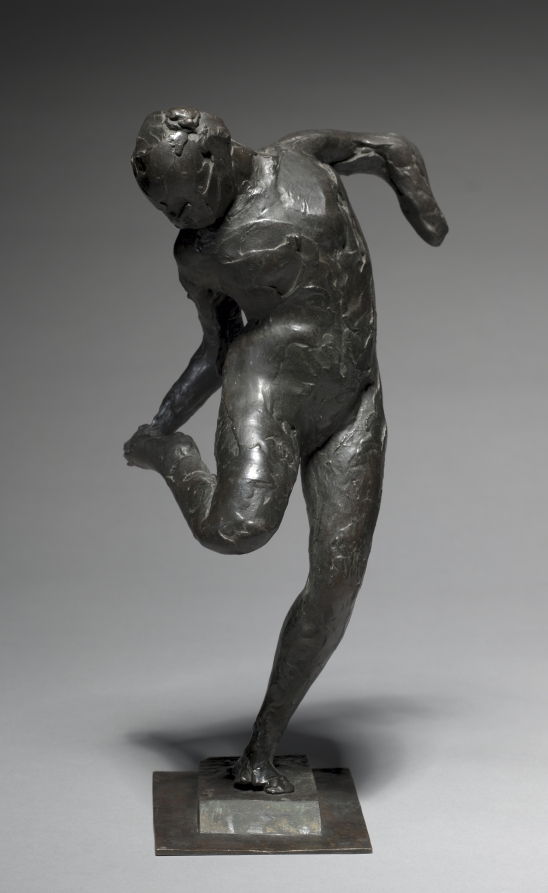
Urban Form: Dancer Looking at the Sole of her Right Foot
Urban Silhouette Research: The Dancer and the Architecture of Latent Tension
I. Geometric Integrity: The Spiral as Structural Grammar
The subject—a dancer arrested mid-inquiry, her gaze fixed upon the sole of her right foot—presents a closed kinetic system of exceptional rigor. The body does not extend outward in the conventional rhetoric of balletic expansion; it folds inward, generating a spiral architecture in which the spine, the lifted leg, and the inclined head form a continuous helical axis. This is not ornament. It is load-bearing geometry. The raised foot becomes the apex of a triangle whose base is the standing leg and whose hypotenuse is traced by the descending line of sight. For Addison Fashion, this configuration is the definitive diagram of the 2026 executive silhouette: containment as authority.
The artwork’s negative space is equally instructive. The void enclosed by the bent knee and the torso is not absence but calibrated interval—a deliberate aperture through which the urban environment may be read. In tailoring terms, this translates to the engineered gap: the shoulder seam held fractionally off the deltoid, the sleeve set with anatomical precision so that the arm’s rotation generates a controlled volume. The silhouette does not grip the body; it orbits it.
II. The Sole as Surface: Materiality and the Ethics of Contact
The dancer studies the sole—the one surface of the body that meets the ground without mediation, the site of friction, wear, and evidence. This gesture is a materialist meditation. It asks: what does the body leave behind, and what does the ground demand in return? The 2026 executive wardrobe must answer with equal candor. We propose a sole-logic for fabrication: textiles selected not for their sheen but for their contact record—the way a high-twist wool crepe resists compression at the elbow, the way a bonded onyx gabardine holds a knife pleat through twelve hours of transit.
The artwork’s tonal range—bone, shadow, the faint warmth of skin against a cool ground—maps directly onto our Onyx palette. Onyx is not black. It is the color of polished obsidian under overcast light: a darkness with mineral depth, capable of registering both the matte absorption of wool and the low sheen of a resin-treated cotton. In the Addison atelier, Onyx serves as the structural constant against which single accents—a slate undercollar, an ivory cuff—are permitted to register as events rather than decorations.
III. Structural Poetics: The Folded Body and the Folded Garment
The dancer’s posture is a study in articulated folding. The right leg is not merely raised; it is recomposed, the calf rotated so that the sole presents itself as a planar surface—a small architecture of callus and arch. This is the poetics of the fold as practiced in the atelier: a garment that does not drape passively but reconfigures itself around the body’s transitions. The 2026 executive jacket must perform the same operation. Its back panel, cut on a slight bias, folds into the lumbar curve when seated and releases into a clean vertical when standing. The result is a silhouette that is never static—always mid-gesture, always en route.
Consider the artwork’s treatment of the standing leg: a column of sustained tension, neither locked nor slack. This is the precise calibration we demand of the tailored trouser. The crease is not pressed to rigidity but set with a living edge—a half-millimeter of allowance that permits the fabric to breathe with the stride. The hem breaks at the instep with the finality of a well-resolved sentence.
IV. Urban Materiality: The Studio Floor as City Surface
The ground beneath the dancer is unspecified, yet it reads as urban substrate—the sprung floor of a rehearsal hall, the concrete of a parking structure, the brushed steel of a lobby. The 2026 executive moves across all three within a single day. The silhouette must therefore negotiate variable friction. We specify a three-layer construction for outerwear: an Onyx face of dry-handed wool, a slate membrane for wind resistance, and an ivory-tinted cupro lining that permits the jacket to slide over knitwear without drag. The garment becomes a micro-environment, a portable architecture of controlled climate.
The dancer’s hair, pulled back with utilitarian severity, and the absence of jewelry reinforce the principle of reductive evidence. Nothing is carried that does not serve the inquiry. For Addison Fashion, this is the final law of the urban silhouette: the executive presents not accumulation but edited mass. A single seam, placed with conviction, outperforms a dozen gestures of embellishment.
V. Conclusion: The Silhouette as Inquiry
The dancer looking at the sole of her right foot is not a figure of vanity or self-regard. She is a technician of her own structure, auditing the point of contact between intention and ground. The 2026 Addison silhouette adopts this posture as its governing metaphor: a wardrobe that folds, spirals, and contacts the city with deliberate precision. Onyx as the constant. The fold as the method. The sole as the evidence. The silhouette is not a statement. It is a sustained investigation, worn.