Urban Form: Architecture of the Middle Ages: Screen in St. Jacques, Dieppe
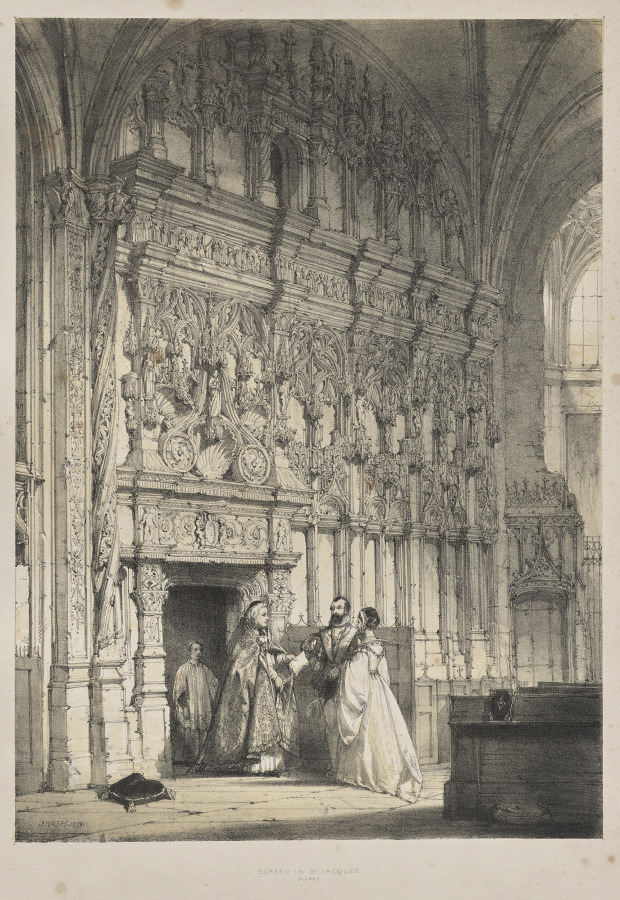
Geometric Integrity: The St. Jacques Screen as a Structural Paradigm
The Screen in St. Jacques, Dieppe, is not merely an artifact of medieval ecclesiastical craft; it is a treatise on verticality, containment, and the dialectic between void and mass. Its stone tracery, carved into rigid, repetitive lancets and quatrefoils, establishes a geometric integrity that transcends its religious context. For Addison Fashion’s 2026 executive silhouette, this screen provides a definitive model for architectural dressing—a system where the body becomes a load-bearing structure, and fabric is treated as a series of interlocking, non-negotiable planes.
The screen’s primary gesture is one of vertical ascension. The pointed arches, stacked in rhythmic succession, create a visual spine that pulls the eye upward, denying horizontality. This is the foundational principle for the 2026 silhouette: a lengthened, columnar torso achieved through precise shoulder construction and a suppressed waist. The jacket, cut from a dense, matte wool-silk blend in Slate, must mimic the stone’s weight and stillness. Its shoulder line is not padded but sculpted—a sharp, angular extension that mirrors the screen’s corbels. The lapel is a straight, unbroken line from collar to hem, a direct translation of the screen’s vertical mullions. There is no concession to the body’s curve; the silhouette is a rigid frame within which the wearer moves, not a garment that moves with the wearer.
Structural Poetics: The Logic of the Lancet
The screen’s lancet windows are not decorative; they are load-bearing voids. Each arch is a structural necessity, distributing the weight of the stone above. This logic of functional emptiness is critical to the urban materiality of the 2026 executive. The garment must incorporate negative space as a structural element. Consider a sleeveless, high-neck top worn beneath the jacket: the armholes are cut high and tight, creating a void that visually lightens the upper body while maintaining the jacket’s architectural mass. The neckline is a stark, horizontal band—a transom—that separates the head from the torso, echoing the screen’s horizontal string courses. This is not a neckline for adornment; it is a cut, a deliberate interruption of the vertical flow.
The materiality of the screen—weathered, unpolished stone—dictates the fabric’s finish. The Slate wool must be felted, its surface dense and matte, absorbing light rather than reflecting it. This is a tactile silence, a refusal of luster that aligns with the screen’s austere presence. Seams are not hidden; they are exposed and reinforced, like the joints between stone blocks. A single, topstitched seam runs down the center back of the jacket, a structural spine that anchors the entire form. Pockets are eliminated; any pouch would disrupt the clean, monolithic surface. The garment is a shell, not a container.
Urban Materiality: The Dialectic of Rigidity and Flow
The screen’s tracery, while rigid, is not static. The carved stone creates a rhythm of light and shadow as the sun moves across its surface. This dynamic is translated into the 2026 silhouette through controlled drape. The trousers, for instance, are cut with a straight, narrow leg that falls from the hip without break, mimicking the screen’s vertical piers. Yet, the fabric—a heavy, fluid crepe in the same Slate tone—is allowed to pool slightly at the hem, creating a single, soft fold. This is the only concession to movement, a shadow line that echoes the screen’s carved recesses. The waistband is a flat, wide band of stiffened silk, a horizontal element that anchors the vertical fall of the fabric, much like the screen’s base plinth.
The color Slate is chosen for its chromatic neutrality and its urban camouflage. It is the color of wet pavement, of limestone facades, of the city’s hard edges. It is not a color of warmth or comfort; it is a color of presence and permanence. The entire ensemble—jacket, top, trousers—is monochromatic, creating a single, unbroken volume. This is the ultimate expression of the screen’s geometric integrity: the body is not dressed; it is encased in a unified architectural envelope.
Conclusion: The 2026 Executive as a Walking Facade
The Screen in St. Jacques, Dieppe, teaches that true structural poetics lies in the honesty of construction. Every arch, every mullion, every void has a purpose. For the 2026 executive silhouette, this translates into a wardrobe of essential, irreducible forms. The jacket is a buttress; the trouser is a pier; the top is a void. There is no ornament, no gesture toward softness. The wearer becomes a mobile facade, a figure of urban authority whose silhouette is defined not by the body’s anatomy, but by the geometric laws of architecture. This is the definitive urban silhouette for the executive who understands that power is not expressed through volume, but through the precision of containment.