Urban Form: Overmantel Decoration
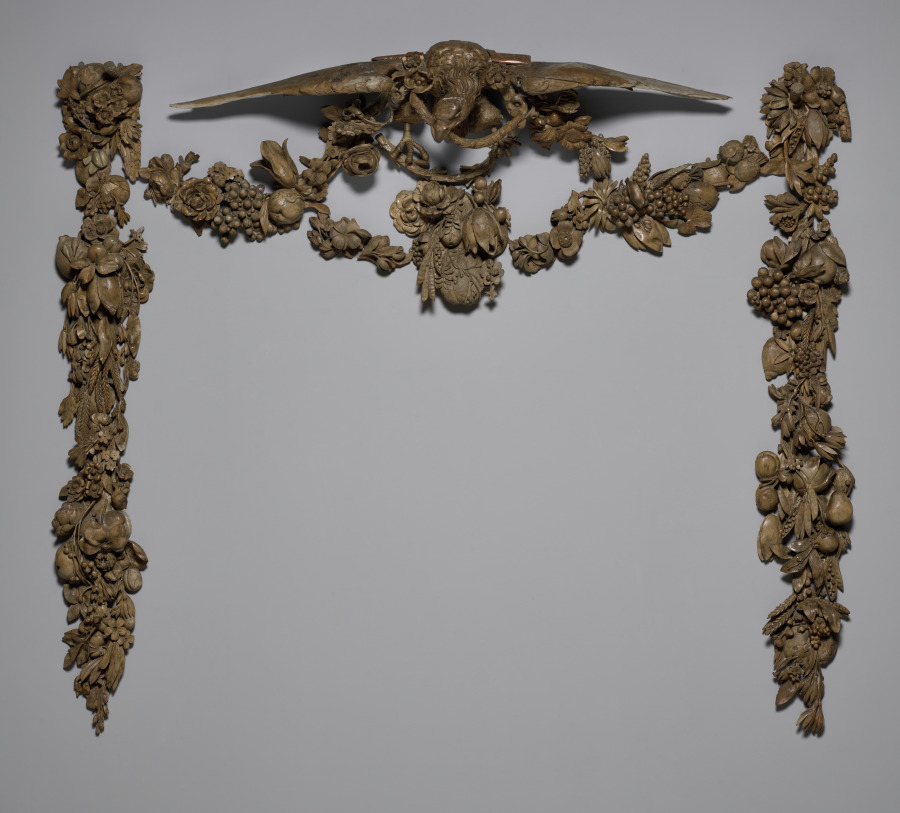
Urban Silhouette Research: Overmantel Decoration as Structural Precedent
I. The Overmantel as Compositional Artifact
The overmantel—that architectural zone suspended above the hearth—operates as a liminal register within the domestic interior. It is neither wall nor furniture, neither ornament nor structure, but a threshold surface where the vertical logic of the room resolves into a focal plane. For the 2026 executive wardrobe, this register offers a precise analytical model: a bounded field in which form must achieve maximum expressive density within strict spatial constraints. The overmantel does not permit excess. It demands that every gesture—every carved volute, every tonal shift—justify its occupancy of the plane. This is the governing discipline of the Addison silhouette: compression as authority.
II. Form: The Closed Geometry of Interiority
The Pilgrim Sudhana figure establishes a formal principle we designate centripetal closure. The body resolves into a near-complete geometric volume—shoulders rounded, drapery continuous, the silhouette reading as a self-sufficient mass rather than an open gesture. Light does not strike this form; it permeates it, producing a diffuse halo that reads as internal rather than reflected. Translated to tailoring, this yields the sealed shoulder: a construction in which the sleeve head is set without external padding, the armhole curve continuous with the torso line, and the garment's outer contour unbroken by hardware or seam disruption. The executive jacket, in this register, becomes a closed volume—a monolith of wool or bonded crepe that communicates containment rather than reach.
Contrast the Harpist's rhythmic triangulation: the arm, the instrument, and the torso forming an open, dynamic S-curve that implies continuation beyond the frame. This is the counter-principle—latent kineticism—and it governs the lower body and the accessory plane. Where the torso seals, the trouser must suggest motion arrested: a tapered leg with a single forward break, a hem that hovers rather than pools. The overmantel composition, read correctly, is a negotiation between these two logics—closure above, potential below.
III. Color: The Slate Register and Chromatic Restraint
The Sudhana palette is monochromatic and material-derived: ivory, warm brown, the muted glaze of fired clay. Color here is not applied but inherent—a property of substance rather than surface. The Harpist's red-figure binary—ochre against black—operates by contrast rather than modulation, defining volume through opposition. The Addison synthesis for 2026 is Slate: a blue-grey of low chroma and high value-stability that functions as both ground and figure. Slate absorbs light at the shoulder and releases it at the lapel edge, producing the internal luminosity we associate with the Sudhana glaze without recourse to sheen. It is a color that refuses ornamentation—no contrast stitching, no tonal piping—because its authority derives from uniformity of surface. Against Slate, the only permissible accent is Onyx at the closure point: a single button, a zip pull, a belt edge. This is the red-figure principle reduced to its minimum viable expression—one chromatic event per garment.
IV. The Overmantel Translated: 2026 Wardrobe Architecture
The overmantel's structural lesson is framed emptiness. The decorative field is bounded by molding; within that boundary, negative space carries equal weight to carved relief. Applied to the executive wardrobe, this produces the framed plane jacket: a clean rectangular torso bounded by a defined shoulder line and a straight hem, with the interior field left unarticulated—no darts visible, no pocket flaps, no vent disruption. The garment reads as a single compositional unit, its authority residing in the precision of its boundaries rather than the density of its detail.
Beneath this framed plane, the Harpist's kinetic logic operates in the columnar trouser: a straight leg of identical Slate cloth, crease pressed to a knife edge, hem terminating at the ankle bone with mathematical exactness. The two elements—sealed torso, potential leg—form the overmantel's own duality: the static register above, the implied motion below. Accessories recede to the threshold: a Slate leather portfolio, an Onyx-banded timepiece, footwear in matte calf that reads as shadow rather than shine.
V. Conclusion: The Discipline of the Bounded Field
The overmantel teaches the executive wardrobe its most necessary lesson: that authority is a function of containment, not accumulation. The 2026 Addison silhouette is a closed geometric proposition in Slate—a garment that occupies its spatial field with the deliberateness of a carved relief, permitting no gesture that does not resolve into the whole. In an urban environment of visual noise, the overmantel logic offers the executive a form of sartorial silence: a bounded, luminous, self-sufficient plane. This is not minimalism as absence but minimalism as compression—the maximum of presence achieved through the minimum of means.