Urban Form: Portrait of Philip II, King of Spain
Urban Silhouette Research: Structural Poetics of the Portrait of Philip II, King of Spain
I. The Armor as Architectural Armature
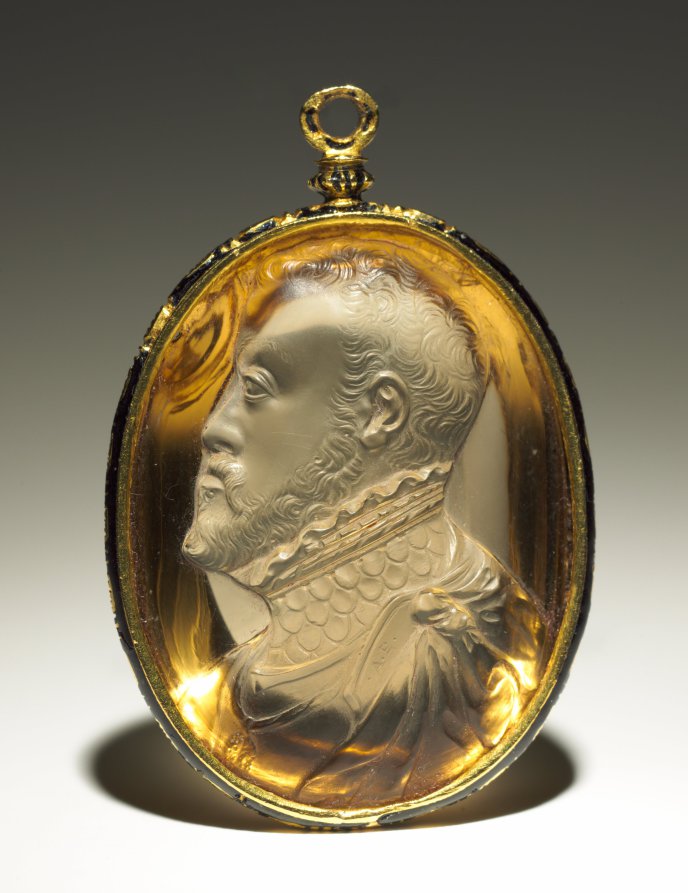
The Portrait of Philip II presents a sovereign encased in a rigid, articulated shell—a half-armor of polished steel that functions less as protective garment than as exoskeletal architecture. The geometric integrity of the piece resides in the tension between the body's organic volume and the armor's engineered planes. The breastplate is not a smooth dome but a faceted topography: a central ridge descends from the gorget to the waist, dividing the torso into two symmetrical convex quadrants that catch light along their medial seam. This is the load-bearing spine of the silhouette—a vertical axis that organizes every subsequent element, from the pauldron's segmented curvature to the tasset's horizontal banding. For the 2026 executive, this translates into a tailored shoulder line that is neither padded nor softened but structurally resolved: a single, continuous seam that traces the deltoid's arc and terminates in a precise, unornamented cap. The armor's articulation—the overlapping lames at the elbow and knee—offers a model for modular tailoring, wherein each garment component is a discrete geometric unit that locks into the next without visual interruption.
II. The Gorget and the Vertical Throat
The gorget—that crescent-shaped collar rising to the jaw—is the portrait's most aggressive geometric gesture. It creates a truncated cone around the neck, forcing the head into a columnar relationship with the torso. The silhouette is thus tripartite: a horizontal base (the waist), a vertical shaft (the torso), and a terminal sphere (the head), all mediated by the flaring lip of the gorget. This is the architectural logic of the plinth and the capital, applied to the human figure. For 2026, the executive collar must achieve the same cold precision: a stand collar or high-necked shell that does not drape but erects, creating a clean, unbroken vertical from shoulder to jawline. The material must be onyx-dense—a double-faced wool or bonded cashmere that holds its shape without visible stiffening. The throat is not exposed; it is framed.
III. The Pauldron as Cantilevered Plane
The left pauldron—three overlapping plates—demonstrates the principle of cantilevered volume. Each plate projects outward from the shoulder joint, creating a stepped, aerodynamic profile that widens the upper body without adding bulk. The geometry is additive but not accumulative: each layer is thinner and shorter than the one beneath, producing a tapered, wing-like silhouette that suggests motion even in stillness. This is the urban poetics of the overhang—the awning, the balcony, the projecting cornice. For the 2026 executive, the shoulder must be extended but not exaggerated: a dropped shoulder seam that sits two centimeters beyond the acromion, combined with a single, knife-edge pleat at the sleeve head, creates the same layered, forward-leaning profile. The fabric—slate-grey technical wool—must be bonded to a micro-mesh to maintain the crisp, architectural edge without weight.
IV. The Tasset and the Horizontal Rhythm
Below the waist, the tassets—articulated lames of steel—introduce a horizontal counter-rhythm to the vertical torso. Each lame is a shallow arc, parallel to the ground, creating a stacked, sedimentary geometry that anchors the figure. The silhouette is thus tensioned between the vertical and the horizontal: the torso ascends, the hips stratify. This is the urban grid—the floor plate and the elevator shaft. For 2026, the executive lower body must adopt this stratified logic: a straight, narrow trouser with a single, horizontal crease at the knee, or a box-pleated skirt whose folds are pressed to a knife-edge and spaced at regular intervals. The waist is not cinched but demarcated by a flat, wide belt of onyx leather—a horizontal datum line that separates the vertical torso from the horizontal hip.
V. Materiality and the Onyx Palette
The portrait's surface is cold, reflective, and non-porous—the steel is burnished to a high sheen, the velvet is deep and light-absorbing. The chromatic restraint is absolute: black, silver, and the faintest warm grey. This is the onyx discipline—a palette that refuses ornament and relies on surface variation for visual interest. The 2026 executive wardrobe must adopt this monolithic materiality: onyx-black wool with a dry, matte hand; gunmetal hardware that is functional and flush; leather that is ungrained and lacquered. The silhouette is not decorated; it is engineered. Every seam is a structural joint, every fold a load-bearing crease. The geometric integrity of the portrait lies in its refusal of the organic—the body is contained, not revealed. For Addison Fashion, the 2026 executive silhouette is a portable architecture: minimalist in surface, maximalist in structure, and utterly cold in its precision.