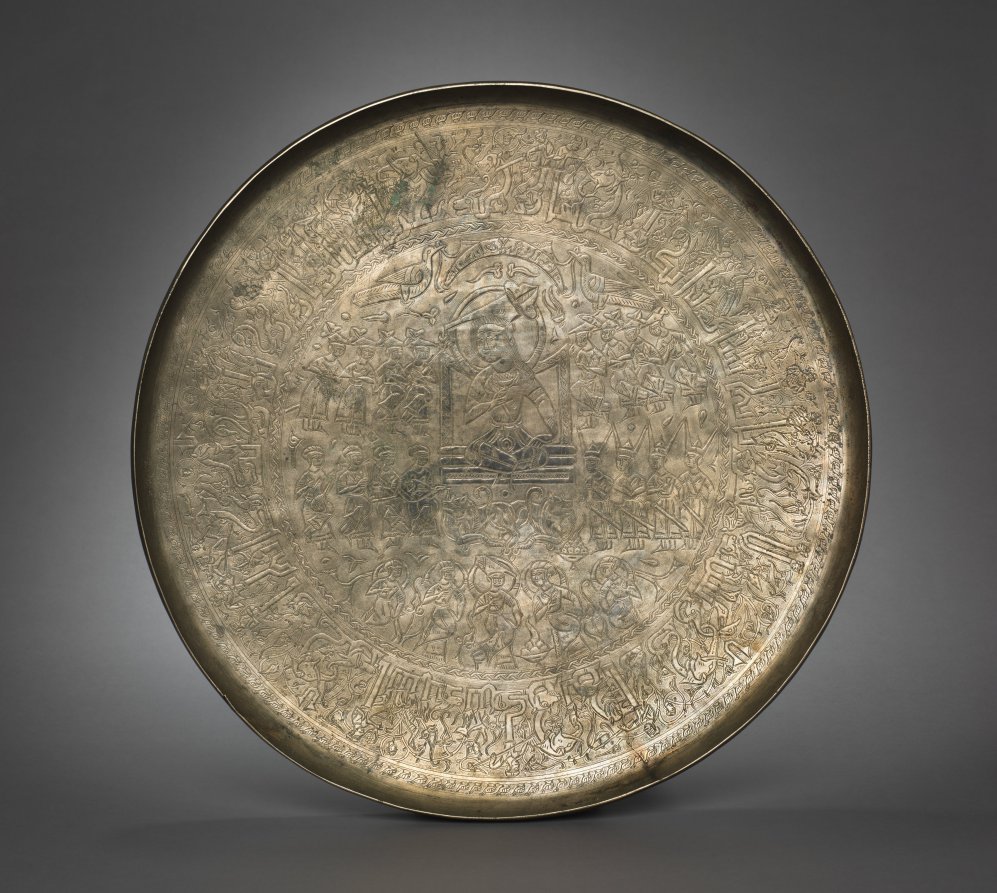
Urban Form: Salver
Urban Silhouette Research: Structural Poetics of the Void
I. Geometric Integrity: The Architecture of Absence
The Salver artifact presents a dual geometric proposition that demands rigorous formal analysis. The “Udumbara Flowers” plaque operates on a principle of compressed planar density—its carved surface generates a labyrinthine topography of overlapping petal-forms that refuse resolution at any single viewing angle. The geometry here is not additive but subtractive: the artisan removes material to create the illusion of accumulation, a paradox that establishes the plaque as a study in negative volume. The edge erosion and lacquer depletion are not flaws but temporal registrations—the geometry of wear itself becomes a structural element, introducing an irregular perimeter that destabilizes the rectangle’s authority.
The “Cup and Stand”瓷杯 advances a counter-geometric logic: radial symmetry under compression. The eggshell-thin body tapers to a rim that curves inward—a gesture of containment that refuses the open cylinder. The stand’s wide, lotus-form base distributes weight across a horizontal plane while the cup’s verticality remains deliberately fragile. The geometric integrity of this pairing resides in the tension between the plaque’s planar complexity and the cup’s volumetric simplicity—one accumulates visual information through surface, the other through silhouette. Together they define a spatial dialectic: the wall-mounted rectangle versus the pedestal-supported circle, the carved versus the thrown, the opaque versus the translucent.
II. Structural Poetics: The Executive Silhouette as Vessel
For the 2026 executive wardrobe, the Salver’s dual geometry translates into a silhouette of deliberate contradiction. The plaque’s carved density informs a new approach to surface treatment: textural layering that reads as monolithic from a distance but reveals micro-complexity upon inspection. Consider a slate wool overcoat whose surface is bonded with a laser-cut lattice—the pattern echoing the Udumbara’s petal-scrolls—yet the overall line remains a clean, unbroken rectangle from shoulder to hem. The executive does not wear decoration; the executive wears compressed information.
The cup’s geometry, meanwhile, dictates the interior architecture of the garment. The rim’s inward curve—that gesture of reception—becomes the collar’s precise stand, a minimal funnel that frames the neck without touching it. The stand’s wide base translates into a flared hem or a structured peplum that distributes visual weight downward, anchoring the figure. The key principle is capacity without bulk: the silhouette must appear hollow, ready to receive, yet structurally resolved. A slate-grey tailored jacket with a stand collar and a gently flared back panel achieves this—the front remains planar and severe, the back introduces a subtle radial volume that suggests the cup’s lotus-base geometry.
III. Urban Materiality: Slate as Sacred Surface
The Salver’s materiality—aged wood, depleted lacquer, eggshell porcelain, jade-like glaze—speaks to a material hierarchy of restraint. For Addison’s 2026 output, slate emerges as the governing color and texture: not the slate of roofing tiles but the slate of weathered stone steps leading to a temple—a grey that absorbs light rather than reflecting it, that registers touch through subtle sheen variations. The fabric vocabulary must mirror the cup’s translucency under opacity: a double-faced wool that appears solid but reveals a lighter inner layer at the cuff and hem; a bonded jersey with a matte exterior and a faintly lustrous interior, visible only when the garment moves.
The plaque’s temporal erosion suggests engineered irregularity—not distressed finishes but precision-cut edges that fray by design. A slate trench coat with laser-sealed seams that release into a controlled fringe at the hem, or a knitwear piece whose ribbing dissolves into loose threads at the wrist, both cite the Udumbara’s paradox of permanence-through-decay. The urban environment demands this material intelligence: garments that register time without deteriorating, that perform the sacred act of self-effacement while remaining structurally impeccable.
IV. Synthesis: The Void as Executive Armor
The Salver’s deepest lesson for the 2026 silhouette is the functionalization of emptiness. The plaque carves away wood to create flowers that are not there; the cup hollows itself to receive what cannot be named. The executive garment must do the same: remove the unnecessary to create capacity for presence. This means no visible closures—magnetic seams, concealed plackets, internal structure that holds the line without external hardware. It means pockets that disappear into seams, collars that stand without interfacing bulk, hems that float rather than fall. The slate palette enforces this discipline: no contrast, no distraction, only the geometry of the body in conversation with the geometry of the cloth.
The final proposition is architectural silence. The Addison executive for 2026 wears a silhouette that is simultaneously a plaque and a cup—a carved surface of compressed detail and a hollow volume of infinite reception. The urban environment is the temple; the garment is the offering; the body is the void that gives it meaning. Slate is the color of that void made visible—not absence, but the precise geometry of readiness.