Urban Form: Seated Buddha (sculpture)
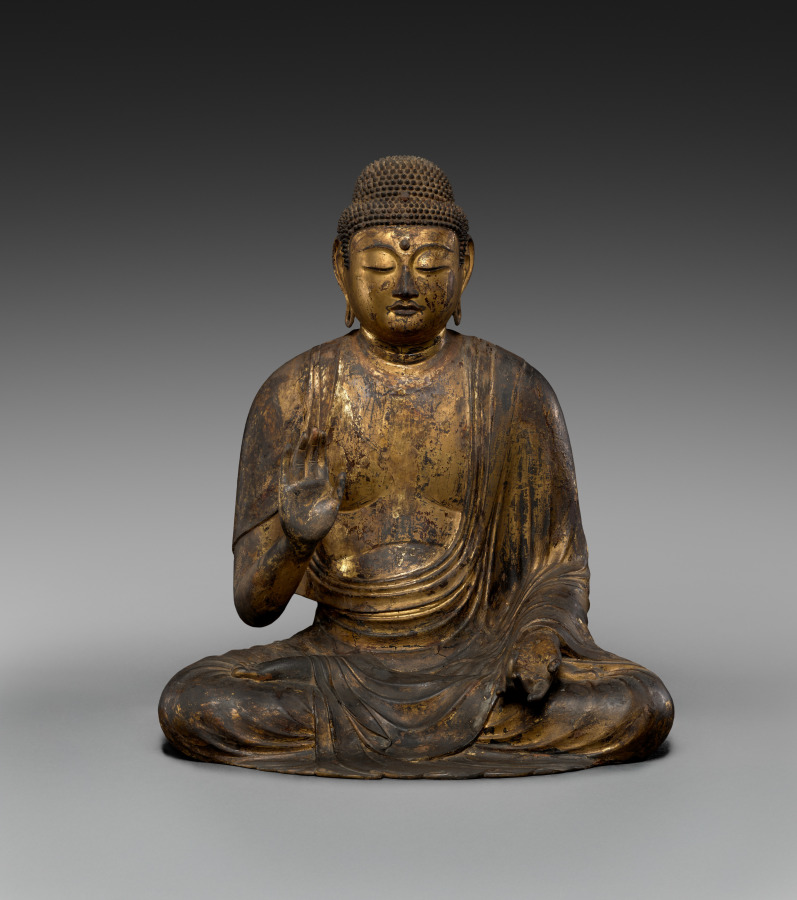
Urban Silhouette Research: The Seated Buddha as Structural Prototype
Preliminary Observation: The Artifact as Architectural Proposition
The Seated Buddha presents itself not as devotional object but as a closed geometric system. Its mass is resolved through a rigorous triangulation: the broad, horizontal plinth of the crossed legs, the ascending taper of the torso, and the stabilizing apex of the cranial form. This is a silhouette governed by load-bearing logic. The drapery does not soften the structure; it articulates it, folding across the body in a manner that recalls the pleated surfaces of brutalist concrete. For Addison Fashion, the sculpture functions as a primary document—a seated architecture whose proportions anticipate the 2026 executive posture.
Geometric Integrity: The Tripartite Column
The sculpture's geometry is fundamentally tripartite, and this tripartition is the operative principle for the coming season's tailoring. First, the base: a wide, low center of gravity that anchors the figure to the ground plane. In garment terms, this translates to a dropped, weighted hemline and a widened shoulder-to-hip ratio that refuses the wasp-waist conventions of prior decades. Second, the torso: a subtle inward compression at the waist, not as an hourglass gesture but as a structural necessity—the point where vertical load transfers to horizontal support. Third, the head and shoulders: a squared, unyielding upper register that reads as a capital upon a column.
The 2026 executive silhouette will adopt this tripartite logic without ornament. Jackets will be cut with a monolithic front panel, the closure concealed, the lapel reduced to a single folded plane. The shoulder will not be padded into aggression but built into a flat, architectural shelf—a direct quotation of the Buddha's squared deltoid line. Trousers will mirror the plinth: wide, hem-weighted, and devoid of break or taper. The result is a silhouette that does not follow the body but houses it.
Structural Poetics: The Fold as Load Path
What distinguishes this sculpture from mere mass is the intelligence of its surface. The drapery folds are not decorative; they are load paths made visible. Each crease descends from shoulder to lap in a continuous, unbroken trajectory, distributing visual weight across the figure's front plane. This is the poetics of structural honesty—the garment, like the stone, must declare how it stands.
For Addison Fashion, this demands a reconsideration of seam placement. The 2026 collection will expose the load path: a single continuous seam from the shoulder point to the hem, pressed flat and left raw at the edge. Darts will be eliminated in favor of geometric paneling that mimics the Buddha's folded drapery—each panel a planar facet, each junction a structural hinge. The urban materiality here is not textile as soft covering but textile as cast surface: bonded wool, resin-treated cotton, and double-faced cashmere pressed into rigid planes. The hand of the fabric must resist, not yield.
Urban Materiality: Stone, Bronze, and the Weight of the City
The sculpture's material presence—whether stone or bronze—is absolute. It occupies space without apology. This is the materiality the 2026 executive requires: garments that hold their own volume in the vertical canyon of the city. The Addison wardrobe will favor surfaces that absorb light rather than reflect it: onyx-dyed wool, slate-grey gabardine, and unpolished silver hardware. The palette is mineral, not metallic.
Crucially, the sculpture's surface is weathered but not eroded. Its edges remain crisp; its planes remain legible. This is the balance Addison Fashion will pursue—a materiality that records time without losing geometry. Bonded seams, laser-cut edges, and compressed felt will produce garments that read as carved rather than sewn. The urban environment is abrasive; the 2026 silhouette must be equally so, yet remain composed.
The Seated Posture and Executive Composure
Finally, the sculpture's seated attitude is its most radical proposition. It does not stride, gesture, or lean. It is grounded, frontal, and still. The 2026 executive silhouette will adopt this composure: a garment that does not chase movement but frames stillness. The wide leg, the flat shoulder, the concealed closure—these are devices of composure. They refuse the kinetic energy of streetwear and the anxious tailoring of the boardroom. They propose instead a seated authority: the body at rest, the structure intact.
In the Addison Fashion atelier, the Seated Buddha will be pinned to the wall as a working drawing. Its geometry is the pattern; its folds are the seam map; its weight is the drape. The 2026 silhouette is not designed from the figure but from the artifact—a mineral, monolithic, and utterly composed architecture for the urban executive.