Urban Form: Mourner from the Tomb of Philip the Bold, Duke of Burgundy (1364–1404)
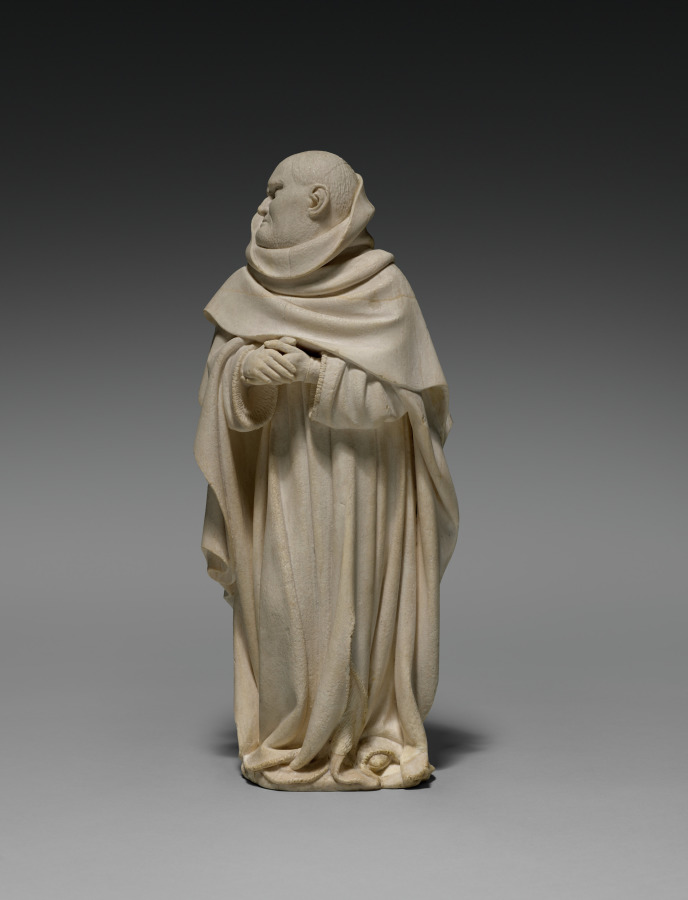
Urban Silhouette Research: The Mourner of Dijon — Form, Drapery, and the Architecture of Grief
I. Provenance and Formal Premise
The subject under analysis is a pleurant—a mourner—from the tomb of Philip the Bold, Duke of Burgundy (1364–1404), executed under the direction of Claus Sluter and his workshop for the Chartreuse de Champmol. The figure belongs to a processional frieze of some forty alabaster mourners, each cloaked in a hooded, floor-length mantle that suppresses individuation in favor of a collective, rhythmic anonymity. For the purposes of Addison Fashion NYC, the mourner is not a historical curiosity but a formal prototype: a masterclass in the subordination of anatomy to drapery, and of drapery to a single, continuous silhouette. The garment is the body; the body is the garment's interior logic. This inversion—where cloth governs structure rather than merely describing it—is the operative principle for the 2026 executive wardrobe.
II. Silhouette: The Closed Column
The mourner's silhouette is best described as a closed column with a terminal flare. From the crown of the hood to the hem, the figure presents an unbroken vertical mass. There is no waist suppression, no shoulder emphasis, no bifurcation of the leg. The volume is distributed evenly, producing a monolithic A-line that reads as architecture rather than apparel. Critically, the hood does not sit atop the head as an accessory; it merges with the shoulder line, eliminating the neck as a transitional zone. The result is a continuous cranial-to-plantar axis—a single gesture from top to bottom.
For the executive wardrobe, this translates into a columnar coat-dress or sleeveless long vest cut with a dropped shoulder and no defined waist. The neckline must be resolved as a high, integrated collar—ideally a funnel or a soft standing band—that continues the shoulder plane upward rather than interrupting it. The hem, in turn, should carry a subtle circumferential flare, achieved through godets or a bias-cut panel, so that movement generates a controlled, pendulum-like sway. The silhouette is not oversized in the streetwear sense; it is volumetrically precise—a Minimalist exercise in negative space management.
III. Drapery: The Grammar of Folds
The mourner's mantle is carved with a hieratic fold system that merits close technical reading. The folds are neither random nor purely naturalistic. They are organized into three registers: compression folds at the shoulders and elbows, where the cloth gathers under its own weight; catenary folds across the chest and back, forming shallow U-curves that distribute tension; and vertical fall folds from the hip to the hem, which establish the columnar read. The carving is deep—the folds are channeled, not modeled—creating sharp ridges and shadowed valleys that give the alabaster an almost graphic contrast.
In fabric terms, this demands a material with high bending stiffness and low drape coefficient: a double-faced wool, a bonded crepe, or a heavy silk faille. The fold system should be engineered, not improvised. Knife pleats set at 3–4 cm intervals can simulate the vertical fall register; released tucks at the shoulder seam can generate the compression register; and a shaped back yoke can produce the catenary register without visible seaming. The objective is a garment that holds its own geometry when stationary and reveals a controlled kinetic rhythm in motion—never chaotic, never limp.
IV. Color: The Onyx Discipline
The mourner's alabaster is a cool, desaturated white—a material fact that, in the Addison palette, resolves to Onyx as its chromatic inverse. Onyx is not black; it is a depth-bearing neutral with a faint mineral undertone, capable of absorbing light at the fold valleys while reflecting it at the ridges. This is the critical property: Onyx articulates form through value contrast rather than through hue. In a monochrome column, the fold system becomes the sole carrier of visual information. The executive wardrobe therefore demands tonal discipline: a single Onyx ground, with variation introduced only through surface finish—matte wool against a low-sheen satin binding, or a bonded seam that catches light at a different angle than the body cloth.
V. Application: The 2026 Executive Wardrobe
The mourner's formal logic yields three actionable directives. First, the columnar coat-dress in Onyx double-faced wool, cut with an integrated funnel collar and a godet hem, serves as the season's anchor piece—a garment that reads as a single, deliberate statement. Second, the hooded capelet—a cropped, shoulder-spanning layer that merges with the collar line—offers a modular translation of the mourner's cranial continuity, suitable for transitional layering over a columnar base. Third, the engineered fold system should be applied selectively: a knife-pleated back panel on a tailored jacket, or a released-tuck shoulder on a sleeveless vest, introducing the mourner's drapery grammar without literal costume.
The mourner is, finally, a study in restraint as authority. The figure commands attention not through ornament but through the integrity of its silhouette and the precision of its fold logic. For the Addison client—an executive operating in a visual economy of overstatement—the mourner offers a counter-proposition: that form, rigorously resolved, is the only luxury that matters. The 2026 wardrobe should be built on this premise. Onyx, columnar, engineered. Nothing more; nothing less.