Urban Form: Standing Buddha
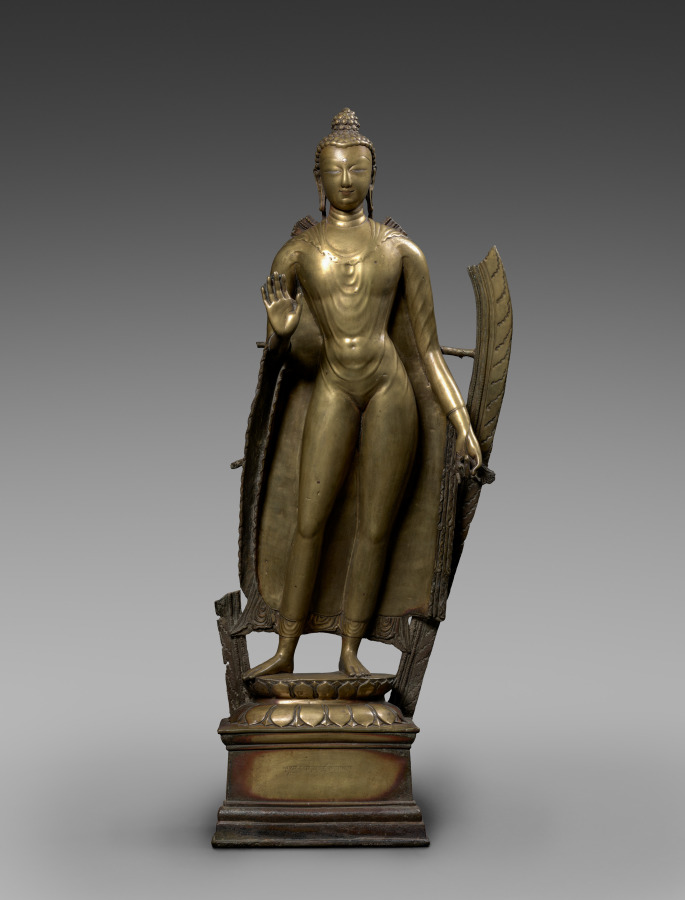
Urban Silhouette Research: Standing Buddha — Structural Poetics of the Sacred Vessel
I. The Standing Axis: Verticality as Doctrinal Geometry
The Standing Buddha presents a silhouette governed by a single, uncompromising vertical axis. This is not the relaxed contrapposto of the classical West, nor the serpentine curve of the baroque; it is an architectural column of flesh and drapery, a load-bearing element in the visual grammar of permanence. The figure’s geometry resolves into three nested volumes: the cranial dome (ushnisha) as a compressed sphere, the shoulder line as a horizontal counterweight, and the robe’s cascading folds as a series of descending, near-parallel planes. For the 2026 executive silhouette, this axis translates directly into the unbroken shoulder-to-hem line — a tailored spine that refuses interruption. The Addison wardrobe will absorb this principle as a single, continuous seam from collar to cuff, eliminating the decorative break at the waist. The result is a garment that reads as a monolith, not a garment.
II. Drapery as Negative Architecture
The robe’s folds are the artwork’s most sophisticated structural proposition. They are not soft; they are channeled grooves, carved rather than draped, each fold a shallow trough that catches shadow and releases light in strict alternation. This is materiality as rhythm — a corrugated surface that converts a static form into a kinetic field. In urban terms, this corresponds to the pleated panel and the articulated seam: a wool-cashmere blend pressed into permanent ridge lines, or a bonded leather panel scored at precise intervals to mimic the robe’s cadence. The 2026 silhouette will deploy these grooves not as ornament but as structural stiffening — folds that hold the garment away from the body, creating a controlled void between skin and shell. This void is the executive’s armor: a buffer of composed silence.
III. The Hand Gesture: Asymmetric Tension and the Broken Symmetry
The Buddha’s raised hand — the abhaya mudra of reassurance — introduces the sole asymmetry into an otherwise bilateral composition. This gesture is critical. It is a controlled rupture, a single point of directional energy that prevents the silhouette from collapsing into inert symmetry. For Addison’s 2026 tailoring, this translates into the asymmetric closure: a single offset placket, a diagonal storm flap, or a cuff that extends three centimeters beyond its counterpart. The gesture is not decorative; it is functional tension, a reminder that authority resides in the deliberate exception, not the rule. The executive silhouette must carry one such rupture — a visible, intentional deviation that signals agency.
IV. Materiality: The Patina of Authority
The Standing Buddha’s surface — whether bronze, stone, or gilded wood — is defined by patina as temporal evidence. The oxidation, the micro-abrasions, the uneven sheen: these are not flaws but credentials. They record the object’s endurance. The 2026 Addison silhouette will operationalize this through engineered patina fabrics: carbon-washed silks, mineral-dyed wools, and resin-finished cottons that carry a pre-weathered surface. The color must be Onyx — not flat black, but a black with depth, a black that absorbs and returns light unevenly, like the shadowed recesses of the robe’s folds. This is urban materiality: the garment as a weathered monument, not a pristine product.
V. The Plinth and the Void: Grounding the Silhouette
The Buddha stands upon a lotus plinth — a compressed, horizontal base that anchors the vertical mass. This base is essential to the silhouette’s stability. In tailoring, the plinth corresponds to the hem and the shoe interface: a weighted, slightly flared trouser break, or a squared, low-profile boot that reads as a foundation rather than a finishing touch. The 2026 executive will not float; they will be planted. The void between the robe’s hem and the plinth — that narrow band of negative space — is the silhouette’s breath. Addison will preserve this void through a cropped, hovering hemline on outerwear, a deliberate gap that separates the garment from the ground and insists on the wearer’s verticality.
VI. Conclusion: The Sacred Column as Executive Form
The Standing Buddha is not a figure of repose; it is a load-bearing structure of belief. Its geometry — the vertical axis, the corrugated drapery, the single asymmetric gesture, the patinated surface, the grounded plinth — constitutes a complete architectural system. For Addison Fashion’s 2026 executive silhouette, this system becomes a doctrine of minimal, monumental tailoring: garments that stand, that hold their own void, that carry the evidence of time, and that break their own symmetry with intention. The silhouette is not soft. It is not fluid. It is Onyx, Minimalist, and structurally absolute — a column of urban poetics, dressed for the long endurance.