Urban Form: Education of the Virgin
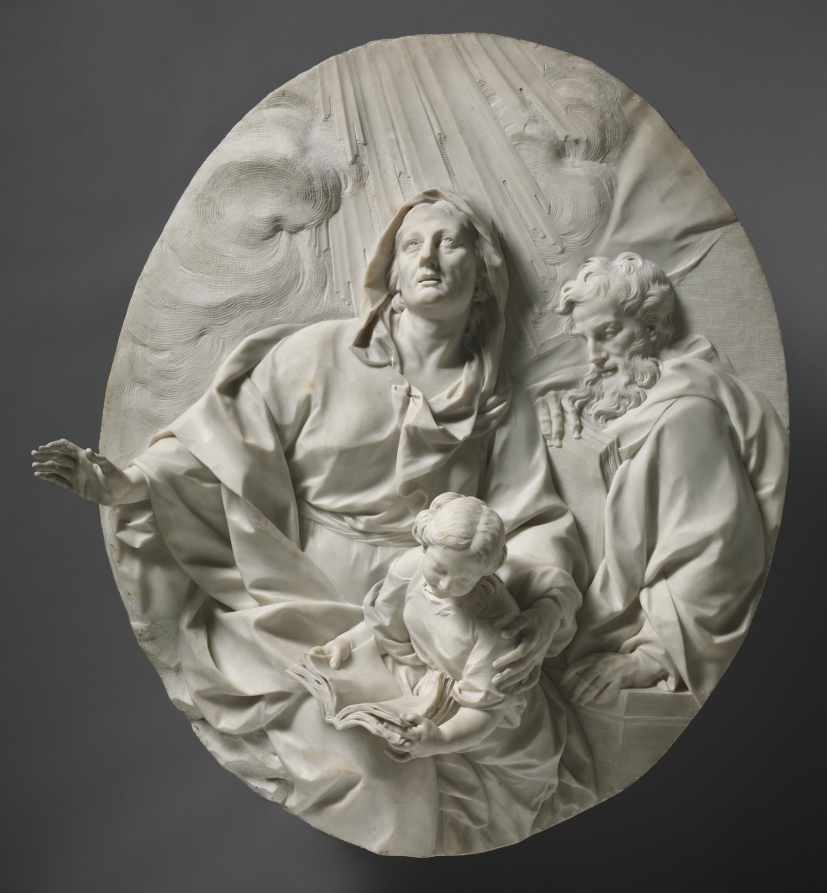
Urban Silhouette Research: The Education of the Virgin — Geometric Integrity and the 2026 Executive Silhouette
Preliminary: The Architectural Premise
The Education of the Virgin presents a compositional problem that is, at its core, a tailoring problem. The subject—Saint Anne instructing the young Virgin—is rendered not through narrative excess but through a rigorous economy of mass and void. The figures occupy a shallow, stage-like interior; the architecture behind them is reduced to a vertical rhythm of pilasters and a single, decisive window aperture. This is not a painting of incident. It is a painting of structural containment. For Addison Fashion, the operative question is therefore not what the figures do, but how the painting holds them—and what that holding logic proposes for the executive silhouette of 2026.
The Vertical Axis and the Disciplined Column
Saint Anne's seated form establishes the primary vertical. Her posture is not relaxed; it is load-bearing. The spine is held, the shoulders squared to the picture plane, the drapery falling in unbroken planes from shoulder to floor. This is the geometry of the column—a single, continuous load path from capital to base. The 2026 executive silhouette inherits this logic directly: a shoulder line that is architecturally resolved rather than padded, a torso that reads as a single plane rather than a series of darts, and a hem that terminates with the finality of a plinth. The silhouette does not taper to flatter the body; it tapers to resolve the structure.
The young Virgin, by contrast, provides the secondary vertical—offset, subordinate, yet essential to the composition's stability. In tailoring terms, this is the counter-axis: the lapel that breaks the symmetry, the asymmetric closure that prevents the garment from becoming inert. The painting teaches that structural integrity is not monotony; it is the tension between a dominant axis and a disciplined counterweight.
The Window Aperture: Negative Space as Garment Logic
The window at the upper left is the painting's most consequential void. It is a rectilinear subtraction from an otherwise dense field—a single, unmodulated aperture that admits light without admitting distraction. This is the negative-space principle that governs the 2026 executive wardrobe: the deliberate absence. A coat that closes to the throat but opens at the cuff. A jacket whose back panel is unbroken, its seam allowance suppressed to a single line. The garment must contain at least one aperture of restraint—a place where the eye rests because the construction has chosen to stop.
Note also the window's placement: it is not centered. It is off-axis by design, and the composition's balance depends on that asymmetry. The executive silhouette of 2026 will reject the centered, symmetrical closure in favor of the offset aperture—a diagonal seam, a displaced button stance, a collar that sits fractionally to one side. Symmetry is for ceremonial dress. Asymmetry is for the working executive.
Drapery as Materiality: The Slate Register
The drapery in this painting is not decorative; it is evidence of weight. The folds are broad, planar, and few—each one a decision rather than an accident. The fabric reads as a heavy wool or a densely woven linen, capable of holding a fold without collapsing into fussiness. This is the material register we designate Slate: a cool, mineral gray that absorbs light rather than reflecting it, that reads as urban stone rather than pastoral softness.
For 2026, the Slate register governs the executive palette precisely because it is non-committal in temperature and absolute in value. It does not flatter; it frames. The drapery's planar discipline translates directly into fabric specification: high-twist worsteds with sufficient body to hold a knife pleat, bonded cottons that resist the soft collapse of casual tailoring, and double-faced cashmere whose seams can be left raw because the material itself is the finish. The painting does not depict luxury as ornament. It depicts luxury as the confidence to leave a plane unbroken.
The Hand and the Book: The Gestural Restraint
The single most important detail for the 2026 silhouette is the hand of Saint Anne—raised, index extended, arrested mid-instruction. It is a gesture of controlled authority, and it is the only diagonal in an otherwise orthogonal composition. In garment terms, this is the single permitted gesture: one sleeve that breaks the wrist line, one collar that lifts fractionally from the neck, one pocket that sits at a deliberate angle. The executive silhouette must not be gestural throughout; it must be orthogonal with one exception. The exception is what the eye remembers.
Conclusion: The 2026 Silhouette as Secular Icon
The Education of the Virgin is, finally, a painting about transmission under compression—wisdom passed between two figures held within a geometry that permits no waste. The 2026 executive silhouette adopts this compression as its governing principle: Minimalist in category, Slate in color, architectural in cut, and severe in its refusal of the incidental. The garment does not decorate the body. It structures it, as the pilasters structure the room and the window structures the light. This is the Addison position: the executive wardrobe as a load-bearing system, worn with the cold composure of a figure who has already resolved the composition and now simply occupies it.