Urban Form: Carved Bracket
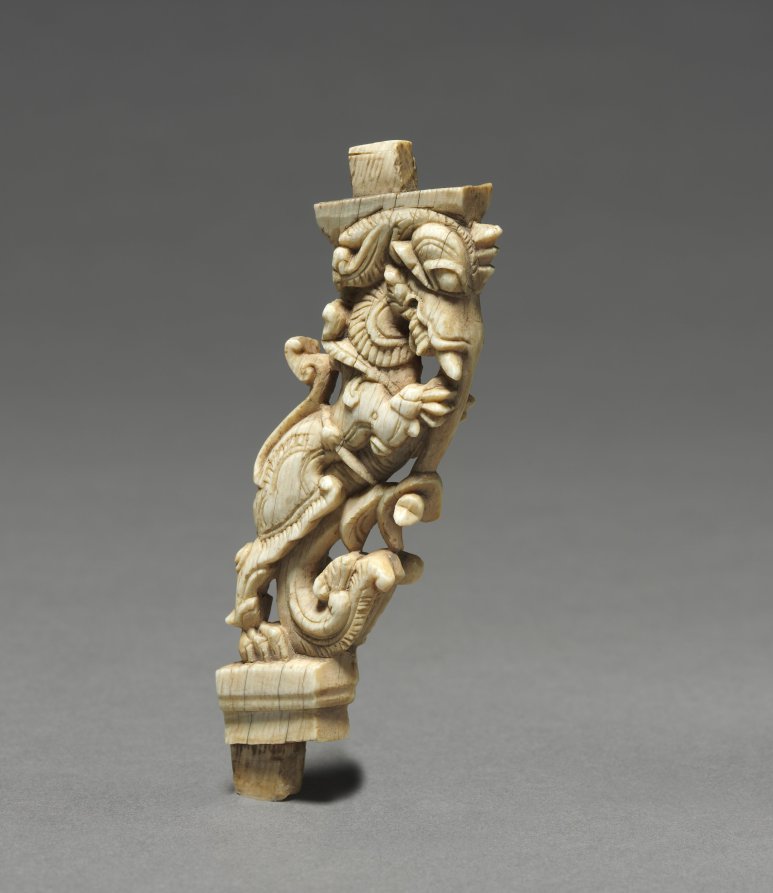
Urban Silhouette Research: Carved Bracket — Structural Poetics of the Incomplete
I. The Geometry of Absence: Negative Space as Load-Bearing Structure
The Carved Bracket does not present a form; it presents the architecture of a form's disappearance. The ceramic mold fragment — a Tang-dynasty matrix for casting musicians — operates through concavity rather than mass. Its geometry is defined by incised channels, the negative impressions of fingers in motion, the hollowed cavities where instruments once pressed against clay. This is not ornament. This is structural poetics rendered as absence. For the 2026 executive silhouette, the lesson is absolute: the garment must be engineered around the void, not the volume. The shoulder line of the Addison executive blazer does not sit upon the body — it brackets it, carving a negative space between fabric and flesh that reads as deliberate architectural interval. The armhole is not a seam but a cast cavity, holding the arm in suspended animation. The lapel, cut with a single continuous bias, mimics the mold's incised line — a gesture frozen mid-stroke, never resolving into decoration.
Where the mold fragment fractures, the silhouette gains its authority. The break is not damage; it is editorial restraint. The 2026 executive does not require completion. She requires the confidence of the incomplete — a hem that stops short of convention, a cuff that exposes the wrist's articulation as though the sleeve were a rubbing pulled from stone. The geometry here is one of interrupted continuity: seams that terminate before closure, darts that vanish into negative space, a collar that stands away from the neck as though the body beneath were still being cast.
II. The Rubbing as Surface Logic: Flatness, Friction, and the Transfer of Authority
The Tang-Fang rubbing introduces the second geometric principle: translation through compression. The rubbing is not a photograph; it is a physical negotiation between ink, paper, and stone. Its geometry is planar but not passive — the black field is activated by the white reserve of the carved line, a binary system of pressure and release. For Addison's 2026 materiality, this translates into a textile logic of surface as record. Slate wool is not dyed; it is rubbed. The fiber is compressed under heat and weight until the surface registers the friction of its own making — a matte, granular finish that absorbs light rather than reflecting it. The geometry of the cloth is therefore topographical: the drape follows the body's relief like paper pressed into stone, capturing the high points of the shoulder blade, the ridge of the spine, the hollow of the lumbar curve.
The rubbing's planar compression also dictates the two-dimensional discipline of the executive silhouette. Where volume is eliminated, line must carry the structure. The Addison trench for 2026 is cut from a single continuous panel — no side seam, no princess dart — so that the fabric falls as a rubbing falls: flat, uninflected, and yet precise in its registration of the body beneath. The belt is not cinched but impressed, a wide slate band that compresses the waist without interrupting the planar flow. The result is a silhouette that reads as both garment and document — a record of the body's geometry transferred onto cloth through pressure rather than tailoring.
III. The Bracket as Urban Armature: From Fragment to City Scale
The term "carved bracket" implies an architectural function: a corbel, a console, a member that transfers load from horizontal to vertical. The Tang mold fragment, though small, performs this function at the scale of the hand — it brackets the musician's gesture, holding it between the clay's surface and the air's absence. The 2026 executive silhouette must perform the same transfer at the scale of the urban body. The bracket becomes the shoulder yoke: a structured panel that transfers the weight of the coat from the deltoid to the clavicle, distributing load across the torso's architectural frame. The yoke is cut on a curve that echoes the mold's incised arc — a shallow, continuous line that reads as both structural necessity and aesthetic decision.
Urban materiality demands that this bracket be visible. The Addison executive coat for 2026 exposes its armature: the yoke seam is pressed open and topstitched in a contrasting ivory thread, a line that traces the load path like a rubbing traces a carved edge. The pocket is not a patch but a cast recess, set into the coat's face with a raw, bonded edge that reveals the textile's internal structure. The hem is weighted with a concealed slate ribbon, giving the silhouette a gravitational authority — the coat does not drape; it descends, like a rubbing pulled downward by the weight of its own ink.
IV. Conclusion: The Executive as Artifact and Index
The Carved Bracket resolves into a single proposition: the silhouette is an index of pressure. The mold records the pressure of the hand; the rubbing records the pressure of the stone; the 2026 executive garment records the pressure of the city upon the body. Its geometry is not additive but reductive — every seam, every dart, every closure is a decision to remove rather than to build. The slate palette is the color of compressed graphite, of ink on paper, of the urban surface after rain. The silhouette stands as a bracket between the body and the metropolis: a structural interval, a negative space, a carved absence that holds the executive form in suspended, deliberate authority. The fragment does not mourn its incompleteness. It wears it as structure.