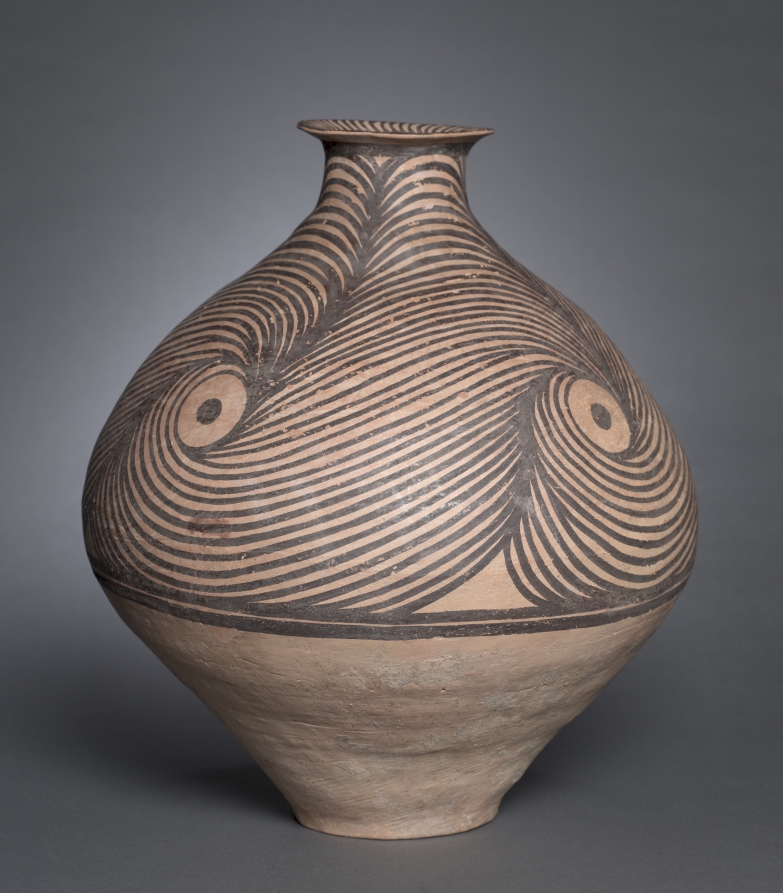
Urban Form: Jar with Spiral Designs
Urban Silhouette Research: Structural Poetics of the Contained Form
I. Geometric Integrity: The Vessel as Architectural Proposition
The Meiping form operates on a principle of controlled volumetric tension. Its shoulder line—a soft, deliberate inflection rather than a hard angle—establishes the primary structural datum from which the entire silhouette is derived. For Addison Fashion, this is not decorative history; it is a masterclass in the geometry of restraint. The jar’s profile describes a continuous curve that swells at the shoulder, narrows at the waist, and resolves into a disciplined foot. There is no excess. There is no apology. The form is self-justifying.
Translated to the 2026 executive silhouette, this geometry mandates a shoulder that carries authority without aggression—a slate-toned tailoring in which the seam sits precisely at the acromion, neither extended nor collapsed. The waist is suppressed but never cinched; the fabric follows the body’s architecture rather than correcting it. The result is a garment that reads as a closed system of proportion, legible from across a boardroom and intimate at conversational distance. The spiral wave motif, abstracted into a tonal jacquard or a laser-cut repeat, becomes a surface code—visible only on approach, invisible at a distance. This is the Addison principle: authority is felt before it is seen.
II. The Carceral Line: Graphic Tension as Tailoring Discipline
The Daumier plate introduces a countervailing geometric logic: the diagonal as moral instrument. The judge’s elevated plane, the accused’s lowered gaze, the sharp convergence of hatching—these are not compositional accidents but structural verdicts. The line in Daumier is a blade; it cuts the picture plane into zones of power. For the 2026 silhouette, this translates into the disciplined use of the asymmetric closure—a single diagonal seam across the torso, a lapel that breaks the vertical axis, a hem that resolves at an oblique angle. The garment becomes a field of negotiated tension, neither purely ornamental nor purely functional.
Materially, this demands urban materiality of the highest order: a slate wool crepe with sufficient weight to hold a diagonal without sagging, a bonded seam that reads as a drawn line rather than a stitched one. The Daumier lesson is that line carries judgment. In tailoring, every seam is a verdict on the body beneath it. Addison Fashion does not hide this. The 2026 executive does not require concealment; they require precision that acknowledges its own construction.
III. The Dialectical Silhouette: Container and Cage
The critical insight of this research is that the Meiping and the Macaire plate are not opposites but two states of the same structural condition. The jar is a container that imprisons its own waves; the print is a cage that liberates its subject through the act of depiction. The 2026 executive silhouette must inhabit this dialectic. It must be a container of authority—closed, resolved, self-possessed—and simultaneously a cage of visible construction, where the wearer’s agency is legible in every seam and closure.
Practically, this yields a silhouette defined by three structural registers. First, the shoulder register: a slate-toned shell that holds its plane without padding, derived from the Meiping’s shoulder inflection. Second, the waist register: a suppressed but unconstricted transition, achieved through a bias-cut internal facing rather than a belt or cinch. Third, the hem register: a resolution that is neither flared nor tapered but terminated—a clean horizontal that reads as a verdict, not a suggestion. Between these registers, the surface carries the spiral code: a tonal, non-representational repeat that rewards proximity and punishes nothing.
IV. Urban Poetics: The City as Firing Chamber
The Meiping’s glaze is a fired surface—a record of the kiln’s judgment. The 2026 executive operates in an equivalent chamber: the city, with its thermal pressures of negotiation, transit, and exposure. The silhouette must therefore be kiln-hardened: crease-resistant, light-responsive, and capable of holding its geometry through a sixteen-hour cycle without softening into apology. Slate is the correct chromatic register—neither the black of mourning nor the grey of retreat, but the precise mid-tone of structural steel and overcast sky. It absorbs light without disappearing into it.
The spiral, finally, is not ornament. It is a diagram of continuity—the wave that returns, the line that coils without closing. In the 2026 silhouette, this manifests as a continuous internal construction: a single spiral seam that begins at the shoulder, travels through the torso, and resolves at the hem, binding the garment into one structural argument. The wearer does not decorate themselves with history. They inhabit a resolved geometry that acknowledges both the vessel and the cage, the glaze and the blade.
Conclusion. The Addison Fashion 2026 executive silhouette is a slate-toned, minimalist architecture of contained tension. It derives its shoulder from the Meiping’s inflection, its diagonal discipline from Daumier’s carceral line, and its surface from the fired logic of the kiln. It is not soft. It is not loud. It is structurally honest—a garment that, like the jar, exists without petition, and, like the print, judges without cruelty. This is the urban silhouette: a container that knows it is a cage, and wears the knowledge as precision.