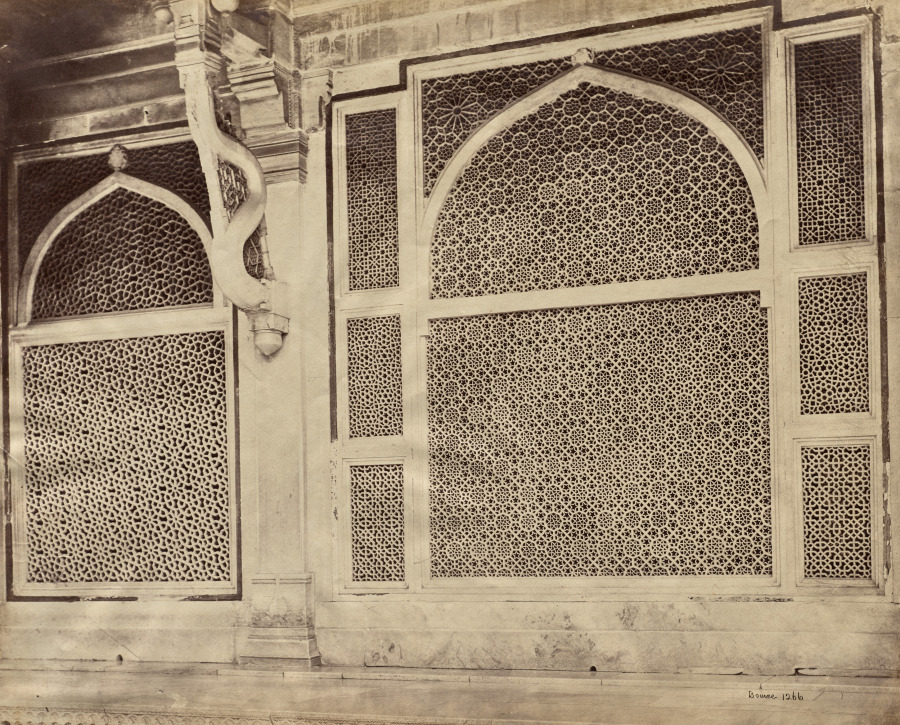
Urban Form: Futtypore Sikri—Two of the Marbled Screens in the Tomb of Sheik Selim Chisti
Urban Silhouette Research: The Jali Geometry of Futtypore Sikri
I. The Marbled Screen as Structural Premise
The two pierced marble screens within the Tomb of Sheikh Salim Chisti at Futtypore Sikri constitute a definitive study in subtractive geometry. Each screen is not an object but an absence—a lattice carved through stone until the material surrenders its mass to a disciplined network of voids. The perforation is executed with a precision that refuses ornament for its own sake; every aperture is a calibrated decision, every remaining rib a load-bearing argument. For Addison Fashion, this is the founding principle of the 2026 executive silhouette: garment as architecture of removal, where structure is defined as much by what is eliminated as by what remains.
The screens operate on a hexagonal and interlocking geometric grid, a system that produces visual density without weight. The eye reads complexity; the body experiences lightness. This paradox—maximal pattern, minimal mass—is the precise tension we translate into tailoring. The executive wardrobe of the coming cycle must perform the same trick: appear rigorous, read as authoritative, yet never burden the wearer with excess fabric or redundant construction.
II. Geometric Integrity and the Tailored Plane
Examine the screens' perimeter framing. A continuous marble border contains the lattice, establishing a hard edge against which the interior pattern vibrates. This is the structural logic of the defined shoulder and the clean armhole—a boundary condition that gives the internal geometry permission to be intricate. In our 2026 tailoring, the shoulder seam functions as this marble frame: absolute, unyielding, a line of control. Within it, the body of the garment may carry the lattice logic—paneled seams, pierced darts, openwork at the cuff and collar—without dissolving into chaos.
The screens' hexagonal modules repeat with metronomic consistency, yet the carving introduces subtle variation in the thickness of each rib. No two apertures are identical in their edge profile. This is the difference between mechanical repetition and crafted rhythm. Our pattern-cutting must absorb this lesson: a suit jacket's pick stitching, the spacing of functional buttonholes, the graduated width of a lapel—each is a rib in the lattice, consistent in system, individual in execution. The result is a garment that rewards sustained looking, that reveals its discipline only to those who understand structure.
III. Materiality: Marble, Light, and Urban Surface
The screens are carved from white marble, a material that in the Agra region carries a faint warmth, a translucency when backlit. The surface is not polished to mirror; it retains a matte density that absorbs light at the edges of each cut and releases it at the face. This is the materiality we pursue for the 2026 executive: Ivory-toned surfaces with optical depth, fabrics that hold shadow in their texture rather than reflecting it away. A double-faced wool crepe, a matte silk faille, a compact cotton with a dry hand—these are the urban marbles of the collection.
The screens' interaction with light is their second architecture. As the sun moves, the lattice casts a secondary pattern on the floor—a shadow geometry that is softer, more fluid, and entirely dependent on the solid form. This is the principle of layered dressing for the executive woman: a structured outer layer that generates a softer, more responsive inner layer. The shadow is not subordinate; it is the proof of the structure's precision. A sleeveless column beneath a carved jacket, a fluid trouser beneath a defined hip—each pairing must produce a shadow pattern as deliberate as the garment itself.
IV. The 2026 Silhouette: Subtraction as Authority
The screens refuse the additive logic of most architectural ornament. They do not apply pattern to a surface; they remove material until pattern emerges. This is the defining gesture of the 2026 executive silhouette—authority through reduction. The power suit of the previous decade accumulated detail: hardware, lining, interfacing, visible construction. The coming cycle strips these away. The shoulder remains, the waist is defined, the lapel is present—but each element is carved back to its essential rib, its load-bearing minimum.
The resulting silhouette is narrow but not tight, structured but not rigid. It reads as Ivory against the slate and onyx of the urban field—a pale, precise form moving through the city's grey density. The screens at Futtypore Sikri were built to filter light and air, to create a boundary that is also a passage. The 2026 Addison executive garment must do the same: define the body's edge while allowing the wearer to move, to breathe, to remain unburdened by the very structure that gives her form. The lattice is the garment; the garment is the lattice. Nothing more, and precisely enough.