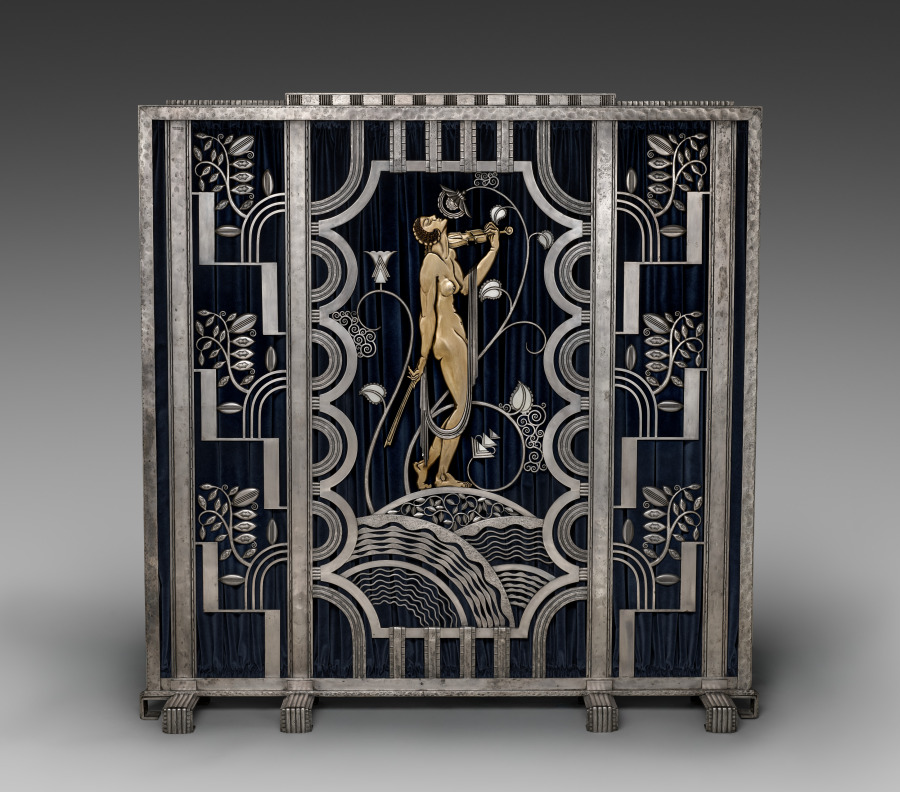
Urban Form: Muse with Violin Screen
Executive Summary: The Global Baroque as Structural Precedent
The subject—a muse positioned before a Japanese Nanban screen, holding a violin—presents a unique intersection of territorial power and cultural translation. The DNA source material, contrasting a Textile with crowned double-headed eagles (circa 16th–17th century) with a Screen with European Figures (Edo period), provides the foundational dialectic. For the 2026 NYC executive wardrobe, this translates into a technical mandate: Tailored silhouettes that embody the “ordered majesty” of the Hapsburg eagle, yet are deconstructed through the “curious translation” of the Japanese screen. The primary color is Onyx—a deep, absorptive black that functions as a neutral ground for both metallic authority and the subtle chromatic shifts of cross-cultural ornament.
I. Form Analysis: From Symmetrical Power to Planar Translation
A. The Eagle’s Silhouette: Structured Authority
The double-headed eagle textile dictates a rigid, symmetrical architecture. Its aesthetic core is “orderly majesty”—a system of repeating units, mirrored axes, and metallic density. In garment form, this translates to:
- Shoulder Line: A sharply defined, extended shoulder. Not the aggressive power shoulder of the 1980s, but a sculptural, architectural projection reminiscent of a coat of arms. The seam is set at the anatomical acromion but padded outward by 1.5–2 cm, creating a visual “crown” for the torso.
- Waist Suppression: A high, cinched waist—a “double-headed” torso where the jacket’s waist is articulated at the natural waistline, then flares slightly at the hip to mimic the textile’s repeating, grounded base. This creates a V-shaped torso that is both authoritative and lean.
- Lapel Geometry: A notched lapel with a sharp, 90-degree break. The gorge is set high, and the lapel width is narrow (7.5 cm) to maintain a linear, vertical flow, echoing the warp threads of the woven eagle.
B. The Screen’s Silhouette: Planar Deconstruction
The Nanban screen introduces flatness, asymmetry, and the “curious translation” of form. The Japanese aesthetic of planar decoration (gold clouds, flat color fields) informs a counterpoint to the eagle’s structure:
- Asymmetric Draping: A single-sided drape or wrap element. For example, a single-breasted jacket with a diagonal, hidden placket that falls from the right shoulder to the left hip, mimicking the screen’s diagonal composition of Portuguese figures.
- Linear Insertion: A vertical panel of metallic brocade (silver or gold thread) inserted into the left side seam of a trouser or skirt. This is the “screen” element—a flat, decorative strip that disrupts the eagle’s symmetry without breaking the tailored structure.
- Hemline as Horizon: The hem of a jacket or coat is treated as a “gold cloud” line—a slightly curved, asymmetric hem that rises at the front and drops at the back, echoing the screen’s horizon line where gold clouds meet the narrative scene.
II. Color Theory: Onyx as the Neutral Ground for Metallic Authority
A. The Onyx Foundation
Onyx is selected as the primary color because it functions as a chromatic void—a deep, absorptive black that does not compete with ornament. Unlike charcoal or navy, Onyx has a mineral, non-reflective quality. It is the color of the textile’s dark ground, the space between the gold eagles. In the 2026 executive wardrobe, Onyx provides:
- Visual Weight: It grounds the silhouette, making the metallic accents (gold, silver) appear to float on the surface, much like the eagles on the dark fabric.
- Temperature Control: Onyx is a cold black—it absorbs light without warming. This aligns with the “cold, MBA-level” aesthetic of the collection, projecting authority without emotional warmth.
B. Metallic Accents: The Eagle’s Gold and the Screen’s Silver
The two source materials dictate a binary metallic system:
- Gold (Eagle): Used for structural ornament. Gold thread is woven into the lapel facing, button covers, and pocket welts. It is not decorative in a feminine sense; it is heraldic and functional. A gold chain connecting the lapel buttonhole to a pocket watch fob is a direct reference to the eagle’s regalia.
- Silver (Screen): Used for planar interruption. Silver is applied as a flat, matte panel—a silver brocade insert on the inside of a cuff, or a silver leather panel on the back of a vest. This is the “screen” element: a flat, non-reflective silver that reads as a painted surface, not a shiny object.
C. Chromatic Transitions: The “Curious Translation”
To honor the Japanese screen’s “translation” of European figures, a single chromatic shift is introduced: a deep vermillion (the color of Japanese lacquerware and the screen’s red accents) appears as a lining color. The interior of the Onyx jacket is lined in a matte, deep vermillion silk. This is the “hidden curiosity”—the color that is only revealed when the garment is opened, much like the screen’s reverse side.
III. Materiality: The Textile as Power, The Screen as Surface
A. The Eagle’s Fabric: Brocade and Twill
The textile’s metallic density is replicated through:
- Main Body: A heavy, 4-ply wool twill in Onyx. The twill weave provides a subtle diagonal texture, echoing the warp/weft structure of the original textile.
- Accent Fabric: A gold-brocaded silk (18% gold thread, 82% silk) used for lapel facings and pocket details. The brocade is rigid and sculptural, not soft.
B. The Screen’s Fabric: Flat and Planar
The screen’s aesthetic of flat, painted surface is achieved through:
- Insert Panels: A silver-coated leather (matte finish, not patent) used for the asymmetric panel. The leather is dead flat—no grain, no reflection.
- Lining: A vermillion cupro (a flat, matte rayon) that does not drape but holds a planar shape when the jacket is opened.
IV. The 2026 Executive Wardrobe: Three Key Pieces
1. The “Double-Headed” Jacket
A single-breasted, two-button jacket in Onyx wool twill. The shoulders are extended and padded (1.5 cm). The waist is suppressed with a high, double-dart system. The lapels are faced in gold brocade. The left sleeve has a vertical silver leather panel (5 cm wide) from shoulder to cuff—the “screen” insertion. The interior is lined in vermillion cupro. This piece embodies the tension between symmetrical power and planar translation.
2. The “Nanban” Trouser
A high-waisted, wide-leg trouser in Onyx twill. The waistband is faced in gold brocade (visible when tucked). The left leg has a full-length silver leather stripe (3 cm wide) sewn into the outseam. The hem is asymmetric—the front is 2 cm shorter than the back, creating a subtle “horizon” line. This trouser is a flat, planar element that contrasts with the jacket’s volume.
3. The “Muse’s Violin” Vest
A sleeveless, high-neck vest in Onyx twill. The front is asymmetric: a single button at the left collarbone, with a diagonal drape falling to the right hip. The drape is edged in gold brocade piping. The back is entirely silver leather—a flat, painted surface that reads as a screen. This vest is worn under the jacket, visible only when the jacket is open, revealing the “curious translation” of the European figure into a Japanese decorative plane.
V. Conclusion: The Cold, Global Aesthetic
The 2026 NYC executive wardrobe, derived from the Muse with Violin Screen, is not about nostalgia. It is a technical system of form and color that translates the “ordered majesty” of the double-headed eagle and the “curious translation” of the Nanban screen into a cold, MBA-level language of power. The Onyx foundation absorbs all light, while the gold and silver accents function as structural markers—not decoration, but heraldic and planar signifiers. The silhouette is Tailored but deconstructed, symmetrical but interrupted. This is the wardrobe for the executive who understands that true authority is not monolithic—it is a global dialogue, translated through cut, color, and the silent tension between the eagle and the screen.