Urban Form: Temple of Ramesses II, Abu Simbel
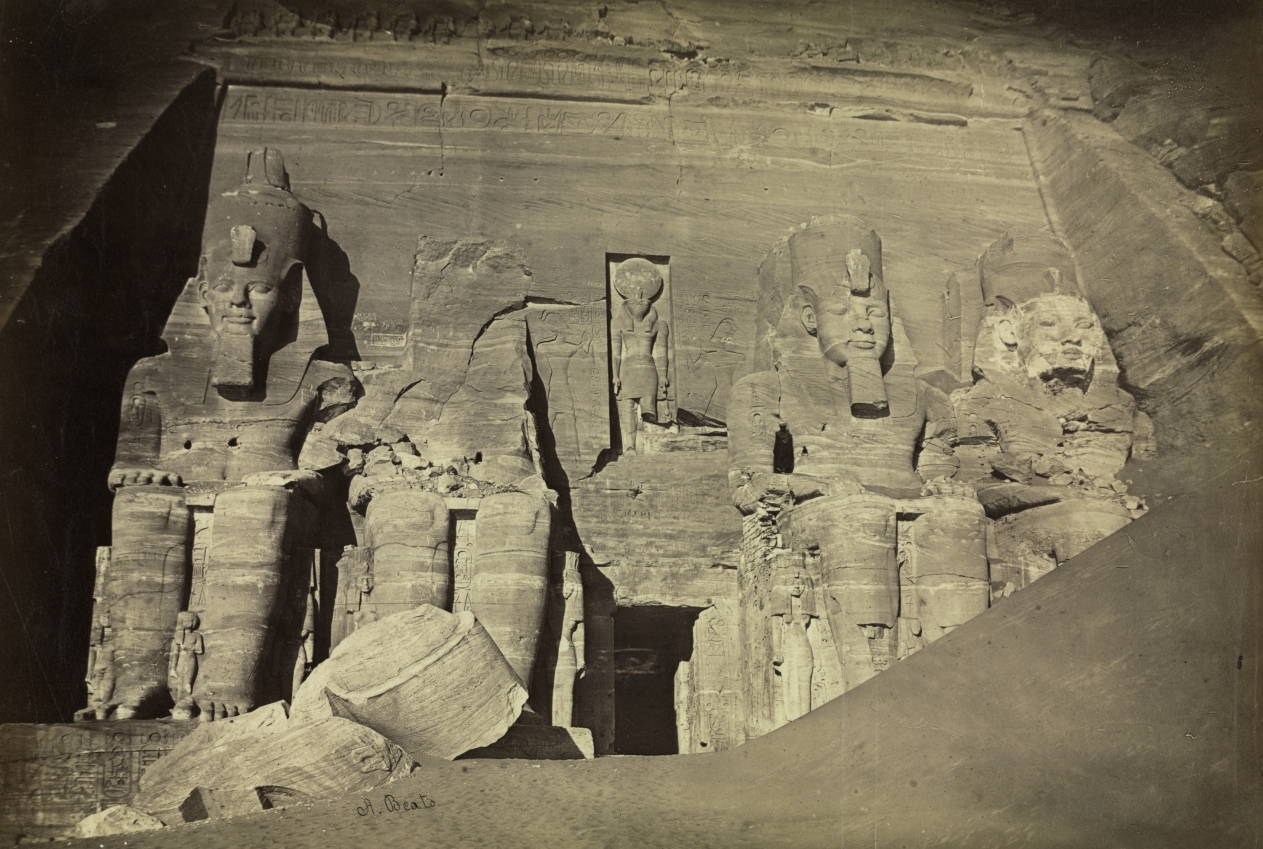
Urban Silhouette Research: The Abu Simbel Columnar Code and the Tang Mold Dialectic
I. The Colossal Facade as Executive Armature
The Temple of Ramesses II at Abu Simbel operates, first and foremost, as a declaration of structural absolutism. Four seated colossi, each approximately twenty meters in height, are not merely carved into the cliff face—they are the cliff face, their negative space excavated rather than assembled. This distinction is critical for the 2026 executive silhouette. The Addison wardrobe for the coming cycle rejects the additive logic of layering in favor of an excavated architecture: garments whose authority derives from what has been removed, not what has been applied. The shoulder line, therefore, is not padded into existence but carved—a clean, monolithic plane that descends without interruption from acromion to hem, echoing the unbroken verticality of the Abu Simbel pilasters.
The temple's geometry is relentlessly frontal. Its symmetry is not decorative but juridical—it legislates how the body is to be read in space. For the executive woman, this translates into a silhouette governed by a central axis: a single, uninterrupted seam line, a closure that reads as a structural joint rather than an ornament, a collar that frames the face with the exacting rectitude of the cornice above Ramesses' brow. The result is a garment that does not drape but pronounces.
II. The Mold Fragment: Tactility as Structural Memory
The Tang dynasty mold fragment with musicians offers the necessary counterweight to Abu Simbel's lithic permanence. Where the temple is subtractive and eternal, the mold is additive and provisional—a negative space designed to receive pressure, to record the gesture of a hand that will never be seen. The concave incisions that once shaped a pipa player's fingers are, in effect, a tactile score: a record of motion compressed into clay.
This principle governs the surface treatment of the 2026 Addison executive suit. The fabric is not smooth in the conventional sense; it carries a micro-relief—a subtle grain that registers touch, that holds the memory of the wearer's movement in the same way the mold holds the musician's hand. The materiality is urban and mineral: compact wool with a sand-finished hand, bonded seams that read as incised lines rather than stitched closures. The garment becomes a matrix, not a shell—it receives the body's geometry and returns it as silhouette.
III. The Rubbing: The Plane as Pure Sign
The Tang-Fang rubbing introduces the third term in this structural triad: translation. The rubbing is a copy that surpasses its original—it strips away volume, weight, and color to isolate the line as autonomous entity. The stone's three-dimensionality vanishes; what remains is the calligraphic trace, the brushstroke's velocity rendered in black and white.
For Addison's 2026 tailoring, this is the mandate for planar reduction. The executive jacket must function as a rubbing of the body: a two-dimensional projection that nonetheless conveys the full authority of the wearer. This is achieved through flat-front construction—no darts, no princess seams, no curved tailoring that would reintroduce volume. The lapel is a single folded plane; the pocket is a slit, not a pouch. The silhouette is read as a graphic proposition against the urban ground, its edges sharp as the boundary between ink and paper.
IV. The Dialectic of Presence and Absence
The genius of pairing the mold fragment with the rubbing lies in their shared interrogation of presence through absence. The mold is complete only in its incompleteness—it exists to be filled, and its beauty is the beauty of potential. The rubbing is a ghost—it preserves what the stone has already lost to erosion. Together, they define the 2026 executive silhouette as a structure of deliberate incompletion: a garment that suggests the body without enclosing it, that leaves the shoulder unbuilt, the waist unmarked, the hem unresolved.
This is not minimalism as renunciation but minimalism as precision. Every removed element is a calculated subtraction, a decision to let the wearer's own geometry complete the form. The Abu Simbel colossi are complete because they are stone; the Addison executive is complete because she is not.
V. Urban Materiality: Sand, Slate, and the Mineral Palette
The color logic follows the material logic. Sand—the color of the mold's fired clay, the desert's erasure, the unbleached linen of the rubbing paper—serves as the foundational tone. It is a color that absorbs light rather than reflecting it, that reads as substance rather than surface. Against this ground, the structural lines of the garment appear as incisions, as the dark grooves of the mold's negative space.
The urban context demands that this palette resist the picturesque. Sand is not beige; it is the color of compressed time—of dust, of mortar, of the patina that accumulates on stone facades. Worn in the city, it functions as camouflage against the built environment while asserting a mineral permanence that synthetic blacks cannot match.
VI. Conclusion: The Silhouette as Excavation
The 2026 Addison executive silhouette is, finally, an archaeology of the present. It borrows the temple's frontal authority, the mold's tactile memory, and the rubbing's planar reduction to construct a garment that is neither costume nor uniform but infrastructure—a system of lines and planes that organizes the body in space with the exactitude of a colonnade. The woman who wears it does not disappear into the architecture; she becomes its measuring unit. The silhouette is not a shape but a standard of measure, and she is the instrument that calibrates it.