Urban Form: Landscape at Loosduinen
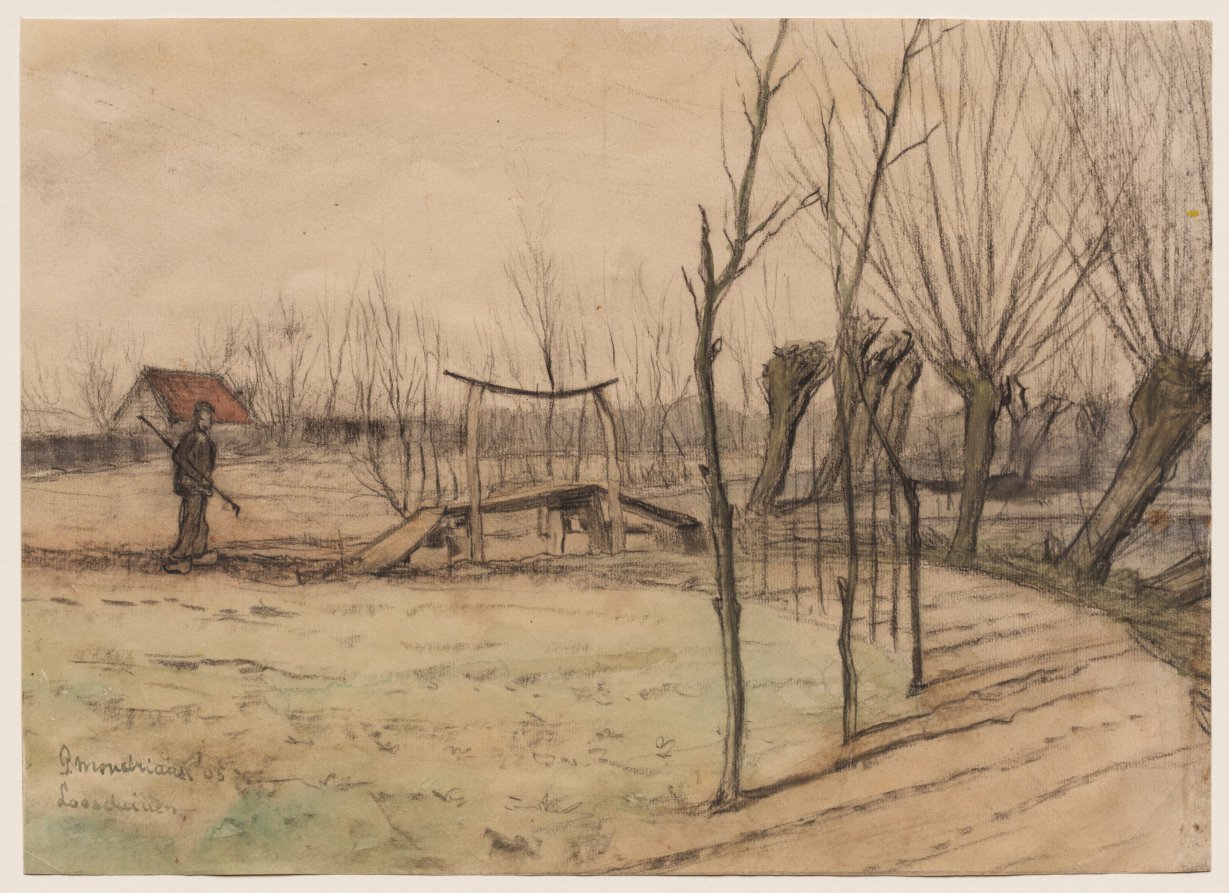
Urban Silhouette Research: Landscape at Loosduinen — Form, Color, and the Phenomenology of the Executive Wardrobe
I. Preliminary Framework: The Dickensian Proposition as Design Heuristic
The Dickensian gesture of naming a ceramic vessel after Jacob David's Death of Socrates constitutes a deliberate collision of two aesthetic regimes: the classical narrative painting and the purely functional cup. This juxtaposition is not whimsy; it is a diagnostic instrument. It forces the designer to interrogate a foundational paradox — namely, which register of depth is operative when we construct a garment for the urban executive? The answer, as this research will demonstrate, resides not in the selection of one register over the other, but in the calibrated equilibrium between them. The Landscape at Loosduinen serves as our DNA source precisely because it occupies this interstitial zone: a landscape that is at once topographical record and phenomenological surface, at once narrative and mute.
II. The Two Depths: Narrative versus Ontological
David's Socrates is the exemplary artifact of representational depth. Every formal decision — the raised right arm, the exposed chest, the weeping disciples, the chains in the jailer's hand — is subordinated to a grand narrative of soul-immortality. The painting demands decoding; its depth is contingent upon memory, knowledge, and the viewer's fluency in classical iconography. By contrast, the ceramic cup bearing the same name operates through ontological depth. Its cobalt-and-indigo vortex signifies nothing; it simply is. Its depth is haptic, spatial, and immediate. It requires no reading — only confrontation.
For Addison Fashion, this distinction maps directly onto the 2026 executive wardrobe's central tension. The narrative garment — the power suit with its inherited codes of authority, its shoulder line as citation of corporate hierarchy — operates in the register of representational depth. The ontological garment — the minimalist shell, the unconstructed jacket, the garment that presents itself as pure form — operates in the register of presence. The former asks to be read; the latter asks to be faced.
III. Formal Deconstruction: The Loosduinen Silhouette
The Landscape at Loosduinen yields a formal vocabulary of horizontal attenuation and vertical restraint. The Dutch landscape's low horizon line, its flat tonal gradations, and its recessive atmospheric perspective translate into a silhouette logic of elongated proportion and suppressed volume. For the 2026 executive wardrobe, this manifests as:
1. The Extended Line. Jackets are cut with a lowered button stance and an elongated lapel roll, producing a vertical unbroken line from shoulder to hem. The silhouette does not narrate authority through padding; it enacts authority through proportion. This is ontological tailoring — the garment's authority is immanent in its geometry, not cited from sartorial convention.
2. Suppressed Volume. Where the classical power suit builds volume at the shoulder and chest to signify presence, the Loosduinen silhouette suppresses volume in favor of planar continuity. The shoulder is natural, the chest is flat, the sleeve is narrow. The result is a garment that reads as surface rather than structure — closer to the ceramic cup than to the painting.
3. The Mute Fastening. Closures are concealed or minimized. Buttons are tonal, plackets are clean, and the garment's front presents as an unbroken plane. This is the sartorial equivalent of the cup's abstract vortex: a formal decision that refuses narrative legibility in favor of material presence.
IV. Chromatic Analysis: Slate as Ontological Ground
The Slate palette is the chromatic correlate of ontological depth. Unlike the narrative colors of executive convention — the navy of institutional authority, the charcoal of fiscal gravity — Slate operates as a non-signifying ground. It is a color that does not tell a story; it establishes a condition. In the Loosduinen landscape, the sky and water share a tonal register that hovers between gray and blue, refusing categorical assignment. This chromatic ambiguity is precisely its value: it creates a surface upon which the wearer's presence — rather than the garment's narrative — becomes legible.
For the 2026 executive wardrobe, Slate functions as a tonal matrix rather than a statement. It permits the kind of monochromatic layering that produces depth through value variation rather than hue contrast. A Slate jacket over a Slate trouser, differentiated only by texture and finish, produces a visual field that rewards sustained attention — the same attention the ceramic cup demands. The garment does not announce; it obtains.
V. Synthesis: The Executive as Phenomenological Subject
The 2026 executive operates in an environment of informational saturation — a condition that mirrors the narrative density of David's Socrates. Every gesture is read, every signal decoded. The Loosduinen wardrobe proposes a strategic withdrawal from this semiotic economy. It offers the executive a garment that does not participate in the narrative of authority but instead instantiates it through form. The depth of the garment is not in what it says but in what it is: a three-dimensional construction of wool, silk, and line that presents itself to the world as pure presence.
This is not an argument for minimalism as austerity. It is an argument for minimalism as phenomenological precision — the reduction of narrative noise to permit the emergence of formal clarity. The executive who wears the Loosduinen silhouette does not wear a story. They wear a condition. And in that condition — between the painting's eloquence and the cup's silence — the wardrobe achieves its deepest register: the equilibrium where form and being coincide.