Urban Form: Wine Flask with Incised and Sgraffito Peony Design
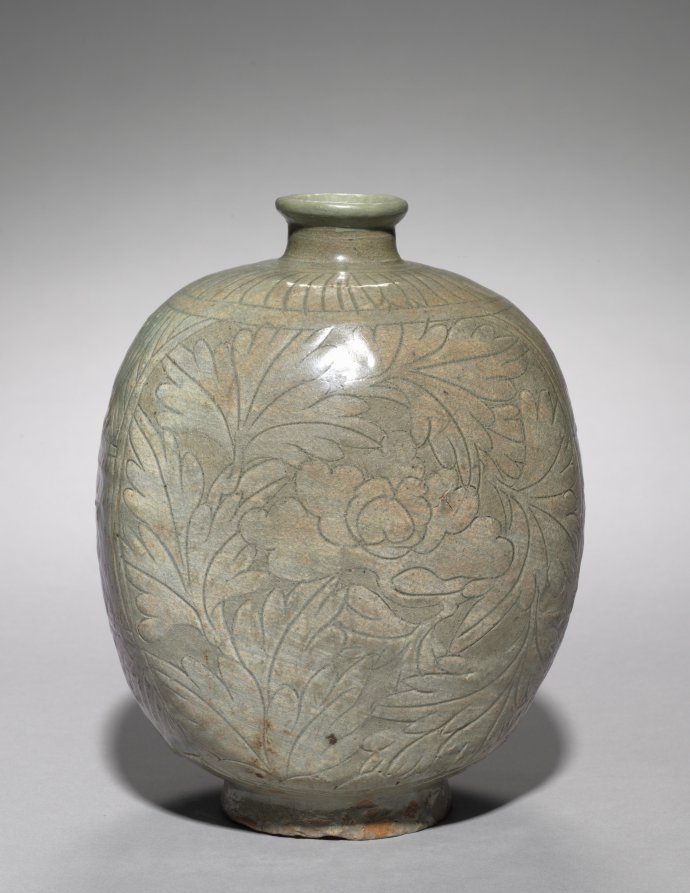
Urban Silhouette Research: Form and Color in the Wine Flask with Incised and Sgraffito Peony Design
I. Object Analysis: The Vessel as Structured Form
The wine flask under examination presents a compressed spherical body with a narrow cylindrical neck and a low, flared foot—a morphology that privileges containment over display. Its silhouette is defined by a deliberate tension between the bulbous mid-section and the restrained verticality of the neck, producing a closed, self-referential volume that resists external projection. This is not a form that announces itself; it is a form that withholds. The shoulder transitions into the neck via a soft, almost imperceptible curve, eliminating any hard articulation that would fracture the object's visual continuity. The foot ring, modest in height, grounds the mass without asserting weight—a structural whisper rather than a declaration.
The incised and sgraffito peony design operates as a surface intervention that does not disrupt the vessel's volumetric integrity. The carving technique—whereby the slip is removed to reveal the contrasting body beneath—creates a two-tier chromatic system: the ground and the figure exist in a relationship of mutual definition, neither dominating. The peony motif, rendered in abbreviated, almost calligraphic strokes, avoids botanical literalism. Petals are suggested rather than described; stems are implied through directional incision rather than continuous line. This is form reduced to its gestural minimum, a discipline of omission that aligns the object with the broader aesthetic logic of the Minimalist category.
Crucially, the sgraffito technique introduces a tactile dimension that the photograph cannot fully transmit: the slight depression of the carved line, the raised edge of the retained slip, the variable depth of the incision across the curved surface. These micro-topographies constitute a haptic signature—the object's resistance to the hand, its insistence on being felt as well as seen. In the context of Addison Fashion's design philosophy, this translates to a material intelligence: garments that reward touch, that communicate quality through surface variation rather than applied ornament.
II. Color Logic: Slate as Chromatic Restraint
The flask's chromatic register operates within a narrow band of warm neutrals—the pale grey-green of the slip ground, the darker olive-brown of the exposed body, the subtle amber pooling in the carved recesses where glaze has accumulated. This is not a palette of contrast but of adjacency: colors that differ by degrees rather than by opposition. The overall impression is one of chromatic humility, a refusal of the decorative impulse in favor of tonal coherence.
For the 2026 executive wardrobe, this logic translates directly to the Slate colorway—a grey that carries both coolness and depth, that reads as authoritative without the severity of black or the neutrality of pure grey. Slate functions as a chromatic substrate: it accepts light and shadow differentially, revealing the quality of the fabric through subtle tonal shifts rather than through pattern or print. In a worsted wool suiting, Slate produces a surface that appears to absorb and re-emit light in a controlled manner, creating a visual depth that flat colors cannot achieve. The sgraffito principle—whereby the ground and the figure are distinguished by texture rather than hue—informs a design approach where tonal variation within a single color family replaces the conventional contrast of jacket and trouser, shirt and suit.
III. Form-to-Garment Translation: The Minimalist Silhouette
The flask's compressed volume and narrow aperture suggest a garment architecture that is closed at the perimeter and open at the center. In tailoring terms, this manifests as a columnar silhouette with a defined shoulder and a straight, untapered line from chest to hem. The neck of the flask—narrow, vertical, and slightly flared at the lip—corresponds to a high, close-fitting collar that frames the face without constriction. The foot ring, modest and functional, translates to a hem that sits precisely at the ankle bone, neither cropped nor pooling, establishing a clear relationship between garment and ground.
The sgraffito peony, with its economy of gesture and refusal of literal representation, informs a design language of implied rather than applied detail. Seams are placed to suggest structure without visible topstitching; darts are eliminated in favor of architectural cutting that shapes the garment through panel construction rather than suppression. The result is a garment that reads as a single, continuous form—a vessel for the body rather than a collection of parts assembled around it.
IV. Strategic Implications for Addison Fashion NYC
The wine flask's aesthetic logic—containment, tonal restraint, gestural economy—provides a coherent framework for the 2026 executive wardrobe. In a market saturated with logo-driven visibility and seasonal novelty, the Minimalist category offers a counter-positioning strategy: garments that derive their authority from proportion, material, and construction rather than from applied identity. The Slate colorway, with its capacity for tonal depth and its compatibility with the urban visual environment, functions as a chromatic signature that is both distinctive and discreet.
The flask's closed form and narrow aperture also suggest a functional discipline: garments designed for the executive environment must accommodate movement, concealment, and the rituals of professional life without sacrificing formal integrity. The sgraffito principle—surface variation through technique rather than ornament—informs a material strategy where texture and finish replace pattern and print. The result is a wardrobe that operates as a system of related forms, each garment a vessel for the body's daily performance, each surface a record of the hand's intelligence.
In the final analysis, the wine flask is not an object of nostalgia but a model of structural clarity. Its lesson for Addison Fashion NYC is precise: form precedes decoration, color serves structure, and the most enduring statements are made through restraint. The 2026 executive wardrobe, conceived through this lens, becomes not a collection of garments but a coherent architecture of daily life—Slate in color, Minimalist in category, and uncompromising in its commitment to the primacy of form.