Urban Form: The Assembly of Tejaprabha Buddha
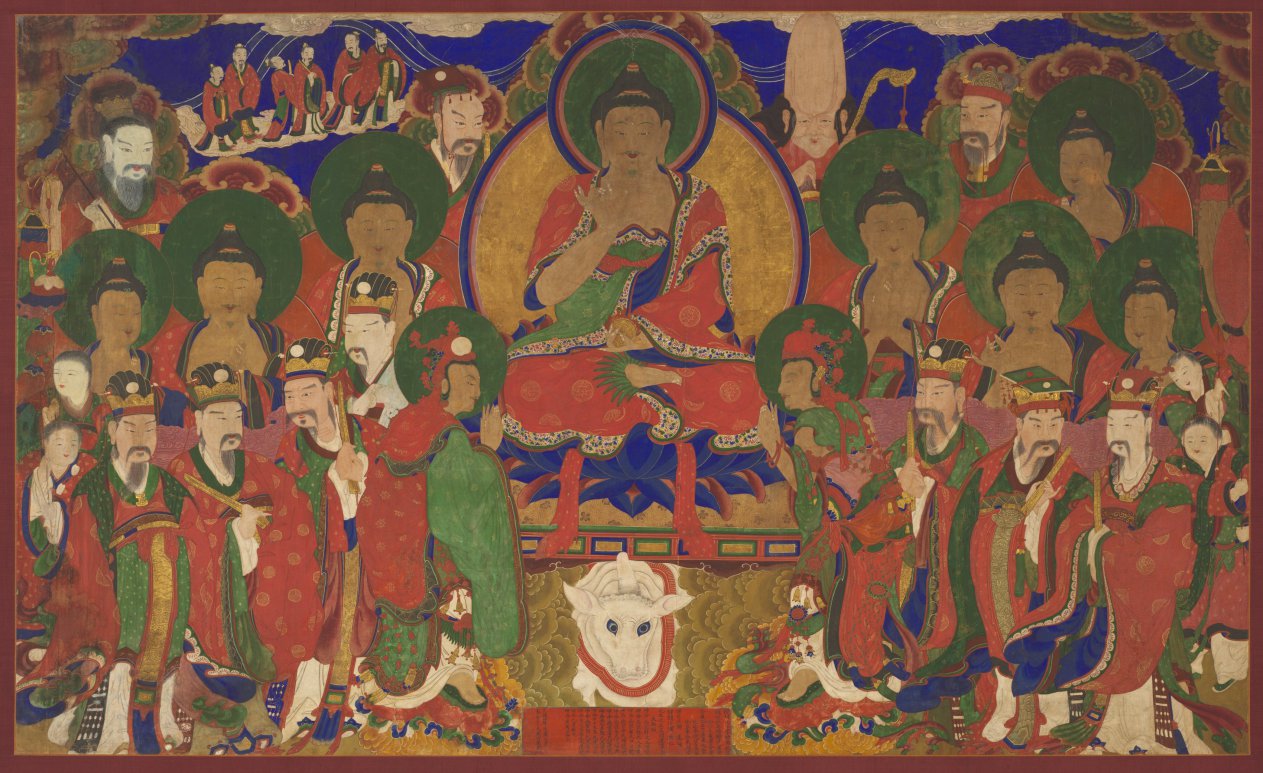
Urban Silhouette Research: The Assembly of Tejaprabha Buddha — Structural Poetics of the 2026 Executive Form
The 2026 executive silhouette is not designed; it is assembled. The reference object — the Assembly of Tejaprabha Buddha — offers a dual-coded architectural thesis: the horizontal scroll of Wang Wei’s Wangchuan Villa and the vertical bronze severity of the Three-Piercing Ritual Blade. These are not decorative citations. They are load-bearing structural propositions. The Addison Fashion studio treats them as a single garment system: a soft, continuous plane of habitation married to a hard, punctured plane of ceremony. The resulting silhouette is a study in controlled opposition — the body as a container for both retreat and protocol.
Geometric Integrity: The Horizontal Plane as Habitable Volume
The Wangchuan Villa scroll establishes a geometry of serial horizontality. Its compositional logic is a lateral progression of framed apertures — pavilions, bridges, tree canopies — each acting as a negative-space cutout against the mountain mass. For 2026 tailoring, this translates into a shoulder line that extends beyond the anatomical joint, creating a continuous horizontal datum across the upper torso. The sleeve is not set in; it is suspended from this datum, allowing the fabric to fall in a controlled, unbroken column. The lapel is reduced to a narrow vertical incision — a single stroke of negative space that references the scroll’s compositional rhythm without ornament. The result is a jacket that reads as a portable room: the wearer does not occupy the garment; the garment provides a perimeter within which the wearer operates.
Critically, the scroll’s depth is achieved through layered occlusion — foreground elements overlapping midground, midground dissolving into mist. The 2026 silhouette replicates this through graded opacity in material selection: a matte wool outer shell, a semi-sheer technical silk inner layer, and a structural interfacing that remains invisible but dictates the fall. The geometry is not flat. It is stratified, with each layer performing a distinct spatial function — shelter, circulation, and structural memory.
The Punctured Plane: Bronze Severity and the Ritual Aperture
The Three-Piercing Ritual Blade introduces the counter-geometry: the punctured plane. Its three symmetrical perforations are not weaknesses; they are regulated voids — precise, intentional absences that convert a solid mass into a coded surface. In the 2026 executive silhouette, this principle manifests as engineered negative space at the waist and wrist. A single, cleanly finished slit at the cuff — no button, no placket — allows the hand to pass through a defined aperture. At the waist, a recessed seam creates a shadow gap between jacket and trouser, a deliberate discontinuity that reads as both restraint and authority. These are not fastenings. They are ritual perforations: points where the garment acknowledges the body’s movement without surrendering its architectural integrity.
The blade’s material logic — cold, dense, patinated — informs the surface treatment. Addison Fashion specifies a slate-toned wool-silk blend with a faint, almost imperceptible sheen, achieved through a high-twist yarn that catches light only at the shoulder crest and the outer sleeve seam. The patina is not printed; it is structural, emerging from the weave itself. The garment does not reflect light uniformly. It absorbs and redirects it, much as aged bronze holds shadow in its incised lines.
Structural Poetics: The Interface of Soft and Hard
The genius of the reference pair lies in their shared grammar of containment. The scroll contains a world; the blade contains a law. The 2026 silhouette contains the executive body within a dual-coded envelope: soft enough for habitation, hard enough for protocol. The shoulder is the scroll — extended, horizontal, generous. The cuff and waist are the blade — precise, perforated, severe. The transition between them is managed through internal structuring: a horsehair canvas in the chest that softens gradually toward the hem, allowing the jacket to shift from architectural rigidity at the shoulder to fluid drape at the waist. This is not a compromise. It is a calibrated gradient of authority.
The trousers follow the same logic. A high, clean waistband with a single concealed closure references the blade’s unadorned surface. The leg is columnar, falling straight from the hip with a subtle break at the shoe — a vertical echo of the scroll’s horizontal continuity. The fabric is a dry-handed wool crepe in the same slate tone, ensuring that the full silhouette reads as a single material statement rather than a collection of parts.
Urban Materiality: The City as Scroll and Blade
The 2026 executive operates in an environment that is itself a layered scroll — glass, steel, and shadow in continuous lateral progression — punctuated by ritual apertures: revolving doors, elevator thresholds, the precise geometry of a boardroom table. The Addison silhouette must perform in both registers. It must disappear into the horizontal flow of the urban plane while retaining the vertical severity required for moments of decision. The slate palette is deliberate: it is the color of both weathered bronze and distant mountain ink. It is the color of institutional memory.
The Assembly of Tejaprabha Buddha is not a motif. It is a construction manual. The 2026 executive silhouette is assembled from its two geometries: the habitable horizontal and the punctured vertical. The result is a garment that does not decorate the body. It frames it — as a scroll frames a landscape, as a blade frames a rite. The wearer is not dressed. The wearer is housed and coded. This is the Addison Fashion position: minimalism as structural ethics, luxury as the precision of the aperture.