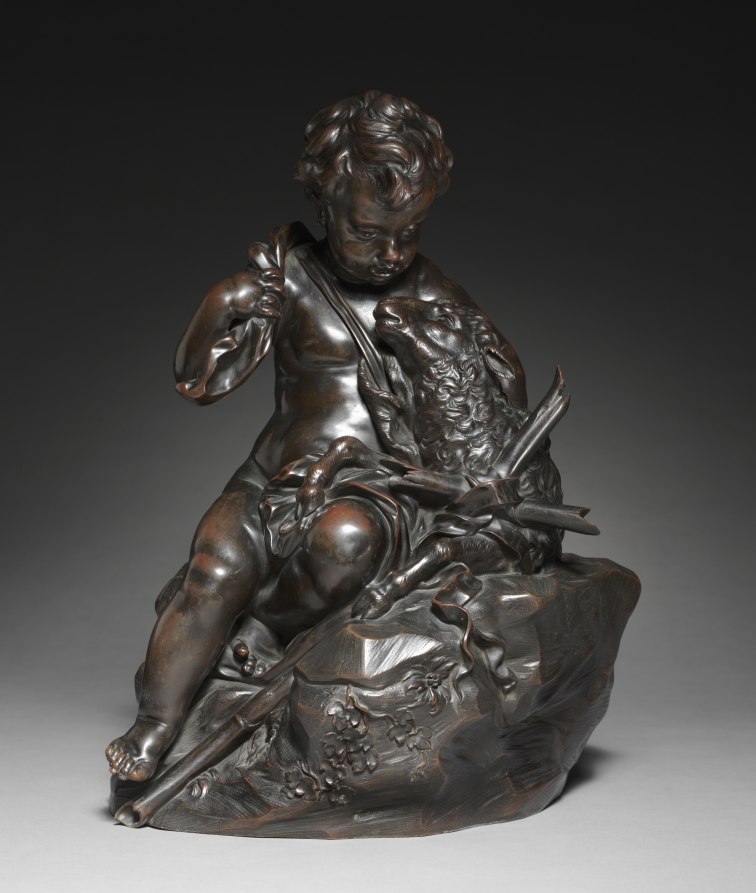
Urban Form: Young Saint John and the Lamb
Urban Silhouette Research: Form and Color in the 2026 Executive Wardrobe
I. The Painted Cassone as Structured Surface: A Study in Contained Volume
The Renaissance cassone—specifically the Famous Women example—operates as a masterclass in the architecture of containment. Its form is a rectilinear volume, planar and unyielding, yet its painted surface transforms the box into a narrative textile. For the Addison Fashion NYC executive wardrobe, this duality is instructive. The 2026 silhouette must reconcile structural rigor with surface intelligence. Consider the tailored blazer: its shoulder line should echo the cassone's lid—crisp, horizontal, and definitive—while the lapel and body panels function as the painted façade, carrying subtle tonal variation rather than ornament. The lesson is not decoration but controlled surface tension. A slate wool double-face coat, cut with a dropped shoulder and a concealed placket, reproduces the cassone's paradox: a closed form that invites scrutiny through the precision of its finish. The executive does not wear narrative; she wears the frame that contains it.
II. The Caparisoned Elephant: Drape, Repetition, and the Politics of Coverage
The Mughal miniature presents the inverse proposition: the body is not contained but reconstructed by textile. The elephant's natural form is subsumed beneath a caparison of repetitive, symmetrical patterning—a visual order that signals imperial authority. For 2026, this translates into the fluid, draped silhouette as a mechanism of executive presence. Where the cassone offers structure, the caparison offers strategic concealment. A slate silk-crepe column dress, cut on the bias with a single asymmetric seam, mimics the elephant's ceremonial cloth: it follows the body without revealing it, creating a continuous plane of color that reads as authority rather than allure. The repetition of the Mughal textile—its grid of motifs—finds contemporary expression in tonal jacquards and micro-patterns that reward proximity, not distance. The executive wardrobe of 2026 must understand that coverage is not modesty but command; the draped surface is a political interface, and its refinement is the argument.
III. The Chromatic Register: Slate as Mediating Surface
Both source objects deploy color as a structural, not decorative, device. The cassone's palette—muted ochres, faded vermilions, and cool greys—serves to unify disparate narrative panels under a single atmospheric field. The Mughal caparison, by contrast, uses saturated jewel tones against a neutral ground to isolate the figure as a spectacle. For Addison Fashion NYC, the synthesis is slate: a color that is neither warm nor cool, neither assertive nor recessive. Slate operates as the cassone's unifying field and the miniature's neutral ground simultaneously. In practice, this means a wardrobe built on tonal stratification: slate wool suiting at the base, slate-grey silk at the mid-layer, and a slate-tinged charcoal for outerwear. The result is a monochromatic armature that allows texture—the nub of a wool flannel, the sheen of a silk twill—to perform the work of pattern. Color becomes a system of value, not hue; the executive is read through the precision of her tonal relationships, not the loudness of her palette.
IV. Form as Ideological Carrier: The 2026 Silhouette
The deeper argument of both source objects is that surface is never neutral. The cassone's painted women are moral exemplars; the elephant's caparison is imperial propaganda. The 2026 executive wardrobe must acknowledge its own semiotics. The minimalist silhouette—clean lines, suppressed detail, a single strong shoulder or a deliberate volume at the sleeve—is not an escape from meaning but a recalibration of it. A slate tailored coat with a concealed closure and a narrow, elongated lapel does not say "power" in the old language of pinstripes and padding; it says control through reduction. The form is legible, the surface is quiet, and the color is a continuous field. This is the Addison proposition: the executive silhouette as a cassone of the self—a contained, finished volume whose surface rewards the disciplined gaze, and whose color refuses the easy spectacle of ornament in favor of the slower authority of tonal precision.
The 2026 wardrobe, therefore, is not a collection of garments but a system of surfaces. It borrows the cassone's structural integrity and the caparison's strategic drape, and it resolves them through a slate chromatic register that is at once unifying and austere. The executive who wears it does not decorate herself; she edits herself into a form that is legible, controlled, and quietly undeniable.