Urban Form: Eighteen Views of Rome: The Piazza Farnese (recto)
Urban Silhouette Research: Structural Poetics of the Farnese Plane
I. Geometric Integrity and the Architecture of Restraint
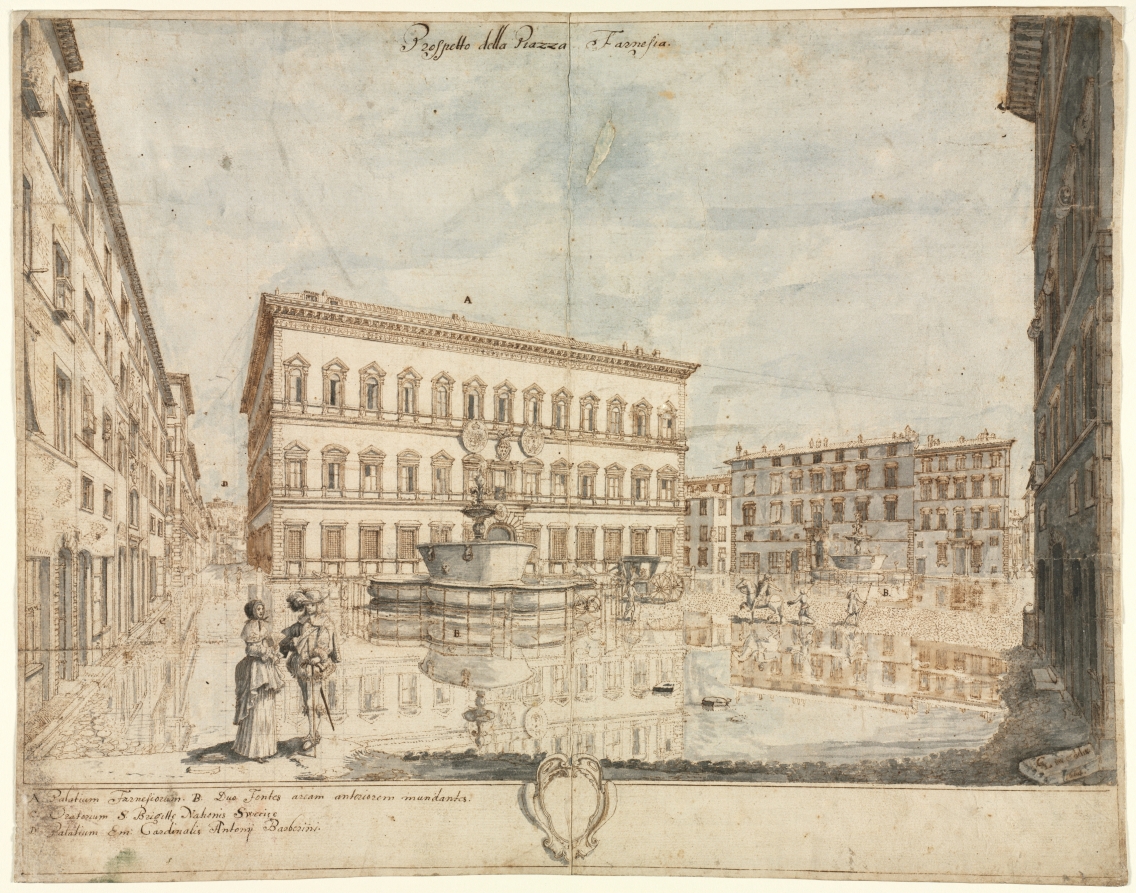
The Eighteen Views of Rome: The Piazza Farnese (recto) presents a compositional logic that is, at its core, an exercise in controlled compression. The piazza is not rendered as open space but as a calibrated void—a negative volume framed by the vertical insistence of the Palazzo Farnese façade and the horizontal discipline of the surrounding palazzi. This is architecture as containment, not expansion. The 2026 executive silhouette must absorb this principle: the body is not dressed but framed. The shoulder line becomes the cornice; the waist, the shadowed recess between volumes; the hem, the terminating plinth. Proportion is not negotiated—it is decreed.
The recto view’s vanishing point is deliberately off-axis, a subtle destabilization that prevents the composition from resolving into mere symmetry. This is the critical lesson for the coming season: asymmetry as structural honesty. A tailored jacket that closes with a single offset seam, a lapel that breaks the vertical axis by two centimeters—these are not decorative gestures but geometric corrections. The Farnese piazza does not apologize for its imbalance; it codifies it. So too must the executive wardrobe.
II. The Void as Material: Negative Space and Urban Weight
Beneath the surface of this engraving lies a deeper structural argument—one that resonates with the internal DNA of the Addison archive. The piazza’s emptiness is not absence but capacity. It is the same logic that governs the Eastern Jar: the vessel’s utility resides in its hollow. In the Farnese view, the open ground plane functions as a receptacle for civic movement, a stage whose silence amplifies the surrounding stone. For 2026, this translates into garments that hold space without occupying it. The minimalist executive silhouette must be built around strategic voids: a dropped shoulder that creates a column of air between fabric and body; a trouser leg cut wide enough to suggest mass but tapered at the ankle to preserve urban velocity. The void is not a flaw in the pattern—it is the primary material.
Consider the tonal discipline of the recto: slate greys, muted ochres, the cold ivory of travertine. These are not colors applied to form; they are structural pigments, each hue assigned to a specific plane to articulate depth. The 2026 palette must operate identically. Slate—the color of this research—is not a neutral. It is a load-bearing tone, capable of absorbing shadow while retaining the crispness of cut. When applied to a double-faced wool coat with a raw-edged seam, slate becomes an architectural statement: the garment does not drape; it stands.
III. Materiality and the Urban Surface
The engraving’s linework is relentless—every edge is inscribed, every surface textured by the burin’s precision. This is materiality as information. The Farnese façade is not smooth; it is striated, layered, and weathered. The 2026 executive silhouette must engage with this urban patina without succumbing to nostalgia. The answer lies in technical fabrics with architectural memory: bonded cottons that hold a crease like folded paper; matte nylons that resist the sheen of artificial light; wool-silk blends that register the body’s movement as a controlled vibration rather than a fluid ripple.
The internal DNA of this research—the Socratic death and the Eastern jar—converges here. Socrates’ death is a rational transcendence of the body; the jar’s emptiness is a material acceptance of the void. The Farnese piazza mediates between these poles: it is a civic space built by rational geometry, yet it accommodates the organic chaos of daily life. The 2026 silhouette must perform the same mediation. A tailored coat in slate bonded wool, cut with a single asymmetric closure and a hem that falls precisely at the mid-calf, is not a garment of escape. It is a garment of presence—a structure that acknowledges the body’s weight while refusing its disorder.
IV. The Definitive Silhouette: A Conclusion
The Piazza Farnese recto teaches that geometry is not abstraction but discipline. The 2026 executive silhouette will be defined by three imperatives: compressed volume (the body as framed architecture), strategic void (negative space as material), and tonal load-bearing (slate as structural pigment). The result is a wardrobe that does not decorate the executive but constructs her—a minimalist armature for urban existence, where every seam is a decision and every absence is a form of presence. This is not fashion as expression. It is fashion as infrastructure.