Urban Form: Medal of Anne of Austria (obverse) and (reverse)
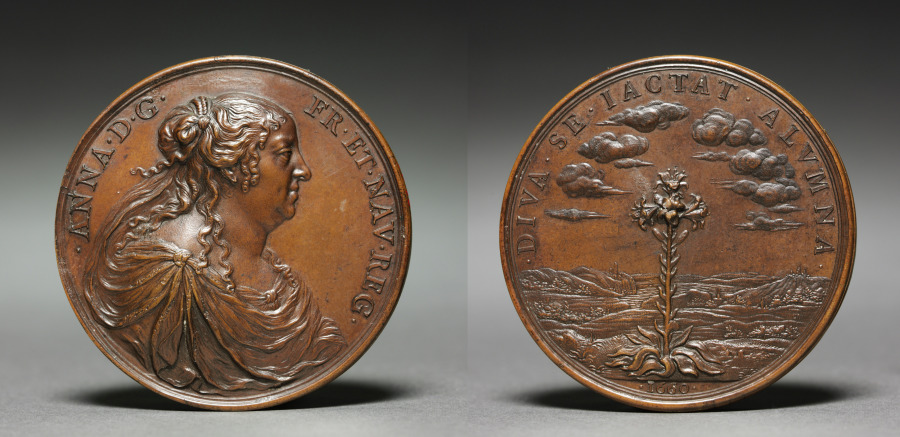
Urban Silhouette Research: Medallic Form as Structural Precedent
I. Object Analysis: The Medal of Anne of Austria as Formal Artifact
The obverse and reverse of the Medal of Anne of Austria constitute a closed formal system — a bounded circular field within which figuration, inscription, and negative space are subjected to absolute compositional discipline. For the purposes of wardrobe architecture, the medal is not a historical curiosity but a compression study: it demonstrates how maximum narrative density can be achieved within minimum planar area without loss of legibility. This is precisely the problem the 2026 executive silhouette must solve — authority communicated through reduction, not accumulation.
The obverse presents the portrait bust in profile, cropped at the truncation of the shoulder — a deliberate amputation of the body that forces all expressive weight into the cranial mass and the neckline. The relief is shallow; the figure emerges from the field rather than sitting upon it. The reverse operates in an inverse register: allegorical figures, inscription bands, and heraldic elements distributed across the disc with a rhythm that reads as controlled asymmetry. The two faces of a single object thus articulate a binary the contemporary wardrobe has yet to resolve — the frontal, declarative self versus the distributed, contextual self.
II. Form Deconstruction: Relief, Rim, and the Discipline of the Edge
Three formal properties transfer directly to garment engineering. First, bas-relief logic: the medal's figure is raised only marginally above the ground plane, creating shadow through millimeters rather than mass. Translated to tailoring, this argues for garments whose authority derives from seam displacement and panel layering rather than padding or structure — a shoulder expressed through a 4mm seam allowance shift, not a foam insert. The 2026 executive jacket should read as emerging from the body's plane, not armored against it.
Second, the rim. The medal's circumference is not decorative but constitutive — it terminates the composition and prevents the field from bleeding into the surrounding void. In silhouette terms, this is the hem, the cuff, the collar edge: the hard boundary that gives a soft interior its credibility. Minimalist wardrobes fail precisely here, when edges are softened into ambiguity. The medal instructs: the boundary must be absolute. A raw-edged wool trouser is acceptable only when the edge is engineered — bonded, weighted, or twin-stitched — to hold a line as decisive as struck metal.
Third, inscription as texture. The legend encircling the medal's field functions simultaneously as information and as surface rhythm — letterforms compressed into a band that reads, at distance, as a single graphic gesture. This is the model for tonal dressing in Slate: monochrome does not mean undifferentiated. A Slate ensemble requires internal inscription — a change in weave direction at the yoke, a tonal jacquard at the placket — legible only at close range, contributing rhythm without breaking the field.
III. Color Analysis: The Slate Register
The medal's patina — the oxidized bronze reading as blue-grey against warm metal — establishes the chromatic thesis. Slate is the correct register for 2026 because it occupies the precise midpoint between the bureaucratic (charcoal) and the aspirational (silver): it is authority without ceremony. The medal's tonal system is tripartite — ground, relief, and highlight — and this triad must be replicated in fabric selection. A Slate wardrobe built on a single value collapses; it requires a base cloth at 18% reflectance, a secondary at 24%, and a highlight at 32%, layered so that the eye registers depth without registering color change.
Critically, the medal's warm-cool tension — cool patina against residual warmth in the recesses — warns against Slate rendered as flat synthetic grey. The correct Slate carries a trace of blue in the warp and a trace of brown in the weft, producing the same optical instability as oxidized metal under directional light.
IV. Application: The 2026 Executive Wardrobe
The translation is structural, not thematic. The obverse-reverse binary becomes the day-to-evening modularity of a single jacket whose lapel reverses from matte to satin-faced — one object, two registers. The relief logic governs the shoulder: unpadded, seam-displaced, reading as the body's own elevation. The rim discipline governs every terminal edge in the collection. And the inscription principle governs surface: no print, no logo, only weave-level information legible at conversational distance.
The result is a wardrobe that functions as the medal functions — a closed system of high information density, absolute edges, and tonal restraint, designed to be read at three meters as silhouette and at thirty centimeters as craft. This is the Addison position for 2026: authority compressed, never announced.