Urban Form: Tea Service
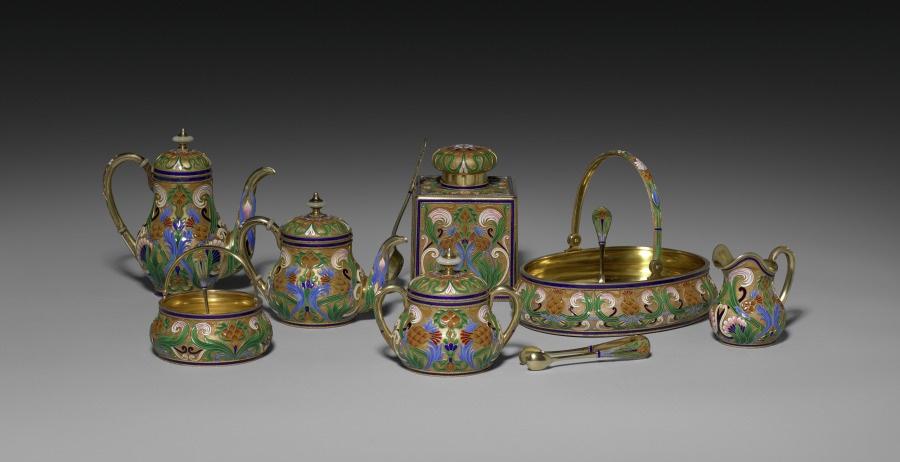
Urban Silhouette Research: Tea Service — Form and Color Deconstruction
I. The Silhouette as Vessel: From Meiping to Garment
The Meiping form offers the most disciplined silhouette in the ceramic canon: a narrow foot that widens into a full, high shoulder before tapering to a slender neck. This is not ornamentation — it is structural logic. The vessel's authority derives from a single continuous curve that resolves tension between containment and release. For the 2026 executive wardrobe, this translates into a garment architecture defined by one governing line: a shoulder that carries volume without collapse, a waist that recedes rather than cinches, and a hem that tapers with intent. The Addison tea-service silhouette is therefore a study in controlled amplitude — a tailored shoulder seam set slightly forward, a body cut on a gentle A-line, and a sleeve that narrows at the wrist to seal the form. Nothing is added. Nothing is subtracted. The garment, like the vessel, achieves completeness through proportion alone.
II. Color as Glaze: The Slate Register
The celadon glaze of the Song dynasty is a chromatic paradox: it is neither green nor grey, but a suspended state between the two, achieved through iron oxide reduction in the kiln. Slate operates on identical principles. It is not a neutral — it is a deliberate ambiguity, a cool grey with a blue undertone that reads as mineral rather than textile. In the executive context, Slate functions as a chromatic substrate: it absorbs light rather than reflecting it, producing a matte authority that neither announces nor retreats. The tea-service palette is monochromatic by design — a single Slate field interrupted only by tonal variation at seams and closures. This is the glaze logic: color as surface integrity, not as decoration. A Slate wool crepe suiting separates the wearer from the visual noise of the trading floor while maintaining sufficient depth to register under artificial light.
III. Wave Pattern as Structural Rhythm
The incised wave motif on the Meiping is not representational — it is rhythmic infrastructure. The waves are carved, not painted, meaning the pattern exists as subtractive form: the surface is interrupted, and shadow completes the design. This principle informs the Addison tea-service construction. Seam lines are placed not for fit alone but as visual rhythm: a single vertical seam at the center back, a horizontal yoke at the shoulder blade, a diagonal dart at the waist. These are not embellishments — they are structural incisions that create tonal shadow across the Slate surface, producing depth without pattern. The wave, in this reading, is the seam that catches light. The garment's visual interest is entirely contingent on how it is cut, not how it is printed.
IV. The Socrates Problem: Narrative Versus Presence
David's Death of Socrates operates through narrative compression — every gesture points to a story, every shadow carries moral weight. The Meiping refuses narrative entirely. It is presence without plot. The Addison tea-service silhouette adopts the latter position. The 2026 executive does not require a garment that tells a story of ambition or authority; she requires a garment that exists with authority. This means eliminating the narrative markers of conventional power dressing — the padded shoulder, the cinched waist, the contrast lapel — in favor of a form that is self-evident. The tea-service jacket is unlined, single-breasted, with a collar that stands slightly away from the neck. It does not reference the boardroom; it occupies it. The distinction is critical: narrative dressing performs authority; presence dressing enacts it.
V. The Void as Construction: Negative Space in Tailoring
The Meiping's most sophisticated feature is its interior void — the hollow that gives the vessel its function and its formal logic. The exterior curve is entirely determined by the interior capacity. This is the inverse tailoring principle: the garment is built from the inside out, with the interior finish (bound seams, French darts, a floating canvas) determining the exterior silhouette. The Addison tea-service blazer is constructed with a half-canvas front and unpadded shoulder, allowing the wearer's own architecture to determine the final form. The void — the space between body and cloth — is not eliminated but calibrated. This produces a silhouette that is neither oversized nor fitted, but inhabited. The garment moves with the body because it was built to accommodate movement, not to constrain it.
VI. Conclusion: The Silent Garment
The tea-service silhouette resolves the central tension of executive dressing: the demand for authority versus the necessity of ease. By adopting the Meiping's formal logic — single curve, subtractive rhythm, interior-determined exterior — and the celadon glaze's chromatic ambiguity — Slate as suspended mineral tone — Addison Fashion proposes a 2026 wardrobe that is silent but legible. The garment does not argue. It does not narrate. It holds. In the urban context, where visual noise is constant, the tea-service silhouette functions as acoustic insulation: a form so resolved that it requires no explanation. This is the final lesson of the Meiping: beauty is not added. It is revealed through restraint.