Urban Form: Seated Buddha (sculpture)
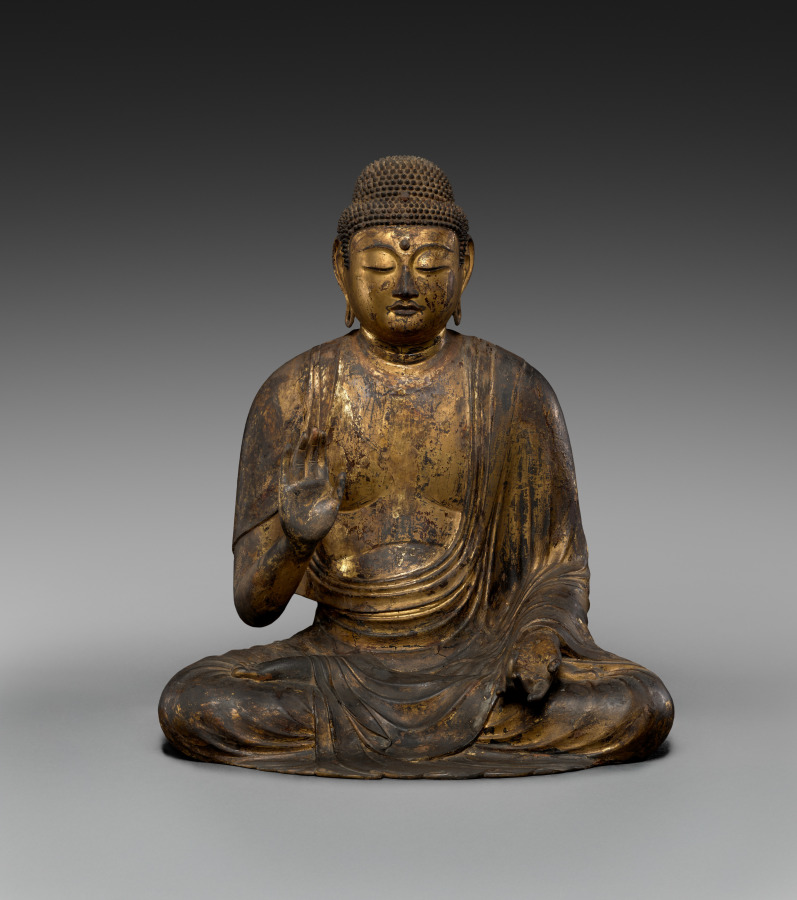
Urban Silhouette Research: The Seated Buddha as Architectural Prototype
I. Geometric Integrity: The Base as Foundation
The seated Buddha presents a silhouette of uncompromising geometric discipline. The lower register—the crossed legs forming a broad, stable plinth—operates as a structural anchor, a horizontal mass that grounds the entire composition. This is not passive weight; it is deliberate architectural intent. The lap creates a trapezoidal volume, widening at the base and tapering toward the waist, establishing a pyramidal hierarchy that governs the figure's vertical ascent. In the context of the 2026 executive silhouette, this translates directly to the tailored lower body: a widened, structured hem that communicates authority without ornamentation. The geometry is severe, almost brutalist in its clarity, yet softened by the organic curvature of the draped robe.
The torso rises as a controlled cylindrical column, subtly cinched at the waist before expanding into the shoulders. This double-cone configuration—broad base, narrow midpoint, broad apex—mirrors the proportions of a precisely cut overcoat or a double-breasted jacket with suppressed waist. The Buddha's shoulders, rounded but expansive, suggest a dropped-shoulder architecture that rejects the aggressive padding of traditional power dressing in favor of a more organic, fluid authority. For 2026, this signals a departure from sharp, angular tailoring toward a silhouette that is monumental yet approachable, commanding through mass rather than edge.
II. The Armature of Drapery: Fluid Lines Within Rigid Frames
The robe's folds are the critical intermediary between the body's geometry and the surrounding space. Each fold operates as a directional vector, cascading from the shoulders in rhythmic, parallel channels that echo the verticality of urban architecture—the fluting of columns, the repetition of window mullions, the striations of concrete formwork. These folds are not decorative; they are structural poetics, articulating volume and movement within a static form. The drapery clings at the knees and ankles, revealing the underlying armature, then releases into broader, more generous swathes at the sides. This tension between adhesion and release is precisely the dynamic that defines the 2026 minimalist wardrobe: garments that trace the body's architecture without constricting it, that offer volume where needed and precision where required.
The hands—one resting on the knee, the other often raised in a mudra—introduce asymmetrical interruption into the otherwise symmetrical composition. This calculated imbalance is essential. It prevents the silhouette from becoming static, inserting a point of gestural focus that draws the eye and creates narrative tension. In tailoring terms, this manifests as the single exposed seam, the asymmetrical closure, the pocket placed off-axis—details that disrupt uniformity without sacrificing coherence.
III. Materiality and Surface: The Urban Patina
The Buddha's surface—whether stone, bronze, or gilded—carries the weight of material honesty. The patina of age, the subtle variations in texture, the way light pools in the recesses of the folds and glances off the raised edges: these are the qualities of urban materiality that inform the 2026 palette. Slate, as a color designation, captures this precisely: a cool, mineral gray that absorbs and reflects light with equal composure, neither warm nor cold, neither inviting nor forbidding. It is the color of weathered concrete, of oxidized metal, of the city's quiet surfaces at dawn.
The fabric translation demands dense, matte textiles—heavy wool crepe, bonded cotton, brushed cashmere—that hold their shape while yielding to the body's movement. The surface should be non-reflective but not flat, possessing a subtle grain that rewards close inspection. This is luxury defined by restraint, by the quality of the hand rather than the flash of the finish.
IV. The Silhouette in Space: Monumentality and Intimacy
The seated Buddha occupies space with a particular duality: it is monumental in mass but intimate in scale. The figure does not dominate through height but through density, through the sheer concentration of form and meaning within a compact volume. This is the defining characteristic of the 2026 executive silhouette—a presence that is felt rather than announced, that commands attention through gravitas rather than aggression. The broad base and grounded posture communicate stability; the upward taper and serene expression communicate vision. Together, they form a complete architectural statement: rooted in the earth, oriented toward the sky.
The silhouette's relationship to negative space is equally instructive. The Buddha does not fill its environment; it organizes it. The space around the figure—the void beneath the crossed legs, the air between the raised hand and the shoulder—is as carefully considered as the form itself. For 2026, this translates to garments that breathe, that create volume without bulk, that allow the wearer to inhabit space rather than merely occupy it. The executive silhouette becomes a frame for the body's stillness, a structure within which movement is deliberate and meaningful.
V. Conclusion: The Seated Buddha as Tailoring Manifesto
The seated Buddha is not merely a religious image; it is a treatise on proportion, balance, and the poetics of restraint. Its geometric integrity—the pyramidal base, the cylindrical torso, the rounded shoulders—provides a blueprint for a silhouette that is at once authoritative and humane. Its drapery demonstrates how fluid lines can articulate rigid structure without compromising either. Its materiality speaks to a luxury of substance over surface. For Addison Fashion's 2026 executive silhouette, the Buddha offers a minimalist architecture of power: grounded, composed, and quietly monumental. The city is its temple; the wearer, its still center.